
In brief: Most visitors drink the mineral water and leave. Stay longer and you can explore Vardzia's cliff-carved monastery, ski the slopes at Bakuriani, hike through one of the Caucasus' oldest national parks, stargaze at a Soviet-era mountaintop observatory, walk through megalithic ruins, and drive to volcanic lakes on the Armenian border.
Borjomi is famous for one thing: its mineral water, the sparkling stuff that has been bottled and sold across the former Soviet Union for over a century. But the town itself sits at the entrance to a valley system that fans out toward ski resorts, cave monasteries, volcanic plateaux, and some of the oldest protected forests in the Caucasus. Treat Borjomi as a base for two or three days and you will discover a completely different side of Georgia's interior. Here are seven excursions that make the case for lingering.
Moving Around the Region
Borjomi sits in the Samtskhe-Javakheti region of south-central Georgia. The town has a small bus station with marshrutka vans running to nearby villages and regional centres. Taxis are easy to arrange through your guesthouse or the Bolt app. For multi-stop itineraries or mountain roads, a rental car from Tbilisi gives the most flexibility. The drive from Tbilisi takes roughly three hours via the motorway. Read our driving tips before heading out, especially if you plan to tackle the unpaved roads toward the Javakheti lakes.
Ski Town and Soviet Relics
1. Bakuriani: Georgia's Family Ski Resort and the Road to Get There
45-60 minutes south · Full day · Year-round (best December-March for skiing)
Perched in the Trialeti Mountains above Borjomi, Bakuriani was the ski capital of the Soviet Union. Today it has more than 30 kilometres of runs served by a dozen lifts and gondolas, with gentle slopes that make it particularly popular with families. Outside ski season, the resort turns green and peaceful: some lifts reopen for summer sightseeing, and the mountain air is noticeably fresher than in the lowlands.
The drive up is half the experience. Stop at the Eiffel Bridge at Tsemi, an iron railway bridge reportedly designed by Gustave Eiffel's firm, and at Sanatorium Libani, a vast abandoned Soviet sanatorium slowly being consumed by forest. Near Tsaghveri, a short detour leads to the ruins of a medieval castle, the Timothesubani Holy Dormition Church (covered in remarkable 13th-century frescoes), and a waterfall at the end of a forest trail.
Getting there: Marshrutka vans from Borjomi bus station run throughout the day (3 GEL, first at 8:30am, last at 4:30pm). Taxi costs about 100 GEL one way. Note: the historic Kukushka narrow-gauge railway is not currently operating.
2. Vardzia Cave Monastery and Rabati Fortress
2.5 hours south · Full day · Year-round
The longest drive on this list, but arguably the most rewarding. Vardzia is a 13th-century cave monastery carved into a sheer cliff face above the Mtkvari River, with hundreds of rooms, a frescoed church, and irrigation channels still visible in the rock. Arrive when gates open at 10am, especially in summer when the exposed cliff gets fiercely hot. Take the audio guide for the full story of Queen Tamar's underground city.
On the way back, stop in Akhaltsikhe to visit Rabati Castle, a beautifully restored 9th-century fortress complex that blends Georgian, Ottoman, and Persian architectural elements. The museum inside is worth an hour. Eat lunch in town and try Meskhetian specialties: apokhti khinkali (tiny dried-meat dumplings) and the local version of khachapuri, which is richer and flakier than the Imeretian style.
Getting there: Marshrutka to Akhaltsikhe departs at roughly 8:45am (5 GEL). From Akhaltsikhe, onward transport to Vardzia is available but infrequent. A rental car or hired driver makes this trip far more practical.
Forest Monasteries and National Park Trails
3. Likani, the Green Monastery, and a River Walk
25 minutes south · Half day · Year-round
Head down the Mtkvari River to Likani, a mineral water village with its own bottling tradition and a string of Soviet-era sanatoriums. The former Mountain Valley Sanatorium has an extraordinary mosaic on its facade. The village is also home to a Romanov-era palace designed by Leon Benois (currently closed for restoration, but the exterior is worth seeing).
Continue to Mtsvane Monastery (the Green Monastery), tucked deep in the forest along the Chitakhevi River. A walking path follows the river and takes about 45 minutes, passing through old-growth woodland. The monastery dates to the 9th century and sits in a clearing so quiet you can hear the river from the church door. Beyond the monastery, trails lead into the Borjomi Nature Reserve.
Getting there: Public bus #1 from Borjomi's central square to Likani (0.20 GEL). Walk to the monastery or continue by taxi.
4. The Footprint Trail Through Borjomi-Kharagauli National Park
15 minutes to trailhead · Full day · May-October
One of the largest protected areas in the Caucasus, Borjomi-Kharagauli National Park covers nearly 86,000 hectares of ancient forest. The Footprint Trail is the most popular day hike: 13 kilometres of marked trail through dense woodland and meadows, taking six to eight hours. The terrain is moderately difficult with uphill sections. You must register for a free safety permit at the National Park Administration Office in Borjomi (open daily from 9am) before setting out. Carry your own food and water.
If the full trail is too ambitious, shorter loops are available, and the park office provides maps. For serious trekkers, multi-day routes include the four-day St. Andrew Trail, one of the finest long-distance hikes in Georgia.
Getting there: The trailhead is at the Guard Station in Likani. Take bus #1 to Likani, then walk 30 minutes, or taxi directly (15 GEL).
Stargazing, Megaliths, and Volcanic Highlands
5. Abastumani: Hot Springs and a Soviet Observatory Under Clear Skies
1.5 hours west · Full day · Year-round
Higher and quieter than Borjomi, Abastumani is a resort town with a fascinating Romanov backstory. Grand Duke George Alexandrovich, younger brother of the last tsar, was sent here in the 1890s for tuberculosis treatment, and the town still bears the imprint of that era: restored wooden dachas line the main street, a royal bathhouse stands near the river, and a second Romanov palace (currently under restoration) overlooks the valley.
The real draw is above the town. On Mount Kanobili, the Abastumani Astrophysical Observatory, built in the 1930s as the USSR's first mountaintop astronomical facility, has reopened for guided tours. The altitude and dry air make for exceptionally clear night skies. Combine the observatory visit with a soak in the town's public hot springs, which are modest but genuinely therapeutic.
Getting there: No direct public transport. Taxi or hired driver recommended. Rabati Fortress in Akhaltsikhe is on the way and makes a good stop.
6. Saro and Nijgori: Bronze Age Fortresses in a Hidden Canyon
2 hours south · Full day · Year-round
Deep in the Meskheti region between Akhaltsikhe and Vardzia, the tiny village of Saro perches above the Chobaretiskhevi River gorge. Here you will find a Bronze Age cyclopean fortress, one of an estimated thousand megalithic structures scattered across southern Georgia, built from massive stone blocks without mortar. Nearby stands the 7th-century Archangel Church of Saro, modest in size but extraordinary in setting.
A marked 2.2km trail connects Saro to the village of Nijgori on the main highway, passing through landscapes that feel genuinely ancient. In Saro village, ask to see a darbazuli sakhi, a traditional Meskhetian hall house with a distinctive pyramid-shaped wooden ceiling. These are privately owned but villagers occasionally welcome visitors.
Getting there: No direct buses. Taxi to Saro, then walk down to Nijgori and flag a marshrutka back along the highway.
7. Tabatskuri and the Javakheti Volcanic Lakes
1.5-3 hours south/southeast · Full day · April-October (best spring/autumn for birds)
South of Bakuriani, the landscape transforms dramatically. The forested mountains give way to a vast volcanic plateau dotted with lakes, dry grasslands, and almost no trees. This is the Javakheti Protected Area, one of Georgia's most important bird habitats and one of its least-visited regions.
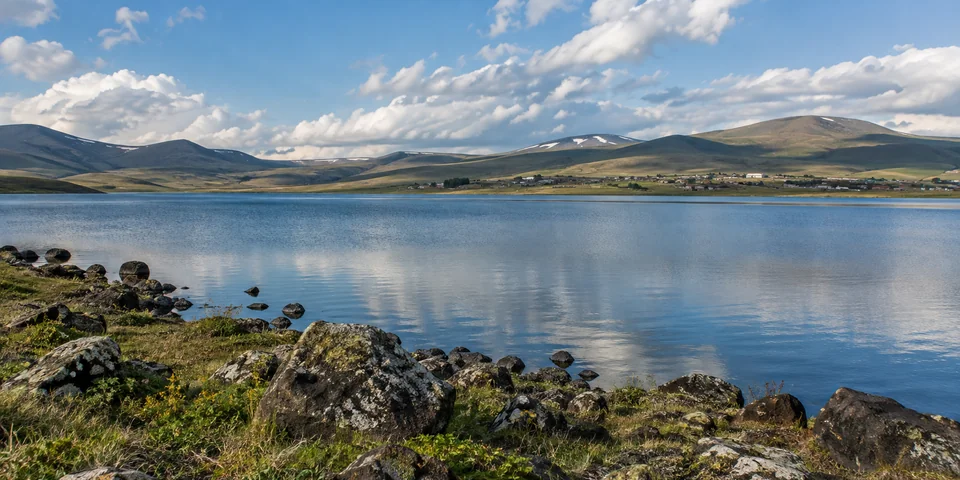
Tabatskuri Lake is the closest, reached via the spectacular Tskhratskaro Pass from Bakuriani (passport required at the checkpoint; unpaved road, 4WD recommended). The western shore has an easy walking path along the water. Further south, Paravani Lake is the largest in Georgia, with a lakeside monastery where nuns sell handmade chocolate truffles and natural skincare. Bughdasheni Lake, near the Armenian border, is the most photogenic: a volcanic crater lake ringed by treeless peaks.
In spring and autumn, thousands of migratory birds, including flamingos, descend on the wetlands. Birdwatchers should allow a full day.
Getting there: One marshrutka to Tabatskuri leaves around 4pm (inconvenient for a return). A rental car or hired driver is essential for visiting multiple lakes.
Practical Notes
- Getting to Borjomi: Three hours by car from Tbilisi via the motorway. Marshrutka vans and trains run daily from Tbilisi. If arriving at Tbilisi Airport, you can pick up a rental and drive directly.
- Combining trips: Bakuriani pairs well with Likani/Green Monastery. Vardzia and Rabati fill a long day together. Abastumani can include a Rabati stop. The Javakheti lakes need a dedicated day with a 4WD.
- Packing: Bring layers. Borjomi sits at 800m elevation and evenings are cool even in summer. The Javakheti plateau is significantly colder. See our packing guide.
- Connectivity: Mobile signal is reliable in Borjomi and Bakuriani but patchy in the Javakheti highlands and around Vardzia. Get a Georgian SIM card before leaving Tbilisi.
- Other excursion guides: See our guides to outings from Tbilisi, Kutaisi, Batumi, and Kazbegi.
Sources
These official sources support the practical details in this guide. Recheck live schedules, prices, opening hours, and road conditions before you travel.
- Georgian Railway passenger ticket portal - official train ticket search and passenger schedule checks.
- Roads Department of Georgia restrictions - official road restriction and closure notices for mountain and highway routes.
- Georgia Travel official destination guide - official country destination context for regions, cities, culture, and parks.
- National Parks of Georgia - official visitor information for protected areas and national parks.