
In brief: Eight neighborhoods dissected by someone who rents cars to people exploring them daily. Which part of Tbilisi matches your trip style, budget, and tolerance for steep hills.
Tbilisi is walkable enough that your neighborhood choice matters less than in most capitals. But it matters more than you think for comfort, food quality, and how much time you waste in traffic. After 13 years of delivering cars across every district, here is our honest take on eight areas where visitors actually stay.
The 30-Second Summary
- First time, short stay: Sololaki or Mtatsminda-Rustaveli corridor
- Foodies and nightlife: Chugureti (around Marjanishvili)
- Boutique hotel atmosphere: Sololaki or Vera
- Budget-conscious: Avlabari or Saburtalo
- Families or longer stays: Vake
- Using Tbilisi as a road trip base: Anywhere with easy highway access (Saburtalo, Vake, or near Station Square)
Kala: The Walled Old Town
The fortress district. Narikala looms overhead, sulfur baths steam below, and every cobblestone lane twists past churches, mosques, and crumbling caravanserais. Abanotubani, Betlemi Quarter, Sioni Cathedral, the Gabriadze Clock Tower, and the Cotton Rows bar strip all sit within these old walls.
The honest take: Kala is extraordinary to walk through but mediocre to sleep in. Rooms are small and overpriced. Restaurants cater to tour groups with inflated menus. Streets are too narrow for taxis, so luggage day becomes a cardio workout. The sulfur smell drifts depending on wind direction.
Best for: A full day of exploring, then retreating to a better neighborhood to sleep. Liberty Square metro is a 5-minute walk from the edges.
Transit: Liberty Square metro, plus buses along Rustaveli Avenue.
Sololaki: Architecture and Atmosphere
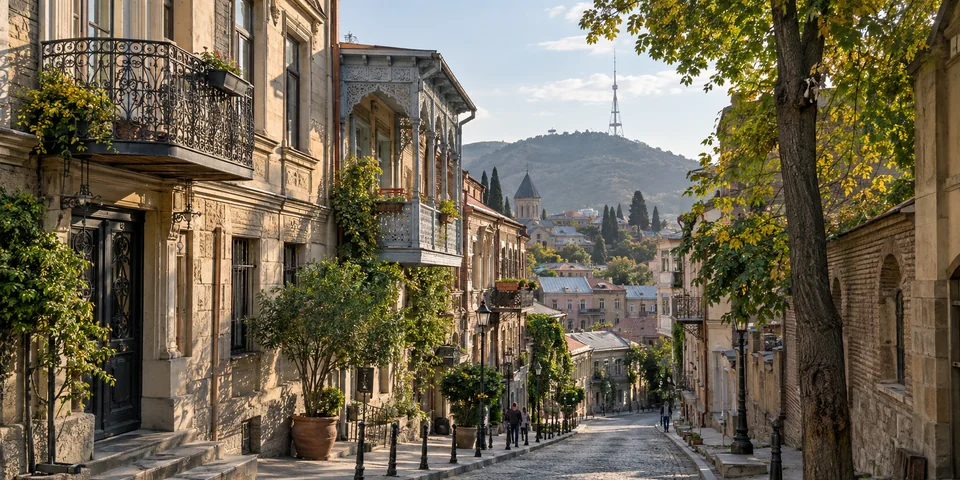
Gridded 19th-century streets climbing west from Freedom Square toward Mtatsminda hill. Every building facade is a miniature art gallery: Art Nouveau iron balconies, neo-Moorish arches, and pastel plasterwork slowly crumbling in photogenic ways. Wine bars, specialty coffee, and Georgian fusion restaurants have colonized the ground-floor apartments.
The honest take: This is where most visitors should stay if they want beauty, walkability, and good food within 200 meters. The downside is noise: old buildings have paper-thin walls, plumbing is temperamental, and some apartments lack natural light due to the dense block structure. Summer crowds can feel claustrophobic.
Best for: First-time visitors who want to walk everywhere. Couples. Architecture lovers.
Transit: Liberty Square metro is right here. Buses along Rustaveli Avenue.
Mtatsminda and Rustaveli Corridor
Tbilisi's cultural spine. Rustaveli Avenue runs through the center with the Opera, Parliament, National Gallery, and the Biltmore hotel anchoring the strip. Streets climbing west reach the funicular and TV tower. Streets dropping east toward the river (Garetubani) lead to Orbeliani Square, the Dry Bridge flea market, and Dedaena Park.
The honest take: Central, well-connected, and the safest bet for a comfortable hotel stay. The Rustaveli metro station puts the entire city within reach. Avoid eating directly on the avenue itself, as several spots there are tourist traps. The streets behind Parliament are brutally steep, so check your hotel's elevation before booking if you have mobility concerns.
Best for: Museum lovers, luxury travelers, anyone who values metro access above all else.
Transit: Rustaveli metro. City buses in every direction. See our public transport guide.
Avlabari: Budget-Friendly Left Bank
Across the river via the Bridge of Peace or Metekhi Bridge, Avlabari sits on elevated ground with the massive Sameba Cathedral dominating the skyline. This was historically the Armenian quarter, and the crumbling old houses give it a nostalgic, slightly melancholy character. Rike Park, Metekhi Church, and Queen Darejan's Palace are the main landmarks.
The honest take: The best value in central Tbilisi. You are a 10-minute walk from the Old Town but paying half the price. The trade-off is food: restaurant options are genuinely poor here. Stock up at the Carrefour or local markets if you cook. The area is changing fast with new apartment complexes under construction.
Best for: Budget travelers, self-caterers, anyone who wants central location without central prices.
Transit: Avlabari metro station. Bus 337 to Tbilisi Airport stops at nearby Isani.
Chugureti (Marjanishvili): Food, Art, and Edge
Also called Marjanishvili or Plekhanovi depending on which block you are standing on. This left-bank neighborhood runs from Fabrika (the former Soviet sewing factory turned hostel-bar-coworking complex) through the restored facades of Aghmashenebeli Avenue up to Station Square and the Dezerter Bazaar food market.
The honest take: Tbilisi's most interesting neighborhood for eating and drinking. New restaurants open constantly, and the quality-to-price ratio is the best in the city. The pedestrianized stretch of Aghmashenebeli is touristy, but one block in any direction and you find genuinely local spots. Station Square area can feel rough at night, but it is improving. Fabrika is the social hub for backpackers and digital nomads.
Best for: Foodies, nightlife seekers, coworkers, budget travelers who want character.
Transit: Two metro stations (Marjanishvili and Station Square). Trains depart from the Central Railway Station here.
Vera: Wine Bars and Walkable Cool
A compact residential pocket northwest of Rustaveli, centered on Melikishvili Street. Wine Factory N1 anchors the dining scene, surrounded by natural wine bars, third-wave coffee shops, fashion ateliers, and coworking spaces. The streets are quieter than Sololaki but still walkable to everything central.
The honest take: Vera feels like the neighborhood Tbilisi aspires to be: stylish without being pretentious, central without being loud. Accommodation skews toward the higher end (Stamba and Rooms hotels are here). The closest metro is Rustaveli, roughly a 10-minute walk, so you will use Bolt more than the metro.
Best for: Wine lovers, design-conscious travelers, couples, anyone who values cafe culture.
Transit: Rustaveli metro (10 min walk). Buses along Kostava Street.
Vake: Parks, Families, and Modern Comfort
Tbilisi's upscale residential district, flat and well-planned with Chavchavadze Avenue as the main artery. Vake Park (opened 1946) offers walking paths, a Soviet memorial, and trails connecting to Turtle Lake. University students fill the cafes, families fill the playgrounds, and joggers actually exist here without being stared at.
The honest take: The most liveable district for stays longer than a few days. Modern apartments with proper kitchens and natural light. Excellent breakfast cafes and international restaurants. The catch: no metro line, so you depend on buses or taxis. It is 30 to 40 minutes on foot to the Old Town, which makes it impractical for pure sightseeing trips.
Best for: Families, long-stay visitors, anyone renting a car (easy highway access to leave the city).
Transit: Buses only. No metro. Bolt rides to the center cost 8 to 15 GEL.
Saburtalo: Soviet Concrete, Real Prices
The sprawling residential district above Vake, dominated by Soviet-era apartment blocks softened by parks, street art, and sidewalk cafes. Delisi, Vedzisi, and Bakhtrioni sub-neighborhoods all fall under the Saburtalo umbrella. It has its own metro line, which is its saving grace for connectivity.
The honest take: Apartments here are bigger, cheaper, and better designed for light and airflow than anything in the center. Popular with international students and expats. The downside is distance: you are 5 to 10 km from Freedom Square, and traffic during rush hour is apocalyptic. Use the metro, not taxis, during peaks. Good local restaurants exist but require hunting.
Best for: Budget-conscious long-stay visitors, digital nomads, anyone who values apartment space over proximity to tourist sites.
Transit: Saburtalo metro line (green line). Buses. Heavy traffic.
Picking a Base for Road Trips
If you are renting a car and using Tbilisi as a launch pad for road trips across Georgia, your neighborhood choice shifts. You want easy access to the highways leaving the city, not proximity to the Old Town.
- Heading east (Kakheti wine country, Telavi): Stay near Isani or Avlabari for quick access to the Kakheti Highway
- Heading north (Kazbegi, Gudauri, Military Highway): Saburtalo or Didube for direct access north
- Heading west (Kutaisi, Svaneti, Batumi): Vake or Saburtalo put you on the western highway fastest
- Heading south (Samtskhe-Javakheti, Armenia): Anywhere near the Tbilisi-Rustavi highway
Practical Notes
- Booking platforms: Booking.com dominates in Georgia. Airbnb works but has fewer listings than a few years ago
- Pricing: Budget doubles start around 30 USD. Mid-range hotels run 60 to 100 USD. Boutique properties cost 120 to 250 USD. Apartments on monthly rates drop to 400 to 800 USD
- Noise: Tbilisi is loud. Dogs bark all night, construction starts early, and traffic never fully stops. Bring earplugs regardless of neighborhood
- Elevators: Many buildings in Sololaki, Kala, and Chugureti lack elevators. Confirm before booking if you have heavy luggage
- Heating: Central heating is rare. Most apartments use gas heaters. This matters in winter months
For more trip planning, see our first-time visitor guide, budget breakdown, transit guide, and SIM card guide.
Sources
These official sources support the practical details in this guide. Recheck live schedules, prices, opening hours, and road conditions before you travel.
- Tbilisi Transport Company standard tariff - official Tbilisi metro, bus, minibus, and ropeway fare rules.
- Roads Department of Georgia restrictions - official road restriction and closure notices for mountain and highway routes.
- Georgia Travel official destination guide - official country destination context for regions, cities, culture, and parks.