
In brief: Explore Adjara beyond Batumi Boulevard, with forest parks, coastal fortresses, black-sand beaches, highland villages, wetlands, and Black Sea swimming stops.
Many visitors stay close to Batumi Boulevard and the Old Town, but Adjara's day trips add a very different picture: coastal forts, Colchic forest trails, highland villages, black-sand beaches, mountain roads, and wetlands north of the city. Within 90 minutes of Georgia's Black Sea capital, the region feels much wider than the waterfront suggests.
Getting Beyond the City
Batumi sits at the southwestern tip of Georgia, wedged between the Black Sea and the Lesser Caucasus mountains. The Adjara region climbs steeply inland, with subtropical lowlands giving way to alpine meadows within an hour's drive. To the north, the coastline stretches past Kobuleti toward Guria and Kolkheti. To the south, the road hugs the shore all the way to the Turkish border at Sarpi.
Transport options include city buses (pay with any chipped bank card, about 1 GEL), marshrutka vans from Batumi's old bus station, and taxis via the Bolt app. For mountain routes or multi-stop itineraries, a rental car gives maximum flexibility. The coastal roads are flat and easy. The highland roads are winding but sealed. Read our driving tips before heading inland.
Subtropical Parks and Ancient Forests
1. The Botanical Garden at Green Cape
30 minutes north · Half day · Year-round
Sprawling across a headland north of Batumi, the Botanical Garden is one of the largest in the former Soviet Union. Established in 1912, it holds plant collections from nine distinct climate zones arranged along walking trails with Black Sea panoramas at every turn. The cliff paths drop to a secluded pebble beach below the gardens where you can swim. On the way back, the Batumi Fish Market at Makhinjauri sells fresh catch that the neighbouring restaurants will grill to order while you wait.
How to reach it: City buses #10 and #10a run along Gogebashvili Street to the garden's lower entrance (1 GEL).
2. Mtirala: Georgia's Weeping Rainforest
60 minutes northeast · Full day · April-October
Named after the Georgian word for "to cry" because of its near-constant rainfall, Mtirala protects some of the oldest Colchic forests on the planet. These are the same ancient woodlands that the Greek myth of Jason and the Golden Fleece described. A 7km loop trail leads through dense canopy to a river gorge with a cable crossing and the Tsablnari waterfall. The humidity is intense, but the biodiversity is staggering: ferns the size of cars, 300-year-old chestnut trees, and occasional brown bear tracks.
How to reach it: Take a Kobuleti-bound marshrutka and ask to be dropped at the Chakvistskali turn-off (3 GEL). From the highway, a taxi covers the remaining 14km to the park administration (about 30 GEL). A rental car eliminates the transfer hassle.
3. Machakhela Valley: Gunsmiths and Stone Bridges
40-60 minutes south · Full day · Year-round
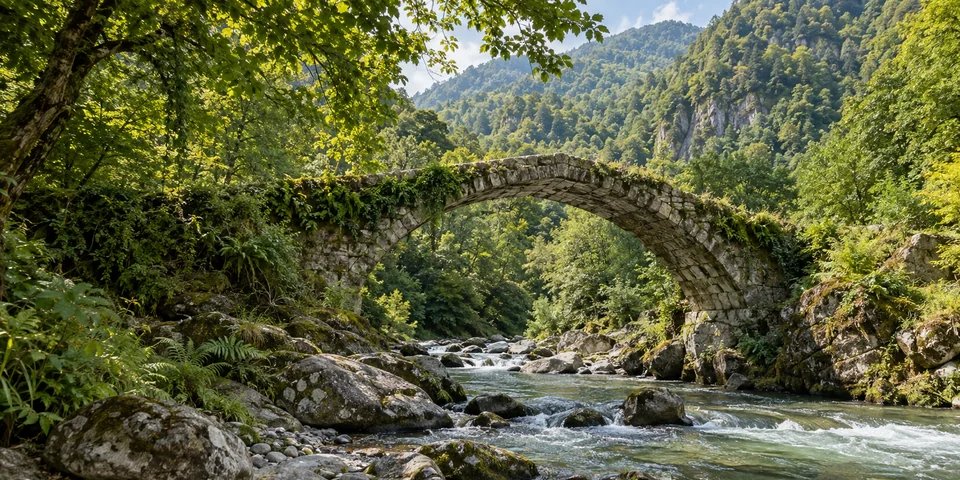
Running along the Turkish border south of Batumi, the Machakhela Protected Area is quieter than Mtirala and richer in cultural interest. Another Colchic forest, the valley conceals a museum set inside a converted mosque, a working gunsmith's workshop where artisans still produce flint firearms by hand, Ottoman-era stone arch bridges, and a pillbox gun emplacement from the border wars. Arrange lunch at a village home for Adjarian specialties: sinori cheese pie and borano, a bubbling pot of cheese melted in butter.
How to reach it: No direct public transport. Book a taxi or hire a driver for the day. A scooter tour is a popular option for the adventurous.
Coastal Explorations
4. The Turkish Border Run: Gonio, Kvariati, and Sarpi
30 minutes south · Half to full day · Year-round
Head south from Batumi along the coast for a string of stops that pack history, beaches, and architecture into a short loop. Gonio Apsaros Fortress is a 2nd-century Roman citadel, one of the oldest and best-preserved fortified sites in the Caucasus. Above it, the Gonio Cross viewpoint offers a panoramic Black Sea sunset after a short hike. Kvariati Beach is the last stretch of sand before the cliffs rise, and the water here is cleaner than central Batumi. At the border itself, the wave-shaped Sarpi checkpoint building is a piece of modernist architecture worth photographing.
How to reach it: City bus #16 hops between all three villages. You can also cycle the coastal path. A rental car makes it easy to combine all stops.
5. Kobuleti, Petra Fortress, and the Hidden Beach at Tsikhisdziri
45 minutes north · Full day · Year-round
Heading up the coast, the 6th-century Petra Fortress sits on a headland with sweeping sea views. Directly below it, Tsikhisdziri Hidden Beach is a local favourite with volcanic rock formations, a natural sea arch, and a swimming platform. Further north, Kobuleti was a major Soviet holiday resort. Today its long grey beach has clean water for swimming, while abandoned Brutalist hotels along the waterfront attract photographers. The town also holds Soviet-era mosaics and a small museum displaying archaeological finds from Petra.
Past Kobuleti, the UNESCO-listed Kobuleti Nature Reserve protects peat bogs and wetlands where Eurasian otters live. An elevated boardwalk leads to a lookout tower.
How to reach it: Marshrutka from Church of the Holy Spirit parking lot (3 GEL, 60 min). Ask to be dropped at Petra/Tsikhisdziri on the way.
6. Magnetic Sands: Shekvetili and Ureki
60 minutes north · Full day · May-September
Where the coastline enters Guria region, the pebbles give way to fine black sand rich in iron ore minerals. Locals have long claimed healing properties for the magnetic beaches. Shekvetili is the quieter option, backed by forest, with a delightful Miniature Park (an open-air museum of tiny replicas of Georgia's most important monuments) and the Dendrological Park, a transplanted forest that inspired the documentary film Taming the Garden. Ureki is busier and more commercial but has a wider beach. Both are good for families.
How to reach it: Take a Poti-bound marshrutka and exit at Shekvetili. Ureki is 20 minutes further by car.
Mountain and Inland Adventures
7. Highland Waterfalls: Makhuntseti and Mirveti
45-60 minutes east · Half day · April-October
In the foothills of Upper Adjara, two waterfalls offer a cool escape from coastal humidity. Makhuntseti is the taller of the pair, with a swimming hole below and a photogenic hemispheric stone bridge nearby. Mirveti is more secluded, with its own arched bridge. Both are popular in summer, so an early start helps. Combine with a wine tasting at one of the nearby Adjarian vineyards on the way back.
How to reach it: Khulo-bound marshrutka from old bus station (10 GEL, every 30 min from 8am). Ask to be dropped at Makhuntseti.
8. Wine Tasting in the Adjarian Highlands
40-75 minutes east · Half to full day · Year-round
Georgia's wine story is not limited to Kakheti. The steep slopes of Adjara produce distinctive Tsolikauri (dry white) and Chkhaveri (dry rosé) using the same ancient qvevri clay vessel method. The Adjara Wine Route threads through highland villages around Keda Municipality, where family cellars offer tastings paired with home-cooked meals. Closer to the city, smaller wineries near Makhinjauri produce natural qvevri wines and offer cooking classes for khachapuri and churchkhela. The mountain scenery from the higher vineyards is extraordinary.
9. Upper Adjara: Alpine Villages and Painted Mosques
2-2.5 hours east · Full day · May-October
The mountains behind Batumi climb sharply into a world of wooden villages, wildflower meadows, and Islamic Georgian culture. The highlands of Adjara are majority Muslim, with painted wooden mosques scattered through the valleys. The town of Khulo has a remarkable cable car that crosses the valley in a single long span. Beyond Khulo, the village of Tago offers glamping with mountain views, and Merisi has a popular eco-lodge with outdoor hot tubs overlooking the peaks. In spring, the alpine meadows explode with wildflowers.
How to reach it: New public buses run from Batumi to Khulo (10 GEL, departs 7am and 6:30pm Mon-Sat from Boni Culture House). Marshrutka vans leave every 30 min from old bus station. The road is sealed but winding.
Wetlands and Wildlife
10. Kolkheti Wetlands and the Port City of Poti
60 minutes north · Full day · Year-round (best March-May for birds)
The UNESCO-listed Kolkheti National Park protects 34,000 hectares of wetlands, peat bogs, and lakes along the coast north of Batumi. More than 200 bird species nest here, making it one of Georgia's top birdwatching sites alongside the Javakheti Plateau. The best way in is by water: boat tours navigate Lake Paliastomi, or you can rent a kayak for the 9km Churia Nature Paddling Trail through an ecosystem that genuinely resembles a small-scale Amazon. Book in advance through the park administration.
Nearby Poti, a port city at the mouth of the Rioni River, has a climbable historic lighthouse, scattered Soviet mosaics, and a museum dedicated to the Kingdom of Colchis, the ancient Georgian state that flourished here from around 2000 BC.
How to reach it: Hourly marshrutkas from Batumi bus station to Poti. Kolkheti park entrance is a 6-minute taxi from Poti centre.
Practical Notes
- Weather factor: Adjara is Georgia's wettest region. Pack a rain jacket even in summer. Mtirala and Machakhela are best on dry days. The coast is swimmable from late May through September.
- Combining trips: The Turkish border run (Gonio/Kvariati/Sarpi) pairs well with Makhuntseti waterfall. Kobuleti pairs with Shekvetili. Mtirala and wine tasting make a full day.
- Airport arrivals: If flying into Batumi Airport, several of these excursions work as stops on the way into the city.
- Beyond Batumi: For excursions from other Georgian cities, see our Tbilisi day trips and Kutaisi day trips guides. For longer road trips, check our 10-day Georgia road trip.
- Connectivity: Pick up a Georgian SIM card at the airport. Mountain areas can have spotty signal.
Sources
These official sources support the practical details in this guide. Recheck live schedules, prices, opening hours, and road conditions before you travel.
- Georgian Railway passenger ticket portal - official train ticket search and passenger schedule checks.
- Georgia Travel official destination guide - official country destination context for regions, cities, culture, and parks.
- UNESCO World Heritage Centre - official heritage-site listings and conservation context.