
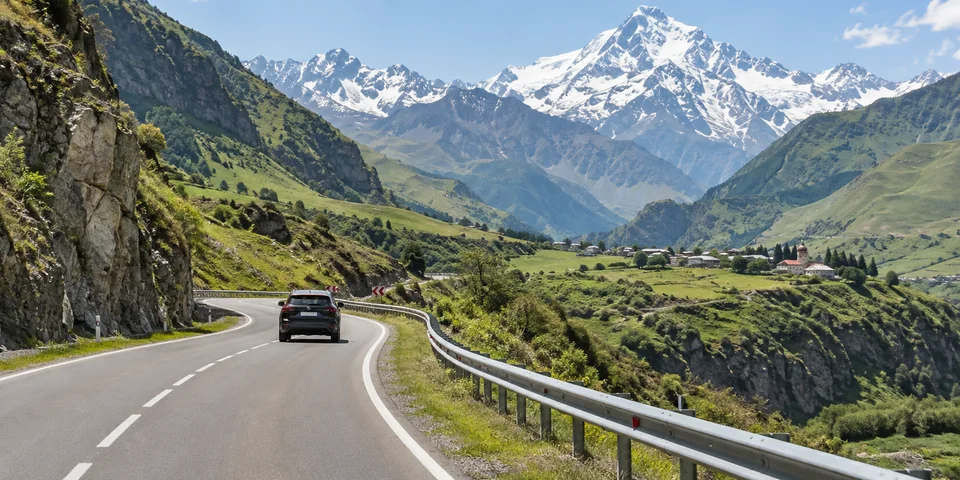
In brief: Planning to rent a car and drive in Georgia? Start with the road rules, local driving habits, seasonal closures, insurance basics, and the mountain-road details that matter.
Georgia rewards careful self-drivers. The landscapes change quickly, main roads keep improving, and a car opens up villages, viewpoints, wine routes, and mountain areas that public transport cannot always reach. But local driving style, weather, animals on rural roads, and highland access still need planning.
Before picking up a rental car in Tbilisi or Kutaisi, get comfortable with the rules, road conditions, driving culture, seasonal closures, and insurance details below.
Should You Drive in Georgia?
The honest answer: it depends. Georgia has a working public transport network of minibuses (called marshrutkas) and trains that connect major cities. If you are only visiting Tbilisi and sticking to the main tourist trail, you can get by without a car.
But if you want to explore rural villages, mountain regions, wine country at your own pace, or regions like Racha, Tusheti, or Khevsureti, then renting a car changes the entire experience. You gain freedom to stop wherever you want, leave early in the morning, and reach places no bus will take you.
Renting a car makes sense if:
- You want to explore beyond the main cities and tourist hubs
- You are visiting for more than a few days and want flexibility
- You are comfortable driving in varied road conditions
- You are traveling as a couple or small group (splitting costs makes it very affordable)
You might want to skip driving if:
- You are only in Tbilisi for a short city break
- You are uncomfortable with assertive driving styles
- You are visiting in heavy winter and sticking to mountain routes
Basic Road Rules in Georgia
Here are the key rules every driver needs to know:
- Drive on the right side of the road. Make sure your rental car is left-hand drive for the best visibility.
- Speed limits: 60 km/h in towns and villages, 90 km/h on rural roads, and 110 km/h on highways. White signs with a village name mean you have entered a built-up area and must slow down.
- Seat belts are mandatory for the driver and front passenger.
- Children under 7 must use a child safety seat.
- Drink driving limit is very strict: 0.03% blood alcohol. That is essentially zero tolerance. If you are visiting wine country in Kakheti, do not plan to drive and taste on the same day.
- No phones while driving. Use a dashboard mount for navigation.
- No toll roads. All roads and tunnels in Georgia are free.
- Road signs follow European standards and are usually bilingual (Georgian and English).
What Driving Culture Is Really Like
Here is the truth: Georgian road conditions are often better than people expect, but the driving style can be wilder than most visitors are prepared for.
Drivers tend to be impatient. Overtaking on single-lane roads, sometimes crossing solid lines, is common. Cars may suddenly appear on your right creating a third lane where there is not supposed to be one. Roundabouts can feel chaotic, and tailgating is the norm rather than the exception.
The safest approach is defensive driving. Take your time, stay aware of other vehicles, avoid sudden movements, and check your mirrors constantly. A few specific tips:
- Start early. Roads are quietest before 9am.
- Avoid night driving whenever possible.
- Skip driving in major cities like Tbilisi or Batumi if you can. Have the car delivered to the outskirts or your hotel instead.
- Watch for animals. Cows, dogs, and livestock wander onto roads everywhere, including in cities. Use your hazard lights to warn other drivers.
- Leave extra following distance. Other drivers will cut in, but keeping space is still safer.
Do You Need a Special License?
If your driving license is written in Latin characters (EU, UK, US, Australian, etc.), you do not need an International Driving Permit to rent a car in Georgia. Your regular license is accepted.
If your license is in non-Latin script (Arabic, Chinese, Cyrillic, etc.), you will need either an International Driving Permit or an official translation.
When driving, always carry your driver's license, passport, and the car's registration document (called a "car passport" in Georgia, usually kept in the glovebox).
What Kind of Car Do You Need?
For most routes in Georgia, a standard sedan or SUV is perfectly fine. The major highways and roads to popular attractions are all paved and well-maintained.
That said, a higher-clearance vehicle gives you more peace of mind on rough village roads and after heavy rain. If your trip includes any mountain passes or off-road sections, you will want a proper 4x4 from our Tbilisi fleet.
When you genuinely need a 4x4:
- Driving to Tusheti over the Abano Pass
- Reaching Shatili in Khevsureti
- Exploring the Vashlovani Protected Areas
- The Juta Valley near Kazbegi
- Crossing the Goderdzi Pass between Batumi and Akhaltsikhe
Our fleet includes the Jeep Wrangler, Toyota 4Runner, Toyota FJ Cruiser, and Chevrolet Suburban, all built for exactly these kinds of roads. We also offer 4x4 rentals from Kutaisi.
Road Conditions: What to Expect
Georgia's road infrastructure has improved massively in recent years. Here is a realistic breakdown:
Main highways and tourist routes
The vast majority of roads that tourists use are sealed, smooth, and perfectly manageable in a regular car. The new Rikoti Expressway (completed in late 2025) has cut the drive from Tbilisi to Kutaisi to about 2.5 hours and Tbilisi to Batumi to around 4.5 hours.
Roads to major sights like David Gareja, Vardzia, and Sighnaghi are all paved and easy.
Mountain-road status changes
The road is seasonal: Conditions and official access restrictions on the Mestia–Ushguli–Zagari–Lentekhi routes can change after weather or road works. Before departure, check the Roads Department of Georgia or the relevant official road authority, then choose a vehicle suitable for the current conditions.
Roads that still need caution
- Zugdidi to Mestia: some damaged sections and landslide risk
- The road into Juta Valley near Kazbegi: landslide damage
- Goderdzi Pass (Batumi to Akhaltsikhe): partially unpaved
- Tracks inside Vashlovani Protected Areas: unpaved off-roading only
Seasonal Road Closures
Some mountain roads close completely in winter, usually from late October until May. This includes:
- The road to Tusheti (Abano Pass): typically open mid-June to late September
- Roads to Khevsureti and Juta Valley: open May to October
- Goderdzi Pass and Zagari Pass: open May/June
Even major roads like the highway between Gudauri and Kazbegi can close temporarily during heavy winter storms. If you are visiting between November and April, plan for possible delays and consider winter tires (mandatory on some mountain roads from December 1 to March 1).
For real-time road closure updates, check the GeoRoad Facebook page or call the Roads Department Hotline at +995 322 313 076.
Fuel, Parking, and Practical Stuff
Gas stations
Gas stations are everywhere in Georgia, even in small villages. An attendant fills the tank for you. Just say "Premium" for 95 octane fuel. You can pay by card. Prices are around 2.70 to 3.60 GEL per liter (roughly $1.00 to $1.30 USD). Reliable chains include Wissol, Gulf, SOCAR, and Connect. Fill up before heading into very remote mountain areas, where prices climb and stations are scarcer. Most stations have free restrooms and a small shop for snacks.
Flat tyres and vulcanization
Unlike some countries, you cannot inflate tyres at a gas station. For that, you need a garage that does vulcanization (tyre repair). A quick pressure check and pump costs 1 to 2 GEL, while fixing a punctured tyre runs 10 to 30 GEL depending on location. Punctures are common on rough village roads, so knowing the word "vulcanizatsia" helps when asking for directions to the nearest repair shop.
Parking
Outside the main cities, parking is free and easy. In Tbilisi, Batumi, and Kutaisi, there are paid parking zones managed by the city. Parking passes can be purchased online or via banking apps. At many parking spots, an attendant in a bright vest helps guide cars. A small tip (a few coins) when you leave is expected.
The car passport
Every car in Georgia carries a vehicle "technical passport," a registration card that proves the car is legally registered. In a rental, this document is already in the car, usually in the glovebox. You do not need to arrange anything. Police may ask to see it during a routine check, so it is worth knowing where it is stored.
Navigation
Google Maps works well in Georgia. No need for a GPS unit. Just add 20 to 30 percent extra time to whatever Google estimates, as it tends to underestimate conditions here. Brand new roads may be temporarily unmapped. Getting a local SIM card for data is highly recommended. Magti has the best coverage in remote mountain areas.
What to Do If Something Goes Wrong
Accidents
If you are involved in any accident, even a minor one: stop the car and do not move it. Moving the vehicle can void your insurance. Call your rental company immediately and wait for police. Georgia's emergency number is 112. Take photos of any damage while waiting.
Most private cars in Georgia are not comprehensively insured, so minor fender benders between locals are often resolved informally with a cash payment on the spot. However, if you are driving a rental car, always call the police and your rental company, even for minor damage. Settling privately can leave you personally liable for the full repair cost.
Speeding fines
Traffic cameras are common throughout Georgia. Fines for speeding range from 100 to 200+ GEL depending on the area. Smart cameras also catch crossing solid lines, driving without a seatbelt, and using a phone (50 GEL each). Fines are issued automatically to the car owner by SMS, usually within four hours. You have 30 days to pay or 10 days to appeal. You can check and pay fines online at the Administrative Penalties website using the car's license plate number.
Important: if a police officer stops you in person, never try to pay on the spot. Georgia has strict anti-corruption policies and offering cash to an officer can create serious problems.
Scenic Roads Worth Seeking Out
Once you are comfortable behind the wheel, these drives reward the effort. All are sealed and manageable in a standard car:
- Sachkhere to Oni: The pass connecting Imereti and Racha offers stunning mountain scenery, especially in autumn.
- Kutaisi to Ambrolauri via Nakerala Pass: Travels past Shaori Lake through golden forests in October.
- The Didgori Valley Road: A ribbon of asphalt draped over undulating green hills south of Tbilisi, leading to the Didgori Battle Memorial. Almost always quiet.
- Tianeti to Ninigori: A newly sealed route from Kakheti to the Military Highway, letting you skip Tbilisi entirely when connecting wine country with Kazbegi. For the full Military Highway experience, see our complete self-drive guide.
- The Javakheti Plateau: A quiet volcanic landscape of lakes and treeless grasslands, a stark alternative to the main east-west highway. See our Samtskhe-Javakheti guide.
For a complete driving itinerary, see our 10-day road trip from Tbilisi to Batumi.
Cross-Border Driving
Many rental companies in Georgia do not allow cross-border travel. We specifically offer Tbilisi to Yerevan cross-border rentals with all documentation included. We also have cars available for pickup directly in Yerevan, Armenia and at Yerevan Airport.
If you are planning to drive from Georgia to Armenia, you will cross at the Sadakhlo-Bagratashen border (or the quieter Ninotsminda-Bavra crossing further south). The drive from Tbilisi to Yerevan takes about 5 to 6 hours. We handle the required cross-border paperwork across Georgia, Armenia, Turkey, and Azerbaijan so you can focus on enjoying the drive.
Our Recommendation
Driving in Georgia is one of the most rewarding ways to experience the country. The roads are better than most people expect, and having a car opens up an entirely different level of exploration.
Start with a car from our fleet that fits your route. For paved highways and wine country, any sedan works. For mountain passes and off-road adventures, grab a Jeep Wrangler or Toyota 4Runner. We deliver free to Tbilisi Airport, Kutaisi Airport, Batumi Airport, and any hotel in the country.
Full off-road insurance options, roof tents, camping equipment, no deposit, unlimited mileage, and From EUR 49/day. Check out our guide to 15 hidden places in Georgia for inspiration on where to drive.
Pros and cons
Rental car or self-drive
- Pros: Best for flexible timing, scenic stops, luggage, and routes that continue beyond one town or viewpoint. Groups can share the daily cost instead of paying per seat on every transfer.
- Cons: One traveler needs to manage navigation, parking, fuel, and local road conditions. It is less useful if the whole day stays inside a walkable city center.
Sources
These official sources support the practical details in this guide. Recheck live schedules, prices, opening hours, and road conditions before you travel.
- Roads Department of Georgia restrictions - official road restriction and closure notices for mountain and highway routes.
- Georgia Travel official destination guide - official country destination context for regions, cities, culture, and parks.
- Georgian MFA mandatory tourist insurance notice - official entry-policy notice for health and accident insurance requirements.