In brief: How Tbilisi's cashless transit system works in practice. Two metro lines, a citywide bus grid, four Soviet-era cable cars, a funicular, three different payment cards, and the apps that tie it all together.
Tbilisi runs on a flat-fare, fully cashless transit system. One ride costs 1 GEL (under 0.40 EUR) on metro trains, city buses, and minibuses. There are no zones, no distance calculations, and no coins anywhere in the system. Here is how it all works.
Three Cards, Three Use Cases
Tbilisi has three separate payment cards for transit. Choosing the right one matters because they are not interchangeable across all services.
Option A: Your Own Bank Card
The simplest method for short stays. Tap your contactless debit card or phone wallet on the reader when boarding. Fare is about 1.50 GEL (slightly more than a local card). Wise cards with a lari balance avoid conversion fees entirely. Best for your first airport bus ride.
Option B: White MetroMoney Card (Best for Most Visitors)
The workhorse card. Costs 2 GEL from any metro station cashier (look for the "MS" desk). Works on metro, all buses, minibuses, and three cable cars (Narikala, Turtle Lake, Bagebi). Also valid on Batumi city buses.
Key features:
- Free transfers between metro and bus within 90 minutes
- Multiple passengers can share one card
- Refundable deposit within 30 days (keep your receipt)
- Recharge at orange Bank of Georgia Express payboxes using cash or coins
Option C: Blue Travel Card (Subscription Model)
Worth it only if you ride four or more times daily. Same 2 GEL from metro cashiers. Subscriptions: 1 day (3 GEL), 1 week (20 GEL), 1 month (40 GEL). Capped at 20 rides per day. Cannot be shared. No 90-minute transfer window. Does not work on the Narikala Cable Car.
Mtatsminda Park Card (Separate System)
Required for the Mtatsminda Funicular and the Rustaveli Avenue Cable Car. Neither MetroMoney nor bank cards work on these. Costs 2 GEL from the station cash desks. Can be shared between passengers.
The Metro: Two Lines, 23 Stations
Tbilisi's 1966 metro is clean, fast, and covered in Soviet-era mosaics and bas-reliefs that are worth the ride alone (photography is technically prohibited, but discreet phone shots are tolerated).
The red line (Akhmeteli-Varketili) runs north-south through the city's most useful stations:
- Liberty Square: Old Tbilisi, Freedom Square, Sololaki
- Avlabari: Holy Trinity Cathedral, Rike Park
- Marjanishvili: Fabrika, Chugureti, Aghmashenebeli Avenue
- Station Square: Central Railway Station (interchange to green line)
- Didube: Main bus station for marshrutkas to Kazbegi, Kutaisi, everywhere
The green line (Saburtalo) runs east-west through Saburtalo district. The two lines meet at Station Square.
Operating hours: 6am to midnight daily. Escalators are startlingly fast. The deepest station (Rustaveli) drops 120 metres underground.
City Buses: Filling Every Gap
Where there is no metro station, there is a bus route. Buses serve Vera-Vake, the outer suburbs, and destinations like the Chronicles of Georgia monument. Route numbers starting with 2 or 3 are full-size buses; 4 or 5 are smaller minibuses.
Runs 7am to midnight, every 10 to 40 minutes. Modern buses have AC, USB ports, and wheelchair ramps. Board from any door, tap once on a reader, ride to your stop. Drivers stop at every station by default.
Google Maps integrates all three systems: metro (red), buses (green), minibuses (blue). The official TTC app adds real-time tracking.
The Cable Cars: Soviet Engineering Meets Mountain Views
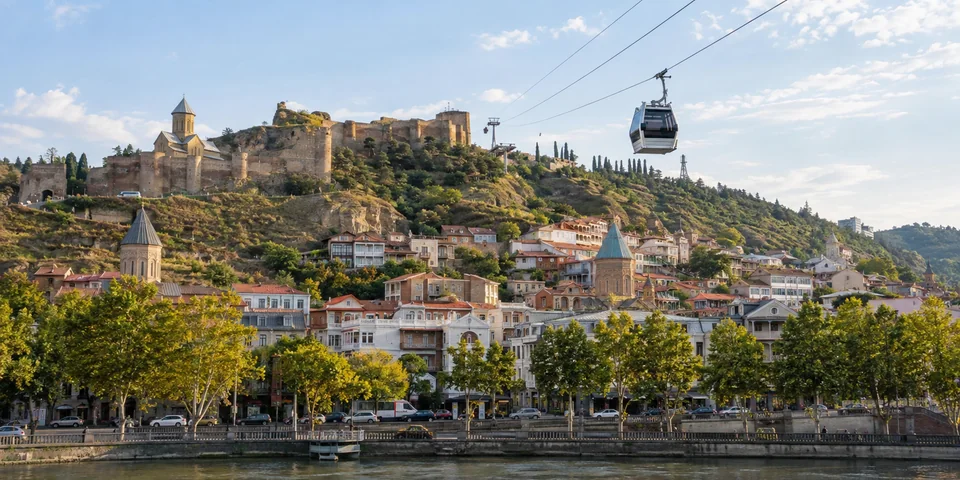
Narikala Ropeway (Rike Park to Fortress)
Modern gondolas cross the river with panoramic Old Town views. 2.5 GEL with MetroMoney or bank card. Open 10am to midnight (summer), 10am to 10pm (winter).
Rustaveli-Mtatsminda Cable Car (Reopened 2024)
Originally built in 1958, closed for 34 years, and finally restarted. The lower station behind the Academy of Sciences is a stunning Soviet landmark with a double-helix staircase. New glass-bottomed cabins take 4 minutes to climb 845 metres. 12 GEL via Mtatsminda Park Card only.
Mtatsminda Funicular (Since 1904)
The classic way up Mtatsminda Mountain, with a mid-station stop at Mamadaviti Pantheon for city views and sculptural gravestones. 12 GEL via Mtatsminda Park Card. Heritage lower station building is a destination in itself.
Turtle Lake Ropeway
Retro blue Soviet cabins from Vake Park to Turtle Lake and the Ethnography Museum. 1 GEL. 10am to 10pm.
Bagebi-Maglivi Ropeway
Soviet-era rectangular gondolas crossing the Vere gorge near Tbilisi State University. Mostly a scenic joyride past Brutalist dormitories. 1 GEL. 8am to 8pm.
Key Transit Connections
- Airport: Bus 337 to/from Station Square via Freedom Square. 1 GEL. Runs 7am-11pm. For night arrivals, use Bolt or rent a car
- Railway Station: Station Square metro is right beside the entrance. Both lines stop here
- Didube Bus Station: Didube metro (red line), above ground. Walk behind the market to reach the platforms
Unwritten Rules
- Board from middle or back doors
- Let people exit before you push in
- Do not talk to the driver
- Give up your seat for elderly passengers and women
- On packed buses, passing your card to someone near the reader for a tap is completely normal
Beyond the City Limits
Transit works brilliantly inside Tbilisi, but for day trips to wine country, mountain hikes, or multi-city itineraries, renting a car is the practical upgrade. Public transport does not reach most of the places that make Georgia special. For mountain roads, check our 4x4 fleet. For a broader view of intercity options, see our transport overview, ride-hailing guide, and driving guide.
Pros and cons
City public transport
- Pros: Low-cost and useful for short city movements when stations match the route. It avoids parking and city traffic stress.
- Cons: It is less convenient with luggage, late-night arrivals, or multiple stops far from stations. Crowds, transfers, and payment cards can slow down a tight plan.
Sources
These official sources support the practical details in this guide. Recheck live schedules, prices, opening hours, and road conditions before you travel.
- Tbilisi Transport Company standard tariff - official Tbilisi metro, bus, minibus, and ropeway fare rules.
- Georgia Travel official destination guide - official country destination context for regions, cities, culture, and parks.