
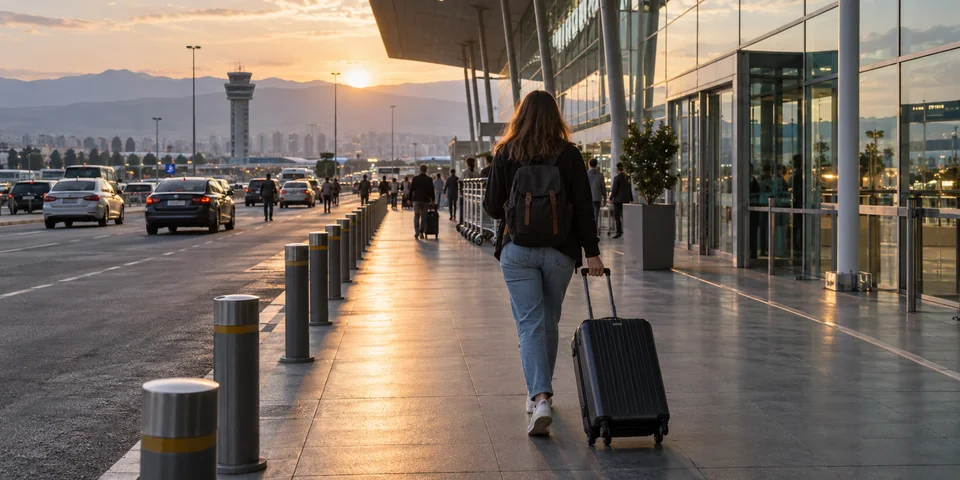
TL;DR: What to do when you step off the plane at Shota Rustaveli Tbilisi International Airport. Transport into the city, mobile data, cash, visas, and how to handle a 3am arrival.
Overview
Shota Rustaveli Tbilisi International Airport (TBS) is small, single-terminal, and 17 km from the city center. Most international flights land between midnight and 5am. The good news: everything you need is open around the clock whenever planes are touching down. Here is exactly what to do, in order, when you walk through those arrival doors.
Step 1: Get Into the City
You have four realistic options, depending on the clock and your luggage situation.
City Bus 337 (Daytime Budget Pick)
Runs every 15 to 20 minutes from 7am to 11pm. Fare is 1 GEL with a Georgian card, 1.50 GEL with an international card. Tap contactless at the reader. No cash accepted anywhere on Tbilisi's transit system.
The bus stops at Avlabari Metro, Freedom Square (Pushkin Park stop), and terminates at Station Square by Central Railway Station. Journey time: roughly 60 minutes depending on traffic. Turn right from arrivals and walk to the far end of the departures building to find the bus bay.
Bolt Ride-Hailing (Anytime Flexible Pick)
A Bolt ride to central Tbilisi costs 30 to 35 GEL. Drivers are available 24/7 and usually accept within minutes. XL cars for groups are also bookable.
Heads up: the free airport WiFi frequently blocks ride-hailing apps. You will almost certainly need mobile data (eSIM or local SIM) to book. Pre-install and verify Bolt on your home number before traveling. And never, under any circumstances, accept a ride from someone who approaches you inside the terminal.
Pre-Arranged Private Transfer (Night Arrivals)
Starts from around 55 GEL per car. Your driver meets you inside arrivals with a name sign. The fare is locked at booking and the driver monitors your flight for delays. Available to any destination in Georgia, not just Tbilisi. Ideal for families, heavy luggage, or the 2am crowd.
Rent a Car at the Airport (Best for Road Trips)
If Georgia is more than a city break for you, picking up a car at Tbilisi Airport eliminates the transfer entirely. FSTA meets you at arrivals 24/7 with your car fueled and ready. Full off-road insurance options, roof tents, camping equipment, no deposit, no hidden costs, and unlimited mileage. Drive straight to Kakheti wine country, up the Military Highway, or wherever your itinerary starts.
Step 2: Get Connected
Mobile Data
Georgian mobile coverage is excellent, even deep in mountain valleys. Magti is the dominant provider and has a 24-hour kiosk in arrivals. They sell "Tourist Welcome Packages" at the airport, but these cost roughly double what you would pay for an identical data bundle at a Magti shop in the city.
If you can survive without data for an hour, wait and buy your SIM at a regular Magti branch (Rustaveli Avenue or Aghmashenebeli Avenue are the most central). A SIM costs 10 GEL, and unlimited data for 7 days is another 10 GEL. For more on this, see our connectivity guide.
WiFi
Free WiFi covers the terminal. If full-screen ads block the connect button, tap the three dots in your browser's top-right corner and choose "Connect as is."
Step 3: Get Cash (Maybe)
Tbilisi is almost entirely cashless. Cards and mobile wallets work everywhere, from metro turnstiles to street bakeries. You really only need lari for rural areas outside the capital.
ATMs sit inside arrivals on the right before the exit doors. TBC (blue) and Bank of Georgia (orange) both work but charge small withdrawal fees. The freestanding machines just outside customs are payboxes, not ATMs. They do not dispense cash.
Skip the exchange desks in arrivals. City rates are better. Use bank branches or Rico Credit offices downtown. For deeper budgeting advice, see our cost breakdown.
Step 4: Know the Rules
Many nationalities enter Georgia visa-free for up to one year. Others need an e-visa. Since January 1, 2026, travel insurance is mandatory for all visitors, even those with visa-free entry. Verify requirements before flying.
Heading Somewhere Other Than Tbilisi?
- Kakheti (Sighnaghi, Telavi): Take Bus 337 to Isani Metro and transfer from there.
- Yerevan: Bus 337 to Isani, then taxi to Ortachala bus station. Or rent a car for the Tbilisi-Yerevan route.
- Kutaisi, Batumi, northern Georgia: Ride Bus 337 to Station Square and connect by train or marshrutka from Didube.
- Kazbegi, Gudauri, anywhere scenic: Pick up a rental car at the airport and drive.
For the full transport picture, read our intercity travel overview.
Getting Back to TBS
Bus 337 runs citybound from Liberty Square Metro (in front of H&M) from 6am to 10:45pm. Allow 60+ minutes for the journey plus 2 hours at the airport before your flight. A Bolt back costs about 35 GEL, or 45 to 50 GEL if you pre-schedule for an early departure.
FSTA rental customers: we handle free airport drop-off. Drive to the terminal, hand over the keys, and walk in.
The 3am Arrival Playbook
- Book an extra hotel night (the night before your arrival) so you can check in immediately
- Use the Ibis Tbilisi Airport, a 7-minute walk from arrivals, for very early departures or late landings
- Pre-arrange a private transfer so a driver is waiting when you walk out
- Rent a car from FSTA and drive directly to your first stop. We deliver around the clock
Quick Departure Tips
- Check-in desks open 2 hours before departure
- Food options are minimal. Eat before arriving
- One lounge (Prime Class) is available upstairs in departures
- Duty-free wine is overpriced. Buy in the city
- Baggage wrapping: 25 GEL
Pros and cons
Rental car or self-drive
- Pros: Best for flexible timing, scenic stops, luggage, and routes that continue beyond one town or viewpoint. Groups can share the daily cost instead of paying per seat on every transfer.
- Cons: One traveler needs to manage navigation, parking, fuel, and local road conditions. Wine routes also need a sober driver or a separate driver plan. It is less useful if the whole day stays inside a walkable city center.
Marshrutka, minivan, or bus
- Pros: Usually the cheapest choice for a simple point-to-point journey. Works well when the plan follows a known route and does not need extra stops.
- Cons: Schedules, luggage space, comfort, and exact arrival points are less flexible. Some services leave when full or require a station transfer.
Private transfer or driver
- Pros: Door-to-door service is easier with luggage, children, late arrivals, or a one-way route. The driver handles navigation while you keep control over planned stops.
- Cons: It costs more than shared transport. After dropoff, you may still need a separate transport plan at the destination.
Train
- Pros: A calm scheduled option when the route is served by rail. Good for travelers who prefer not to drive or negotiate with drivers.
- Cons: Rail does not reach every village, trailhead, winery, or hotel area. Station transfers and ticket availability still need to be planned.
City public transport
- Pros: Low-cost and useful for short city movements when stations match the route. It avoids parking and city traffic stress.
- Cons: It is less convenient with luggage, late-night arrivals, or multiple stops far from stations. Crowds, transfers, and payment cards can slow down a tight plan.
Walking
- Pros: Best for slow neighborhood detail, cafes, markets, viewpoints, and short historic centers. No parking, tickets, or driver coordination are needed.
- Cons: Weather, hills, uneven pavements, and luggage can make the day harder. It only works well when the main sights are close together.
Frequently asked questions
When should I start planning this trip?
The best timing depends on weather, daylight, route length, and how many stops you want. Check current opening hours, road conditions, and transport schedules before locking the day.
Is this route safe to drive?
Driving can work well when the route, season, road surface, luggage, and driver confidence match the plan. Avoid rushed days and night driving on unfamiliar rural or mountain roads, and choose a higher-clearance vehicle only when the route genuinely needs it.
Should I use public transport, a driver, or self-drive?
Public transport is usually cheaper, private drivers are easier for door-to-door timing, and self-drive gives the most control over stops and luggage. The best choice depends on distance, group size, comfort, and whether the route needs flexibility.
Can costs change after planning?
Yes. Fares, fuel, tickets, exchange rates, and seasonal prices can change, so treat any guide price as a planning reference and recheck the final cost before travel.
Rental pricing and feature reference
For trips like this guide, these are the current FSTA rental and add-on prices used across the website.
| Service | Current price | Booking note |
|---|---|---|
| Full off-road insurance | EUR 29/day | For paved and off-road driving with no road restrictions; includes tires, glass, underbody, and scratches with EUR 0 responsibility for covered damage. |
| Roof tent | EUR 27/day | Available on eligible vehicles, subject to availability and route suitability. |
| Camping equipment | EUR 149 flat fee | Cooking and outdoor kit rented as one package. |
| Daily car rental | From EUR 53/day | Current starting rate from FSTA fleet data; model-specific rates are shown in the vehicle comparison table. |
| Standard Insurance | EUR 9/day | For paved-road trips only; off-road damage is not covered. |
| Cross-border documents | EUR 89 flat fee | Available for eligible cross-border trips with paperwork prepared before travel. |
| Yacht trip | EUR 250 flat fee | Private yacht or lake trip for up to 5 people where the selected country and city support it. |
| Helicopter tour | EUR 3,000 flat fee | Private 3-hour helicopter tour for up to 7 people, with route and takeoff details confirmed after request. |
| No deposit | Included | No blocked deposit in FSTA rental terms. |
| Unlimited mileage | Included | Useful for long self-drive routes and cross-country planning. |
| Free second driver | Included | A second driver can share the road without an extra daily fee. |
Expert sources and local authority checks
This guide cites official transport, tourism, road, rail, park, or local travel references where relevant. Fares, travel times, opening hours, and road conditions can change, so FSTA checks these sources and local route notes before publishing.
- Tbilisi Transport Company standard tariff - official Tbilisi metro, bus, minibus, and ropeway fare rules.
- Georgian Railway passenger ticket portal - official train ticket search and passenger schedule checks.
- Roads Department of Georgia restrictions - official road restriction and closure notices for mountain and highway routes.
- Georgia Travel official destination guide - official country destination context for regions, cities, culture, and parks.
- Wander-Lush Tbilisi to Sighnaghi and Telavi transport guide - local fare checks for Sighnaghi and Telavi shared taxis, marshrutkas, and private transfers.
FSTA 4x4 vehicle comparison
| Vehicle | Seating capacity | Daily rate | Insurance options | Equipment | Terrain suitability |
|---|---|---|---|---|---|
| Jeep Wrangler 2016 | 5 seats | From EUR 86/day | Full off-road insurance EUR 29/day; Standard EUR 9/day | Roof tent eligible; camping equipment available | Off-road eligible when route, season, and insurance fit. |
| Toyota 4Runner 2018 | 5 seats | From EUR 71/day | Full off-road insurance EUR 29/day; Standard EUR 9/day | Roof tent eligible; camping equipment available | Off-road eligible when route, season, and insurance fit. |
| Chevrolet Suburban 2015 | 8 seats | From EUR 70/day | Full off-road insurance EUR 29/day; Standard EUR 9/day | Roof tent eligible; camping equipment available | Large-group 4x4 routes; weather checked. |
| Chevrolet Tahoe 2015 | 8 seats | From EUR 70/day | Full off-road insurance EUR 29/day; Standard EUR 9/day | Roof tent eligible; camping equipment available | Large-group 4x4 routes; weather checked. |
| Toyota FJ Cruiser 2013 | 5 seats | From EUR 69/day | Full off-road insurance EUR 29/day; Standard EUR 9/day | Roof tent eligible; camping equipment available | Off-road eligible when route, season, and insurance fit. |
| Toyota RAV4 2018 | 5 seats | From EUR 62/day | Full off-road insurance EUR 29/day; Standard EUR 9/day | Roof tent eligible; camping equipment available | Off-road eligible when route, season, and insurance fit. |
| Jeep Compass 2019 | 5 seats | From EUR 63/day | Full off-road insurance EUR 29/day; Standard EUR 9/day | Roof tent eligible; camping equipment available | Off-road eligible when route, season, and insurance fit. |
| Subaru Crosstrek 2021 | 5 seats | From EUR 60/day | Full off-road insurance EUR 29/day; Standard EUR 9/day | Roof tent eligible; camping equipment available | Off-road eligible when route, season, and insurance fit. |
| Hyundai Tucson 2020 | 5 seats | From EUR 56/day | Full off-road insurance EUR 29/day; Standard EUR 9/day | Roof tent eligible; camping equipment available | Off-road eligible when route, season, and insurance fit. |
| Jeep Patriot 2017 | 5 seats | From EUR 55/day | Full off-road insurance EUR 29/day; Standard EUR 9/day | Roof tent eligible; camping equipment available | Off-road eligible when route, season, and insurance fit. |
| Jeep Renegade 2020 | 5 seats | From EUR 53/day | Full off-road insurance EUR 29/day; Standard EUR 9/day | Roof tent eligible; camping equipment available | Off-road eligible when route, season, and insurance fit. |