
In brief: Trains, minivans, coaches, hired drivers, self-drive, and tiny prop planes. Here is every intercity transport option in Georgia, honestly ranked by speed, comfort, price, and reliability.
Georgia is compact on the map but deceptively slow to cross. Mountain terrain, winding roads, and a decentralized transit system mean that covering even short distances requires planning. After 13 years of helping travelers navigate this country, here is our honest ranking of every way to move between cities.
The Five-Second Decision Tree
- Heading west along the main corridor? Take the train.
- Short hop under 3 hours? A marshrutka van will get you there.
- Going into the mountains? Hire a driver or drive yourself.
- Exploring freely for several days? Rent a car.
- Landing at an airport? Pre-book a coach or transfer.
Rail: The Backbone of East-West Travel
Georgian Railway operates modern Swiss-built Stadler trains along a single main corridor from Tbilisi through Kutaisi to the Black Sea ports of Poti and Batumi, with branches to Zugdidi and Ozurgeti. Tickets run 15 to 35 GEL, punctuality is solid, and seats are reserved.
The catch: rail coverage ends at the western corridor. No trains reach Kakheti, Kazbegi, Svaneti, or any mountain region. If your destination is not on the railway map, you need wheels.
Book on TKT.GE up to 20 days ahead. Summer and holiday trains sell out fast.
Marshrutka Minivans: Cheap and Everywhere
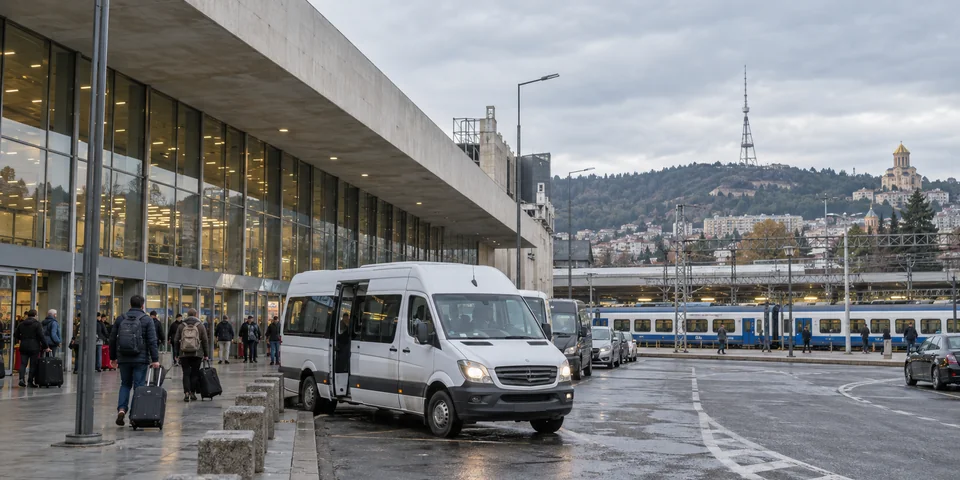
These white or silver minivans connect virtually every settlement in Georgia. Fares range from 5 GEL for short runs to 30 GEL for cross-country routes. They fill up and depart, so there is no fixed timetable. Arrive at the station 30 to 45 minutes early to grab a seat.
Marshrutkas are functional for journeys under 3 hours. Beyond that, the cramped seats, absent air conditioning, limited luggage room, and aggressive driving make them exhausting. Child seats do not exist, and seatbelts are decorative at best.
For shorter hops between towns, they are the most practical shared option. For anything longer, upgrade to a train, coach, or private vehicle.
Self-Drive: Total Freedom, Real Responsibility
Renting a car unlocks destinations that no shared transport reaches: trailheads, viewpoints, wine estates, and remote villages across Racha, Guria, and Samtskhe-Javakheti. It is the only way to travel on your own timetable without negotiating with drivers or waiting for departures.
Driving in Georgia demands confidence. The road culture is assertive, and conditions shift quickly in the mountains. But if you are a competent driver, the reward is unmatched freedom. Start early, avoid darkness, and plan realistically.
Our fleet covers every scenario: compact sedans for highway cruising, 4x4 vehicles for Tusheti's Abano Pass and the track to Ushguli. Full off-road insurance options, roof tents, camping equipment, free delivery to any airport, no deposit, and unlimited mileage.
Hired Drivers: Mountain Comfort Without the Stress
For scenic routes where the journey matters as much as the destination, a local driver with a comfortable vehicle is the sweet spot between independence and safety. Georgian Military Highway day trips run about 80 USD. Cross-country transfers like Tbilisi to Batumi cost around 125 USD. Sedans, 4WDs, and minivans are all bookable.
Drivers stop wherever you ask, photograph-ready viewpoints included. Cross-border trips to Armenia are also straightforward to arrange.
Long-Distance Coaches: The Comfortable Middle Ground
Modern coaches operate on key routes including Tbilisi to Batumi, Tbilisi to Kutaisi, and Kutaisi Airport shuttles. Georgian Bus, Omnibus, and Metro Georgia run 2 to 5 daily services with AC, WiFi, USB charging, and proper luggage storage.
Coaches are safer and more comfortable than marshrutkas but cover a limited route network. Book online through the company websites.
Shared Transfers: Tourist-Friendly for Popular Routes
Pre-arranged shared minivans serve popular mountain routes during high season: Gudauri, Mestia, and other alpine destinations. Cheaper than private cars, more predictable than roadside marshrutkas. Departures are fixed and pickup points are clear.
Prop Planes: Beautiful but Unreliable
Small turboprops connect Natakhtari (outside Tbilisi) with Mestia, Ambrolauri, and Kutaisi. The sole operator is Vanilla Sky, flying Let L-410 aircraft that seat about 15 passengers. Flights depend on visual conditions, so cancellations happen constantly in Georgia's changeable mountain weather. Even when the schedule is running, tickets sell out weeks ahead in summer.
For tight itineraries, road transport is more dependable even when it takes four times longer. Treat a Vanilla Sky flight as a bonus if it works out, not a plan you can rely on.
Shared Taxis: A Quick Upgrade Over Marshrutkas
At every major bus station, shared taxis park alongside marshrutka vans and leave when all four seats fill. A seat typically costs 30 to 50 percent more than the equivalent marshrutka ticket. You cannot make stops if sharing with other passengers, but the vehicle is faster, more comfortable, and driven with marginally less aggression than a minivan.
Shared taxis are particularly useful for routes under 2 hours where marshrutka comfort is worst: Tbilisi to Gori, Kutaisi to Tskaltubo, or Telavi to Sighnaghi. You can also buy all four seats to turn it into a semi-private transfer.
Ride-Sharing and Hitchhiking
BlaBlaCar does not operate in Georgia. Informal ride-sharing happens through Facebook groups, but many posts come from professional drivers rather than private car owners, so payment is usually expected. Hitchhiking is culturally accepted in rural areas and mountain regions. That said, it carries real risk: vehicles may be poorly maintained, and drinking while driving remains a problem on quiet rural roads. Solo travelers should exercise careful judgment. For a safer alternative, see our ride-hailing guide for city travel.
Mountain Road Access Windows
Several mountain roads only open from late June to early October. This affects Tusheti, Khevsureti, and high passes in Racha and around Kazbegi. Landslides and rain can close roads even during the open window. The official GeoRoad Facebook page posts real-time updates on pass closures and road conditions.
In winter, even main highways can become treacherous. The Gudauri section of the Georgian Military Highway closes regularly due to avalanche risk. Trains and private drivers with winter tyres are usually the more practical choices from November through March. Build buffer days into any mountain itinerary, and never commit to a tight connection that depends on a mountain pass being open.
Practical Pointers
- Heavy luggage? Skip marshrutkas. Trains, coaches, and rental cars handle bags properly. Georgian Railway technically has a luggage limit but it is never enforced.
- Families with kids? Trains and private drivers are the most comfortable. Children under five ride trains free. We offer baby seats as a rental add-on. Avoid marshrutkas with small children: no seatbelts, no child seats, and limited space.
- City taxis? Use Bolt exclusively. Never accept unmetered rides, particularly at airports. See our ride-hailing guide.
- Tbilisi metro and bus? Excellent system. MetroMoney card costs 2 GEL, rides are 1 GEL each, 90-minute transfers are free. Full details in our Tbilisi transit guide.
- Booking trains? Use TKT.GE up to 20 days ahead. Summer and holiday trains sell out fast.
- Night travel? Avoid driving after dark on any road outside major cities. Road markings are faint or absent, livestock wanders freely, and unlit vehicles are common. If you must travel late, take a train or schedule a morning departure instead.
Our Recommendation
Most travelers do best with a combination: a rental car for the countryside and mountain regions, trains for the western corridor, and Bolt for city hops. For multi-day road trips, check our 10-day road trip itinerary. For mountain driving specifics, see our driving guide.
Browse our full fleet, and check our first-time visitor guide and seasonal planning guide for more trip planning help.
Pros and cons
Rental car or self-drive
- Pros: Best for flexible timing, scenic stops, luggage, and routes that continue beyond one town or viewpoint. Groups can share the daily cost instead of paying per seat on every transfer.
- Cons: One traveler needs to manage navigation, parking, fuel, and local road conditions. It is less useful if the whole day stays inside a walkable city center.
Sources
These official sources support the practical details in this guide. Recheck live schedules, prices, opening hours, and road conditions before you travel.
- Roads Department of Georgia restrictions - official road restriction and closure notices for mountain and highway routes.
- Georgia Travel official destination guide - official country destination context for regions, cities, culture, and parks.