
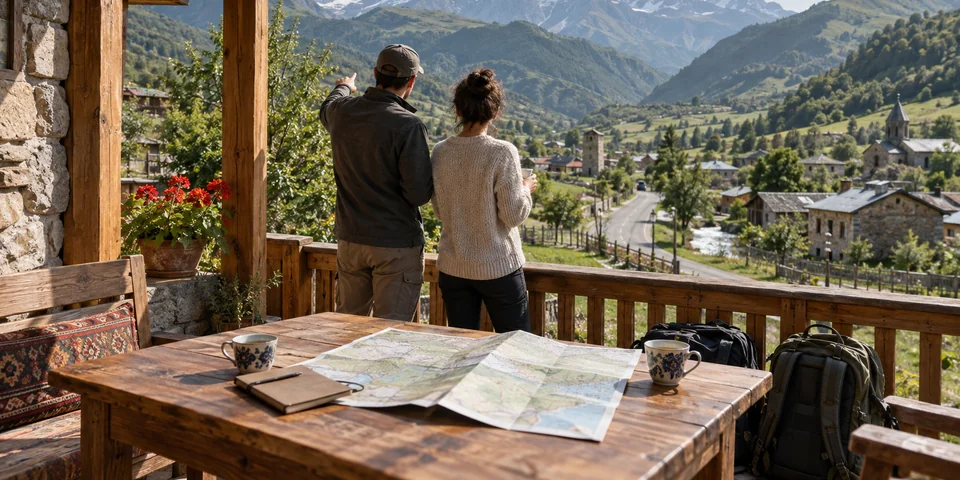
In brief: Visas, budgets, best seasons, cultural expectations, transport logistics, and how to decide between Georgia, Armenia, or both. A complete planning primer for first-time visitors to the South Caucasus.
The South Caucasus sits at the junction of Europe and Asia, wedged between the Black Sea and the Caspian, with the Greater Caucasus mountains forming a dramatic northern wall. Georgia and Armenia together offer ancient monasteries, exceptional food, excellent hiking, wine older than civilisation, and a warmth of hospitality that genuinely surprises most Western visitors. But planning a first trip here raises practical questions that standard guidebooks do not always answer clearly.
Start with the essentials: entry rules, money, language, health, connectivity, cultural norms, transport choices, and a realistic way to divide your time between Georgia and Armenia. For detailed day-by-day routes, see our Caucasus road trip itinerary.
Georgia or Armenia: Which Country First?
Most travellers start in Georgia, for practical reasons. Tbilisi has better international flight connections (direct from most European hubs, Istanbul, Dubai, and several Central Asian cities). Tbilisi Airport is modern and efficient. Georgia's tourism infrastructure is more developed, with a wider range of accommodation, better-marked hiking trails, and smoother roads in most regions.
Armenia is equally rewarding but slightly more raw. Roads outside Yerevan are rougher, signage is less consistent, and English is spoken less widely in rural areas. Starting in Georgia gives you a gentler introduction to the region before crossing into Armenia, where the landscape and culture shift noticeably.
The ideal approach: fly into Tbilisi, explore Georgia for 1 to 3 weeks, then drive across the border into Armenia with a cross-border rental car. Spend 5 to 10 days in Armenia, then return to Tbilisi for your flight home.
Entry Requirements and Visas
Georgia
Citizens of the EU, UK, US, Canada, Australia, and most other Western countries can enter Georgia visa-free for up to one year. No visa application, no fee, no registration. You simply show your passport at the border and receive a stamp. Your passport must be valid for the duration of your stay (no six-month rule). This is one of the most generous visa policies in the world.
Armenia
Most EU, UK, US, Canadian, and Australian citizens can enter Armenia visa-free for up to 180 days. Some nationalities still require a tourist visa, which can be obtained as an e-visa or on arrival. Check the Armenian Ministry of Foreign Affairs website before you travel. Your passport must be valid for at least six months beyond your planned departure date.
Border Crossing
The main land crossing between Georgia and Armenia is at Sadakhlo-Bagratashen, about 1.5 hours south of Tbilisi. The process is straightforward and typically takes 20 to 40 minutes. If driving a rental car, you need cross-border documentation from your rental company. We prepare the required border documents for cross-border bookings; check the current border rules before departure.
When to Visit
The Caucasus has distinct seasons, and the best time depends on what you want to do.
- May to June: The sweet spot. Warm but not hot in the lowlands, mountain passes open, wildflowers everywhere, fewer crowds than July-August. Spring in Georgia is particularly beautiful.
- July to August: Peak season. Hot in Tbilisi and Yerevan (35-40°C). Best for high-altitude hiking in Svaneti, Tusheti, and the Armenian highlands. Most popular and most expensive period.
- September to October: Harvest season. Wine country at its best, golden foliage in the mountains, comfortable temperatures. Autumn in Georgia is outstanding.
- November to April: Cold in the mountains, many high passes closed. Winter is ideal for skiing and lower prices. Armenia's lowland sites remain accessible year-round.
How Much Does It Cost?
Both Georgia and Armenia are affordable by European standards. Here is a rough daily budget per person in 2026:
- Budget (hostel/guesthouse, street food, public transport): 30 to 50 USD per day
- Mid-range (3-star hotel, restaurants, rental car shared between two): 60 to 100 USD per day
- Comfortable (boutique hotel, wine tastings, private car): 120 to 200 USD per day
Armenia is roughly 10 to 20% cheaper than Georgia for accommodation and food. Fuel costs are similar in both countries. For a detailed Georgia-specific breakdown, see our Georgia budget guide.
Currency
Georgia uses the Georgian lari (GEL). Armenia uses the Armenian dram (AMD). Neither currency is widely available outside the region, so exchange on arrival. ATMs are plentiful in both capitals. Cards are accepted at most hotels and restaurants in Tbilisi and Yerevan, but carry cash for rural areas, markets, and small towns.
Language
Georgian and Armenian are unrelated languages, each with its own unique alphabet. English is spoken reasonably well in Tbilisi (especially among younger people), less so outside the capital. In Armenia, Russian is more commonly spoken as a second language than English, particularly among older generations.
A few words in Georgian (gamarjoba = hello, madloba = thank you) and Armenian (barev = hello, shnorhakalutyun = thank you) go a long way. Google Translate works offline for both languages if you download the language packs before your trip.
Connectivity
Both countries have good 4G coverage in cities and along main highways. Coverage drops in remote mountain areas (Tusheti, Upper Svaneti's higher villages, Armenia's Syunik province). Pick up a local SIM card at the airport on arrival. In Georgia, Magti and Beeline offer affordable tourist packages. In Armenia, Ucom and VivaCell-MTS are the main providers. See our Georgia SIM card guide for details.
Note: Georgian SIMs do not work in Armenia without roaming, and vice versa. Activate a roaming package before crossing the border, or buy a second SIM in Armenia.
Getting Around
By Rental Car
A rental car is the most flexible way to explore both countries. Georgia's main highways are well maintained. Armenia's roads vary: excellent between Yerevan and Sevan, rougher in the north and south. Having your own car lets you access remote monasteries, mountain passes, and wine villages that public transport does not reach.
Pick up in Tbilisi, Kutaisi, Batumi, or Yerevan. For cross-border trips, book a Tbilisi-to-Yerevan rental with border documentation included. A standard sedan handles 90% of routes. A 4x4 is needed only for Tusheti, Ushguli, and a few remote Armenian sites like Amberd.
By Public Transport
Georgia has a network of marshrutka minivans connecting most towns. Trains run between Tbilisi, Kutaisi, Batumi, and a few other cities. Armenia has marshrutkas too, but services are less frequent and less comfortable. The overnight train between Tbilisi and Yerevan is a classic experience.
By Private Driver
Hiring a private driver is common in both countries and surprisingly affordable. A full day with driver and fuel typically costs 100 to 150 USD. This option suits travellers who want flexibility without driving themselves, especially on mountain roads.
Food and Drink
Both countries have exceptional food cultures, but they are quite different from each other.
Georgia is famous for khinkali (soup dumplings), khachapuri (cheese bread in regional variations), mtsvadi (grilled meat), pkhali (walnut-vegetable spreads), and churchkhela (grape-and-walnut candy). Georgian wine, made in clay qvevri vessels using 8,000-year-old techniques, is unlike anything you have tasted. See our Tbilisi food guide.
Armenia has its own distinct cuisine: lavash flatbread, khorovats (barbecued meat), dolma (stuffed grape leaves), ghapama (stuffed pumpkin), and jingalov hats (herb-filled flatbread from Artsakh). Armenian brandy is world-famous, and the wine industry centred on the Areni grape is growing rapidly. See our Yerevan shopping guide for food souvenirs.
Cultural Expectations
- Hospitality: Both cultures take hospitality extremely seriously. You may be invited to share meals, offered homemade wine, or given gifts by strangers. Accepting graciously is the norm. Refusing repeatedly can cause offence.
- Religion: Georgia is Orthodox Christian. Armenia is Apostolic Christian (one of the oldest Christian traditions in the world). Both countries are deeply religious, and churches and monasteries are active places of worship, not just tourist sites. Dress modestly when visiting (cover shoulders and knees).
- Toasting: Georgian supras (feasts) involve elaborate toasting rituals led by a tamada (toastmaster). If invited to a supra, pace yourself with the wine. Armenian meals are less formally structured but equally generous.
- Photography: Ask before photographing people, especially in rural areas. Monastery photography is generally welcome, but check for signs prohibiting flash or tripods.
- Tipping: Not obligatory in either country but appreciated. Rounding up the bill or leaving 10% at restaurants is common in Tbilisi and Yerevan.
Health and Safety
Both countries are safe for tourists. Violent crime against visitors is extremely rare. Petty theft is uncommon but use normal precautions in crowded areas. See our Georgia safety guide for details.
Tap water is safe to drink in Tbilisi and Yerevan. In rural areas, stick to bottled water. No special vaccinations are required for either country. Travel insurance is mandatory for entering Georgia and strongly recommended for Armenia.
The biggest safety risk in both countries is road conditions, particularly on mountain roads. Drive cautiously, especially at night, and be aware that local driving styles can be aggressive by Western standards. See our driving in Georgia guide.
How Much Time Do You Need?
- 1 week: Enough for Tbilisi, one Georgian region (Kazbegi or Kakheti), and a taste of Armenia (northern monasteries or Yerevan). Tight but feasible.
- 2 weeks: Comfortable for Tbilisi, two Georgian regions, and 4 to 5 days in Armenia covering Yerevan, Lake Sevan, and one other area.
- 3 to 4 weeks: The ideal timeframe. Covers most of Georgia's highlights plus a thorough exploration of Armenia including Tatev, Gyumri, and the Debed Canyon.
- 5 to 6 weeks: The grand tour. Every region, every back road, every monastery. See our full Caucasus itinerary for the complete route.
Packing Essentials
The Caucasus has dramatic temperature swings. Tbilisi can hit 40°C in July while mountain passes drop below freezing at night. Layer your clothing. Key items: a lightweight waterproof jacket, comfortable walking shoes (not just sandals), a scarf or shawl for monastery visits, sunscreen and sunglasses (UV is intense at altitude), and a power adapter (both countries use European two-pin plugs). For a complete list, see our Georgia packing guide.
Sources
These official sources support the practical details in this guide. Recheck live schedules, prices, opening hours, and road conditions before you travel.
- Georgia Travel official destination guide - official country destination context for regions, cities, culture, and parks.
- Armenia Travel official destination guide - official destination information for Armenia, including cities, culture, food, and regional travel.
- Yerevan Transport official ticketing page - official Yerevan bus, trolleybus, and metro ticket options.