
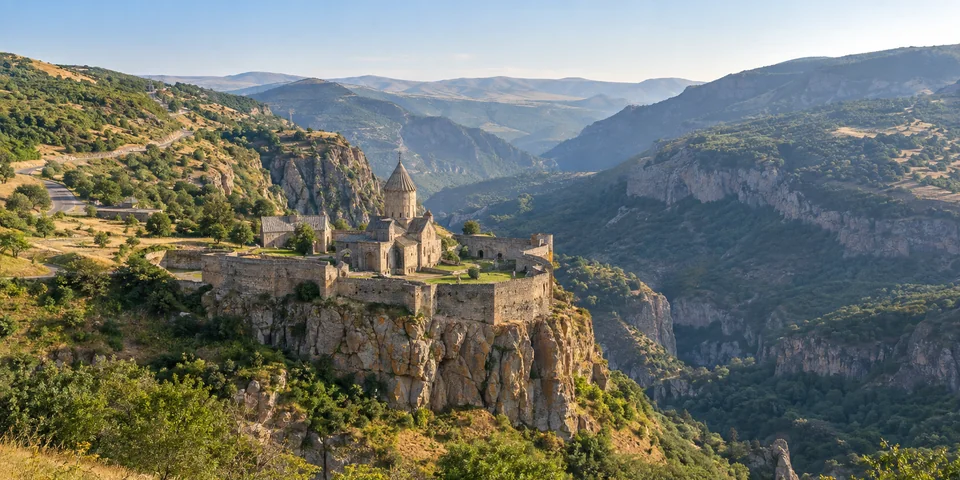
In brief: Tatev Monastery sits on a basalt cliff in Armenia's far south, reachable by the world's longest aerial tramway, with a full driving day from Yerevan and several worthwhile stops along the way.
Tatev Monastery is one of the most dramatically sited religious buildings in the world. Perched on a basalt plateau at the edge of the Vorotan Gorge in Armenia's Syunik Province, it overlooks a canyon so deep and green that the scale is difficult to process until you are standing at the rim. The monastery was founded in the 9th century, grew into one of the most important centres of learning in the medieval Armenian world, and is still an active place of worship.
For most visitors, the journey to Tatev begins in Yerevan. The drive south covers about 253 kilometres and takes between four and five hours depending on stops. That makes a same-day round trip exhausting but possible. A better plan is to break the journey with an overnight stay in Goris and turn it into a proper road trip through some of Armenia's most spectacular scenery.
With a rental car from Yerevan, you control the pace. Stop for Mount Ararat views on the Ararat Plain, explore 13th-century Noravank Monastery in a red-rock canyon, taste wine in the Areni region, ride the world's longest aerial tramway to Tatev, and visit Armenia's answer to Stonehenge at Zorats Karer. None of this requires a tour group or marshrutka timetable.
The Route: Yerevan to Tatev by Car
Yerevan to the Ararat Plain
Leaving Yerevan heading south, the highway crosses the Ararat Plain with Mount Ararat dominating the western horizon. On clear mornings, particularly before 10am, the twin peaks of Greater and Lesser Ararat are fully visible. Pull over on one of the quieter stretches of road for unobstructed photographs. By midday, cloud cover typically obscures the summit.
Khor Virap Monastery
About an hour south of Yerevan, a short detour leads to Khor Virap, the monastery closest to Mount Ararat. This is where Gregory the Illuminator was imprisoned in an underground pit for 13 years before converting King Tiridates III and making Armenia the first nation to adopt Christianity as its state religion in 301 AD. You can climb down into the pit via a narrow ladder. The monastery-with-Ararat backdrop is one of the most photographed scenes in the Caucasus.
Areni and the Wine Region
Continuing south through Vayots Dzor Province, the landscape shifts from flat plains to narrow valleys. The village of Areni is the heart of Armenian winemaking. Several wineries offer tastings, and the indigenous Areni Noir grape produces distinctive reds. Nearby, the Areni-1 Cave is the archaeological site where the world's oldest known leather shoe (approximately 5,500 years old) was discovered in 2008, along with what may be the world's oldest winery.
Noravank Monastery
A winding road through a dramatic red-rock gorge leads to Noravank, a 13th-century monastery complex that is one of Armenia's architectural highlights. The main church, Surb Astvatsatsin (Holy Mother of God), features an unusual two-storey design with narrow stone stairs on the exterior leading to the upper chapel. The carved tympanum above the entrance depicts Christ flanked by figures with distinctively almond-shaped eyes. According to local tradition, this detail is what saved the monastery when Mongol forces swept through the region, as they recognised the familiar facial features and spared the building.
The khachkar cross-stones scattered around the grounds are among the finest in Armenia. Each is hand-carved with intricate geometric and floral patterns, and the level of detail indicates the period: the more elaborate the design, the more recent the stone.
The Road to Syunik
South of Noravank, the highway climbs through mountain passes and drops into the Syunik region. The terrain becomes wilder and more remote. Traffic thins. The last stretch to Halidzor passes through small villages where stone houses and livestock outnumber cars. This is some of the most beautiful driving in Armenia.
Wings of Tatev: The Aerial Tramway
The Wings of Tatev is a 5.7-kilometre aerial tramway connecting the village of Halidzor with the monastery on the opposite side of the Vorotan Gorge. When it opened in 2010, the Guinness Book of World Records certified it as the world's longest non-stop double-track cable car.
The ride takes about 12 minutes and replaces what was previously a winding mountain road of over an hour. The aerial perspective over the gorge, with its river, waterfalls, and scattered ruins on the valley floor, is spectacular. Locals use the tramway as public transport to reach the monastery for Sunday services.
Tickets and Hours
- Operating hours: 10am to 7pm, Tuesday to Sunday. Closed Mondays.
- High season (March to November): 5,500 AMD one-way, 7,000 AMD return.
- Low season (December to February): 3,500 AMD one-way, 5,000 AMD return.
- Weather: The tramway may close at short notice in high winds or storms. Check conditions before making the drive.
If you prefer to hike, a trail descends from the monastery into the gorge and back up to Halidzor. Budget around two hours for the walk.
Exploring Tatev Monastery
The monastery complex sits on a natural basalt platform with sheer drops on three sides. The main structures include the 10th-century Church of Sts. Paul and Peter (Surb Poghos-Petros), the smaller Church of St. Gregory, and the remains of the medieval university that once housed 600 students and scholars studying science, philosophy, music, and manuscript illumination.
The Gavazan, or Swinging Column, stands in the monastery courtyard. This eight-metre stone pillar was erected in 904 AD and is engineered to oscillate at its base in response to seismic activity. It is considered a remarkable feat of medieval engineering and may have served as both a seismograph and an early warning system against approaching armies, whose horses' hooves would cause the pillar to sway.
Look for the hatch door in one of the monastery buildings that opens to a subterranean passage. This tunnel once provided an escape route all the way down to the valley floor during sieges.
The monastery also has a notable place in modern history. In 1920, the Republic of Mountainous Armenia was briefly declared within these walls during a congress led by military commander Garegin Nzhdeh. The unrecognised state lasted until July 1921, when the Armenian Soviet Socialist Republic was established.
Zorats Karer (Karahunj)
About 50 kilometres north of Tatev, near the town of Sisian, lies Zorats Karer, sometimes called Armenia's Stonehenge. The site consists of 223 standing stones arranged in an open field against a backdrop of bare mountains. Some of the basalt pillars have small circular holes drilled near the top, leading to theories that the formation served as an ancient astronomical observatory. Other researchers argue the stones are Bronze Age burial markers.
The site is unguarded and free to visit. It sits right beside the main highway, making it an easy stop on the drive between Tatev and Yerevan. Conditions can be windy and cold even in summer, so bring a jacket.
Where to Stay Near Tatev
The town of Goris, about 35 kilometres northeast of Tatev, is the most practical base. It has guesthouses, small hotels, and restaurants. The town itself is built in a grid pattern and is surrounded by cone-shaped rock formations, some of which contain medieval cave dwellings.
For something more atmospheric, the village of Tatev has a handful of family-run guesthouses where meals are included and hosts can arrange local walks.
Practical Driving Tips
- Road conditions: The main highway from Yerevan to Goris is paved and in reasonable condition. Side roads to Noravank and the final approach to Halidzor are narrower but manageable for a standard car. A 4x4 is not required for this route.
- Fuel: Fill up in Yerevan. There are petrol stations along the way, but options become scarce south of the Areni region.
- Time needed: A comfortable two-day trip allows for stops at Khor Virap, Noravank, Areni, Tatev, and Zorats Karer. If doing a very long day trip, leave Yerevan by 7am and expect to return after 9pm.
- Best season: May to October. Winter driving is possible but passes may be icy and the aerial tramway is more likely to close for weather. Spring brings wildflowers and fewer crowds.
- Cross-border option: If you are driving from Tbilisi to southern Armenia, a cross-border rental allows you to combine Georgia and Armenia in one road trip without backtracking to Yerevan.
Combining Tatev with Other Armenian Destinations
A southern Armenia loop pairs well with the northern route. Drive south from Yerevan to Tatev via Khor Virap and Noravank, overnight in Goris, then return north through the Selim Pass to Lake Sevan. From there, continue to Dilijan and the Debed Canyon monasteries of Haghpat and Sanahin (UNESCO World Heritage Sites), then west to Gyumri before crossing into Georgia.
This full loop covers the best of Armenia in 7 to 10 days and works perfectly with a rental car. We deliver vehicles to Yerevan and handle all cross-border documentation so you can focus on the driving.
Sources
These official sources support the practical details in this guide. Recheck live schedules, prices, opening hours, and road conditions before you travel.
- Armenia Travel official destination guide - official destination information for Armenia, including cities, culture, food, and regional travel.
- Yerevan Transport official ticketing page - official Yerevan bus, trolleybus, and metro ticket options.