
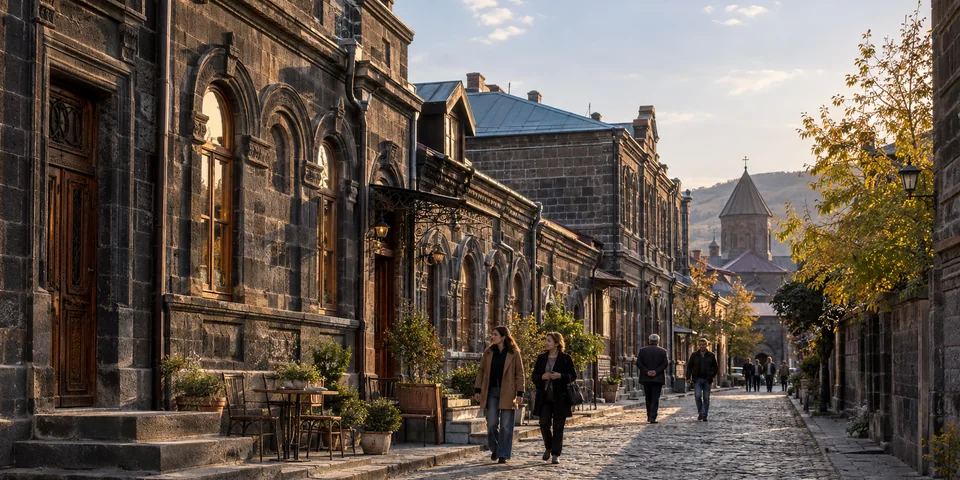
In brief: Armenia's second-largest city was nearly destroyed by the 1988 earthquake. Today its dark volcanic architecture, emerging cafe scene, and proximity to both Georgia and northern Armenia's monasteries make it a compelling stop on any Caucasus road trip.
If Yerevan is the Pink City, Gyumri is the Black City. Armenia's second-largest settlement is built from dark volcanic tuff quarried from the surrounding hills, with orange-gold stone used to frame windows and arches. The effect is striking and unlike anything else in the Caucasus. Walking down Abovyan Street on a grey afternoon, the city looks like it was carved from charcoal and amber.
Gyumri sits in the Shirak Province in northern Armenia, about two hours by car from Yerevan and less than 10 kilometres from the Turkish border. For travellers driving between Georgia and Armenia, the city is a natural stop. It sits directly on the route between Tbilisi and Yerevan, and the overnight train between the two capitals makes a 20-minute stop at Gyumri station.
The city's modern history is defined by the Spitak Earthquake of December 7, 1988. The tremor killed an estimated 25,000 to 50,000 people and flattened most of Gyumri's heritage buildings. More than three decades later, reconstruction is still ongoing. But the city has a determined, forward-looking energy. New cafes, creative studios, and social enterprises have taken root in the restored tuff-stone buildings, and the 1,500 remaining heritage structures of the Kumayri Historic District are gradually being brought back to life.
What to See in Gyumri
Vartanants Square
The central square, also called Freedom Square, is anchored by Gyumri's most important buildings: the City Hall, a WWII memorial, and two prominent churches. The square opened in 1930 and hosted a mass by Pope Francis in 2016. A monument to the Battle of Avarayr sits at its centre.
Holy Saviour's Church (Amenaprkich)
The largest church on Vartanants Square was built between 1858 and 1872, modelled after the Cathedral of Ani. The 1988 earthquake brought its bell tower crashing down. Carved stones from the fallen facade still lie scattered in the grass around the building. Behind the church, stone plinths are inscribed with clock faces frozen at 11:41, the exact moment the earthquake struck. A pyramid-shaped memorial to the victims stands nearby. Restoration began in 2002 and is nearing completion.
Yot Verk Church
The smaller of the two churches on the square, Yot Verk (Cathedral of the Holy Mother of God) is the seat of the Diocese of Shirak. It was rebuilt after the earthquake and is a fully functioning church. Two massive stone pyramids that once topped the steeples but fell during the quake now sit in the front yard, a quiet tribute to the city's resilience. Cherry trees shade the square, and Sunday morning mass draws a significant portion of the city.
Sev Berd (The Black Fortress)
On a hilltop at the edge of town, this perfectly circular fortress of black and orange tuff was built by Russian Imperial forces in the 1820s after the Russo-Turkish War. The location, just 8 kilometres from the Turkish border, was strategically important. The fortress has a single entry point via a drawbridge, small external openings, and a subterranean level with an original well and an informal museum of archival photographs from the city's imperial era. The building recently reopened as an entertainment venue and small hotel. A caretaker is usually on site and will let you inside during the day.
Mother Armenia and Victory Park
Next to Sev Berd, a 1975 bronze Mother Armenia statue raises one arm skyward while holding an ear of wheat. A concrete staircase and fountain complex unfurls below, with gardens and stone blocks inscribed with major WWII battle names in Cyrillic at the base. The statue deliberately faces away from Turkey. Views from the hilltop cover the entire city.
Kumayri Historic District
Stretching across several dozen blocks northeast of Vartanants Square, the Kumayri district contains approximately 1,500 heritage buildings, some dating to the late 18th century. The style is sometimes called "Armenian Belle Epoque," influenced by European architectural trends imported by the merchant class. Pedestrianised Abovyan Street has the most impressive facades.
Many buildings remain boarded up, but restoration is accelerating. Notable landmarks include the Old Alexandrapol Brewery on Jivani Street (built 1898, now a functioning craft brewery with tours available on weekdays), and several restored mansions that now house restaurants and cafes.
The Iron Fountain
About 4.5 kilometres north of the centre, this Soviet-era sculptural fountain was completed in 1982 by architect Artur Tarkhanyan. It was originally the centrepiece of the Polytechnic University campus. The university is gone, but the angular metal sculpture still stands in an empty lot surrounded by industrial ruins. Worth the short taxi ride for anyone interested in Soviet modernism.
Gyumri Market (Shuka)
The city's central market is a lively hall of local produce: stone fruit and berries in summer, aromatic spices year-round, slabs of cured basturma meat, wheels of white cheese, and fresh coffee ground to order. Stallholders are friendly and generous with samples. Open daily from about 9am to 6pm.
Where to Eat
Gyumri's food scene is smaller than Yerevan's but has genuine character. Local specialties lean toward grilled meats, herb-heavy stews, and fresh bread baked in tonir ovens. A few highlights:
- Florence Restaurant: Set in a beautifully restored tuff-stone building on the corner of Gorki and Jivani streets. Good Armenian and European dishes in a heritage setting.
- Gyumri Brewery: The Old Alexandrapol Brewery building from 1898, now producing craft beer with tastings available.
- Market food stalls: For quick, cheap eats, the area around the Shuka has street food vendors selling lahmajun, fresh bread, and grilled meats.
Getting to Gyumri
From Yerevan
The drive from Yerevan takes about two hours on a good highway. Any car handles the route. Marshrutka minivans also run approximately hourly from Yerevan's Southern Bus Station (about 1,500 AMD, 2.5 to 3 hours). A fast train covers the distance in about two hours.
From Tbilisi
Driving from Tbilisi to Gyumri takes roughly 4 hours via the Bavra border crossing in the north. The overnight train from Tbilisi to Yerevan stops at Gyumri station in the early hours of the morning (about 8 hours from Tbilisi). With a cross-border rental car, you can stop in Gyumri on your way between the two capitals and continue south to Yerevan at your own pace.
Onward from Gyumri
From Gyumri, the route east toward Vanadzor (about 90 minutes) leads into the Debed Canyon, where the UNESCO-listed monasteries of Haghpat and Sanahin are located. Continuing south from there takes you through Dilijan and on to Lake Sevan. This northern loop through Armenia is one of the best multi-day driving routes in the Caucasus.
Practical Tips
- How long to stay: One full day covers the main sights. Two days lets you explore the historic district at a slower pace and take a side trip to the Debed Canyon. Gyumri also works as a day trip from Yerevan.
- Best time: Late spring through early autumn (May to October). Winters in Gyumri are colder than Yerevan due to the higher altitude and northern location. Temperatures regularly drop below freezing from November through March.
- Getting around: The city centre is compact and walkable. Taxis are cheap for reaching outlying sights like the Iron Fountain or Sev Berd.
- Car rental: We deliver cars to Gyumri from both Yerevan and Tbilisi. Having a car makes Gyumri an easy stop on a wider Armenia or Georgia-Armenia road trip rather than a standalone destination requiring separate transport.
Sources
These official sources support the practical details in this guide. Recheck live schedules, prices, opening hours, and road conditions before you travel.
- Roads Department of Georgia restrictions - official road restriction and closure notices for mountain and highway routes.
- Georgia Travel official destination guide - official country destination context for regions, cities, culture, and parks.
- Armenia Travel official destination guide - official destination information for Armenia, including cities, culture, food, and regional travel.
- Yerevan Transport official ticketing page - official Yerevan bus, trolleybus, and metro ticket options.