
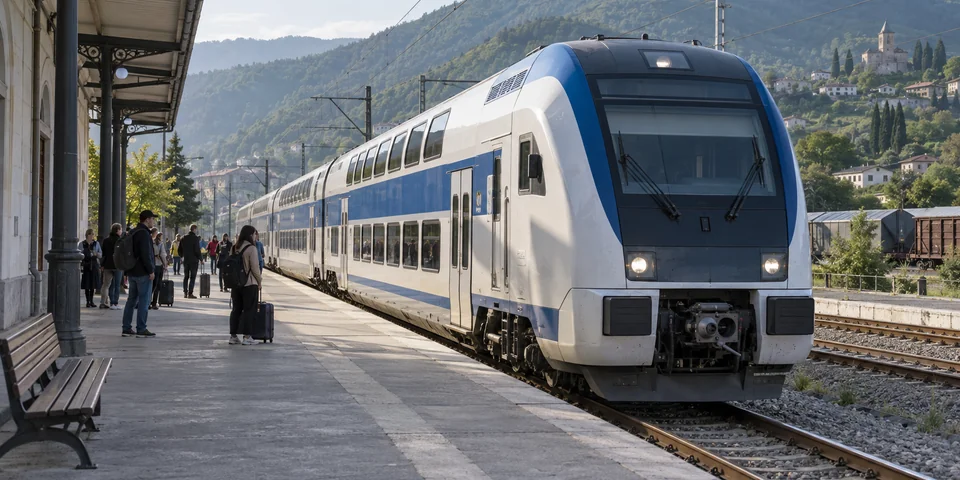
In brief: Georgia has 10 domestic rail routes ranging from sleek Swiss double-deckers to Soviet-era benches that cost 50 tetri. Here is a route-by-route breakdown with ticket tips, station guides, and honest advice on when the train beats driving.
Georgia's railway network is one of the most underrated ways to travel through the Caucasus. The country has 10 domestic routes, 2 international sleeper services, and a mothballed scenic narrow-gauge line. Some trains are modern Swiss-built double-deckers with power outlets and reclining seats. Others date from the Soviet era and cost less than a loaf of bread.
Knowing which trains to take, and which to avoid, is the difference between a comfortable five-hour cruise to the Black Sea and a gruelling day on a hard plastic bench. Below are the active routes, ticket tips, station logistics, and moments when renting a car makes more sense than taking the train.
Quick Overview: Types of Trains
Georgia operates five categories of train. Understanding the differences saves you from booking the wrong one.
- Stadler KISS express: Modern Swiss double-decker trains purchased in 2016. Top speed 160 km/h. Used exclusively on the Tbilisi to Batumi route. Air-conditioned, comfortable seats, power outlets, and (sometimes working) Wi-Fi.
- Fast trains: Older but decent rolling stock on the Tbilisi to Zugdidi, Poti, and Ozurgeti routes. First class and business class are comfortable. Second class varies.
- Passenger electro trains: Soviet-era carriages with hard plastic seats. Used on the Tbilisi to Borjomi and Kutaisi to Sachkhere routes. Tickets cost 50 tetri to 2 GEL and are bought from a coin machine on board.
- Commuter electro trains: Similar vintage to the above. Found on the Tbilisi to Gardabani/Rustavi and Khashuri to Zestafoni lines.
- International sleeper trains: Overnight services to Yerevan (Armenia) and Baku (Azerbaijan, currently suspended).
The Tbilisi to Batumi Train
This is Georgia's flagship rail service and the one most visitors will use. The Stadler train covers the 380 km journey in about 5 hours 10 minutes, stopping at Kutaisi Airport (Kopitnari), Ureki, Kobuleti, and Batumi Central.
At least three services run daily, with extras added in summer. Three classes are available: second (from 35 GEL), first, and business. The train is extremely popular from June through September. Book your tickets as far in advance as possible (up to 21 days) during peak season, because sellouts are common.
Tip: Phone reception is weak on this route, especially on the upper deck. Sit downstairs if you need to stay connected.
When driving beats the train: If you are travelling in a group of 3 or more, a rental car to Batumi works out cheaper per person than three train tickets, and you gain the freedom to stop at Gori, Kutaisi, or Shekvetili along the way. The drive takes about 5.5 hours on the highway. For exploring Adjara beyond Batumi, a car is essential anyway.
The Tbilisi to Zugdidi Train
This fast train connects the capital with Zugdidi in Samegrelo, the launching point for Svaneti and Mestia. It also stops at Rioni Railway Station near Kutaisi. Journey time is 6 hours.
Second class wagons are worn, with some broken seats and no power outlets. First class is a significant upgrade with comfortable seats, outlets, and more space. Business class adds a table.
Important: Tickets for this route can only be purchased through the official Georgian Railway website (gr.com.ge), not through TKT.GE.
When driving beats the train: The train drops you in Zugdidi, but Mestia is still 4 hours away by road with no train connection. If Svaneti is your goal, renting a car in Kutaisi or Tbilisi and driving directly saves an entire day of transfers. A 4x4 from Kutaisi is ideal for the mountain roads beyond Mestia.
The Tbilisi to Poti Train
Arguably the most comfortable train in Georgia. The wagons are in better condition than the Zugdidi service, second class has power outlets, and the journey takes 5 hours 35 minutes. It passes through Rioni, making it another option for reaching Kutaisi from Tbilisi.
First and business classes are also available. Business class has plush recliner seats and a shared table, perfect if you want to work during the journey.
The Tbilisi to Borjomi Train
This is old-school rail travel at its finest (or roughest, depending on your perspective). A Soviet-era electro train with hard plastic seats, no power outlets, and no amenities. One daily departure in the early evening, arriving in Borjomi about 4 hours 15 minutes later. Tickets cost a few GEL from the coin machine on board.
It is more of an experience than a practical transit option. For comfort and flexibility, driving to Borjomi takes about 2.5 hours from Tbilisi on good roads, and a rental car lets you explore Samtskhe-Javakheti at your own pace.
The Tbilisi to Ozurgeti Train
Upgraded in 2025 with newer carriages and reduced travel time, this service still takes about 7.5 hours to reach Guria. Second class costs 16 GEL, first class 28 GEL.
A faster alternative: take the Stadler train to Ureki (on the Batumi line), then grab a 40-minute taxi to Ozurgeti.
The Kutaisi to Sachkhere Train
This electro train heads northeast from Kutaisi through upper Imereti, passing through the historic mining town of Chiatura before terminating at Sachkhere. Journey time is 3.5 hours. The fare is just 50 tetri.
If you want one authentic slow-train experience in Georgia, this is the route. The scenery through the Kvirila gorge is stunning, and Sachkhere Railway Station is one of the prettiest in the country. Note that the service pauses in winter (December through March).
To explore this region properly after arriving, you will need wheels. Consider renting a car from Kutaisi and driving the route instead, which also lets you stop at Chiatura's famous cable cars and the Katskhi Pillar.
International Sleeper Trains
Tbilisi to Yerevan
An overnight sleeper connects Tbilisi with Yerevan and Gyumri in Armenia. New cabins were added recently, making the journey reasonably comfortable. In summer, some services originate in Batumi.
The train is a good budget option for solo travellers. For groups or anyone wanting to explore Armenia beyond Yerevan, renting a car from Tbilisi to Yerevan is more practical. You keep the vehicle for the entire Armenia leg and can visit Garni, Geghard, Lake Sevan, and Dilijan without arranging separate transport. See our Yerevan car rental guide.
Tbilisi to Baku
This night train is currently suspended due to Azerbaijan's closed land borders. No reopening date has been confirmed.
The Kukushka Scenic Railway
Georgia's only scenic railway, the Kukushka ("cuckoo" in Russian), is a 37 km narrow-gauge line between Borjomi and Bakuriani ski resort. First opened in 1902, the train has been out of service since 2020. Georgian Railway has no announced plans to restart it. If you want to make this journey, driving takes about 45 minutes on a winding mountain road.
How to Buy Train Tickets
Online via TKT.GE
The easiest option for most routes. Pay with Visa or Mastercard. Sales open 10 to 21 days in advance. Enter your passport number in the identity field. If your passport contains letters, use the desktop website rather than the app. You receive a QR code by email. No printing required.
Online via Georgian Railway (gr.com.ge)
The official portal, still technically in test mode. Required for Tbilisi to Zugdidi, Poti, and Rioni routes that do not appear on TKT.GE. Create an account first, use "Tbilisi-samg" when searching departures from the capital, and check your spam folder for the confirmation email.
At the Station
Show up in person and pay cash. No service fees. Most station staff speak enough English to help. Bring your passport as you may be asked for ID.
Electro Train Tickets
For Soviet-era electro trains (Borjomi, Sachkhere, Gardabani lines), tickets cannot be purchased online. Use the coin machine on board the train.
Tbilisi Central Station: What to Know
All passenger trains depart from Tbilisi Central Railway Station, next to Station Square metro (red line). Take the escalator to the third floor for ticket desks and the electronic timetable. Platforms are accessed via outdoor stairs.
- Luggage storage is available on platform 1.
- Food court on the upper floor opens at 10 a.m. Several 24/7 bakeries on Dadiani Street behind the station sell khachapuri.
- Charging: Seating areas near the food court have power sockets.
- Boarding: Trains that originate in Tbilisi usually sit on the platform 15 to 30 minutes before departure. Arrive early.
10 Practical Tips for Train Travel
- Arrive 20 minutes early. Board as soon as the train appears so you can settle in and stow luggage.
- Digital tickets are fine. Stewards check your name and seat number, never the QR code. No need to print.
- Keep your passport handy. Some stewards verify ID at boarding.
- Pack food and water. No dining cars on any domestic train. The Batumi Stadler has vending machines, nothing else. The only chance to buy snacks is during a brief stop at Khashuri station.
- Bring a power bank. Not all trains have outlets. Where they exist, sockets are European two-pin (Schuko), not USB.
- Buy unlimited mobile data. A daily data package from Magti or Geocell keeps you online. Signal drops around Rikoti Pass and Kharagauli. Get a Georgian SIM card before your journey.
- Wagons are not in order. Wagon 1 is not always at the front. Check the A4 paper in each carriage window.
- Do not get off at Khashuri. The train leaves without warning. If you must stretch your legs, stay right by the door.
- Offer a snack to your neighbour. It is polite and sometimes reciprocated with something delicious.
- Bicycles and skis: Allowed on some services. Always confirm with the steward before boarding.
Where the Train Cannot Take You
Georgia's rail network has significant gaps. There are no trains in Kakheti (eastern Georgia), Svaneti, Tusheti, Kazbegi, or anywhere in the high Caucasus. For these regions, your options are marshrutka, hired driver, or rental car.
- Kakheti wine country: No rail service at all. The old stations are abandoned. A Kakheti road trip by rental car is the best way to explore.
- Kazbegi and the Georgian Military Highway: No train. Drive yourself or hire a driver. See our Kazbegi guide.
- Svaneti (Mestia, Ushguli): Train goes to Zugdidi, but Mestia is 4 hours further by road. Self-driving to Svaneti in a 4x4 is the most rewarding approach.
- Tusheti: No road access until June. 4x4 required over Abano Pass.
- Racha: No train. A Racha road trip through Nakerala Pass is spectacular by car.
- Gudauri ski resort: No train. Rent a car to Gudauri or arrange a transfer.
For destinations off the rail grid, renting a car from Tbilisi, Kutaisi, or Batumi fills every gap. Full off-road insurance options, roof tents, camping equipment, no deposit, unlimited mileage, and free delivery to any airport or hotel. Check our full transport guide for a comparison of all intercity options.
Train vs. Rental Car: When Each Wins
- Train wins: Tbilisi to Batumi (solo or couple), Tbilisi to Kutaisi (if no car needed at destination), overnight sleeper to Yerevan (budget solo travel).
- Car wins: Groups of 3+, multi-stop itineraries, mountain destinations, eastern Georgia, any trip where you need flexibility at the destination. See our driver vs. rental car comparison for a deeper breakdown.
- Combine both: Take the Stadler train to Batumi, then rent a car there for exploring Adjara. Or train to Kutaisi, then pick up a rental car for day trips into Imereti and Racha.
Pros and cons
Train
- Pros: A calm scheduled option when the route is served by rail. Good for travelers who prefer not to drive or negotiate with drivers.
- Cons: Rail does not reach every village, trailhead, winery, or hotel area. Station transfers and ticket availability still need to be planned.
Sources
These official sources support the practical details in this guide. Recheck live schedules, prices, opening hours, and road conditions before you travel.
- Tbilisi Transport Company standard tariff - official Tbilisi metro, bus, minibus, and ropeway fare rules.
- Georgian Railway passenger ticket portal - official train ticket search and passenger schedule checks.
- Roads Department of Georgia restrictions - official road restriction and closure notices for mountain and highway routes.
- Georgia Travel official destination guide - official country destination context for regions, cities, culture, and parks.