
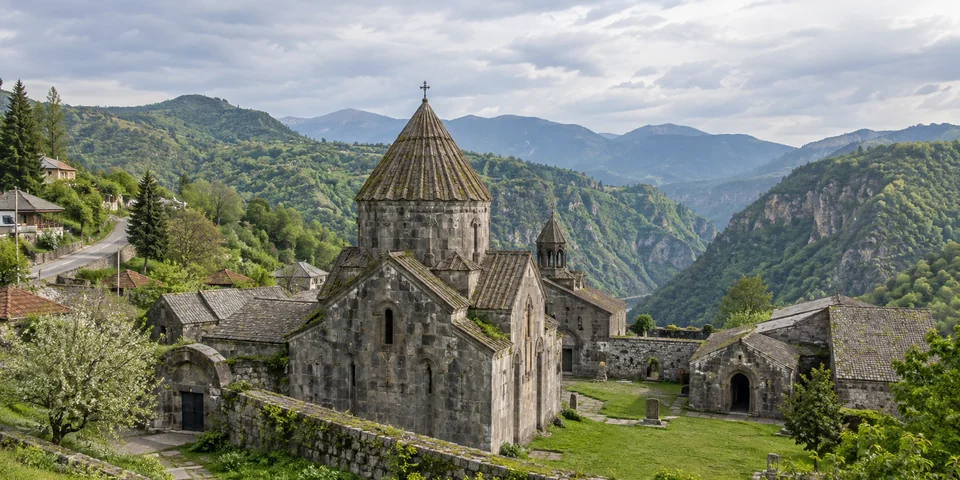
In brief: Two UNESCO-listed monasteries guard the rim of a gorge in Armenia's far north. The drive through the Debed Canyon from Vanadzor is one of the most dramatic in the Caucasus, with copper-mining towns, industrial ruins, and medieval stonework around every bend.
Northern Armenia has a different texture from the rest of the country. The pink tuff of Yerevan and the dark stone of Gyumri give way to something rawer here: steep forested gorges cut by the Debed River, flat-topped plateaus emerging from mist, abandoned Soviet factories rusting beside the water, and, on the canyon's upper rim, two of the finest medieval monasteries anywhere in the Caucasus.
Haghpat and Sanahin were Armenia's first UNESCO World Heritage Site, inscribed in 1996 and expanded in 2000. They date to the 10th century, represent the peak of Armenian ecclesiastical architecture, and sit 16 kilometres apart on opposite sides of the canyon. Visiting both in a single day by car is straightforward. Visiting them properly, with time to wander the grounds, study the carved stonework, and absorb the landscape, is one of the most rewarding experiences Armenia offers.
Use the route below to drive from Vanadzor through the canyon, visit Sanahin and Haghpat, and connect the monasteries with a wider Georgia-Armenia loop.
Getting to the Debed Canyon
From Vanadzor
Vanadzor, Armenia's third-largest city, is the natural base for exploring the canyon. The drive north to Alaverdi (the town between the two monasteries) takes about 75 minutes on a winding road that follows the Debed River downstream. The route is paved throughout but narrow in sections, with occasional construction zones where the highway is being upgraded.
From Yerevan, the drive to Vanadzor takes 2.5 hours on a good highway. From Tbilisi, allow about 3.5 hours via the Sadakhlo-Bagratashen border crossing. If you are driving between Georgia and Armenia with a cross-border rental car, the monasteries sit directly on your route and make a natural half-day stop.
From Tbilisi as a Day Trip
The monasteries are closer to Tbilisi than to Yerevan. A long day trip from Tbilisi is feasible: cross the border at Sadakhlo, drive to Haghpat (about 2.5 hours from the border), visit both sites, and return to Georgia the same evening. It makes for a full day but avoids the need to overnight.
Sanahin Monastery
Sanahin sits on a wooded plateau above the town of Alaverdi. The name translates roughly as "this one is older than that one," a reference to its founding before its sister monastery at Haghpat. Construction began in the mid-10th century under the patronage of Queen Khosrovanush, wife of King Ashot III.
The complex is larger than it appears from the entrance. Multiple churches, chapels, a narthex (gavit), a bell tower, and a scriptorium are clustered together and interconnected by covered passages. The main church, Surp Astvatsatsin (Holy Mother of God), was completed in 966 AD. The adjacent Academy, built in 1063, was one of the most important centres of learning in medieval Armenia.
The Library and Scriptorium
Sanahin's scriptorium is usually locked, but if the caretaker is present you can ask to have it opened. The interior contains remarkable stone shelving carved directly into the walls, where manuscripts were once stored and copied by hand. The oldest surviving Armenian-language codex was produced here. The room is small, dim, and extremely atmospheric.
Khachkars at Sanahin
Dozens of intricately carved cross-stones (khachkars) are scattered throughout the monastery grounds. These are among Armenia's most distinctive art forms. Each khachkar is unique, with geometric patterns, floral motifs, and religious scenes chiselled into volcanic basalt. UNESCO recognises the Armenian tradition of carving khachkars as an Intangible Cultural Heritage.
Sanahin Bridge
Below the monastery, a medieval humpback bridge spans the Debed River. Built in 1192, it is one of the finest surviving examples of Armenian bridge architecture. The single-arch stone structure has relief carvings of animals (cats and bulls) on its parapets. Access from the monastery requires a steep walk down; alternatively, drive through Alaverdi and approach from the riverside.
Alaverdi: The Canyon Town
Between the two monasteries, the town of Alaverdi straddles the Debed River at the bottom of the gorge. It is an old copper-mining settlement, and the remains of a large Soviet-era smelting plant still stand beside the water. The industrial ruins juxtaposed against forested canyon walls and medieval churches above create a visual contrast unlike anywhere else in Armenia.
Alaverdi also has a Soviet-era aerial tramway that once transported workers across the gorge to the mining complex. It is not always operational but is worth checking. A few basic restaurants in town serve home-style Armenian food at very low prices.
Mikoyan Brothers Museum
Near Sanahin, a small museum honours two brothers from the area who achieved prominence in the Soviet Union. Artem Mikoyan co-designed the MiG-21 fighter jet (a full-scale model sits outside the museum). His brother Anastas served as a senior Soviet politician for decades. The museum is modest but provides interesting local context. Entry is free or by donation.
Haghpat Monastery
Haghpat sits on a ridge at the northern edge of the canyon, overlooking the river from a height of about 1,000 metres. Founded in 976 AD, it was built over several centuries and reached its peak as a centre of manuscript production, music, and theology in the 12th and 13th centuries.
The main church, Surp Nishan (Church of the Holy Cross), dominates the complex. Its exterior is austere by Armenian standards, but the interior proportions are impressive, with a tall central dome supported by four massive pillars. Light enters through narrow windows high on the walls, creating a cool, contemplative atmosphere even on the hottest summer days.
The Gavit (Narthex)
Attached to the main church, Haghpat's gavit (completed around 1210) is one of the finest examples of this distinctly Armenian architectural form. Four massive columns support a vaulted ceiling with a central oculus that lets in a cone of natural light. The acoustics are remarkable. The gavit was used for assemblies, ceremonies, and as a gathering space for scholars and pilgrims.
The Bell Tower and Fortifications
A separate bell tower, built in 1245, stands at the edge of the complex. It offers panoramic views of the canyon and surrounding hills if you can gain access (ask the caretaker). The monastery's outer walls include defensive elements, including watchtowers, reflecting the turbulent periods when the canyon was contested between Armenian, Georgian, and Seljuk forces.
The Hamazasp Gallery
A covered two-storey gallery on the south side of the complex served as the monastery's refectory and library. The upper floor has carved window frames and stone benches where monks took meals overlooking the valley. It is one of the most photogenic corners of the entire complex.
Other Stops in the Canyon
- Akhtala Monastery: About 20 kilometres north of Haghpat, near the Georgian border. This 10th-century fortified monastery is notable for its exceptionally well-preserved Byzantine-style frescoes covering the interior walls, rare in Armenian churches. Worth the detour if time allows.
- Odzun Church: A 6th-century basilica just off the main highway between Vanadzor and Alaverdi. One of the oldest churches in the region, with unusual twin memorial stelae in the churchyard.
- Kobayr Monastery: Ruins of a 12th-century Georgian Orthodox monastery clinging to a cliff face above the highway near Tumanyan. Partially collapsed but dramatically sited, with traces of frescoes visible inside.
Driving Tips for the Debed Canyon
- Road conditions: The main highway through the canyon is paved but winding with tight curves. Side roads to monasteries (especially Haghpat) involve steep switchbacks. Any car handles the route, but a vehicle with decent ground clearance is more comfortable on the steeper access roads.
- Time needed: Allow a full day from Vanadzor to visit both monasteries, explore Alaverdi, and drive the canyon. Half a day is sufficient if you are passing through on the Tbilisi-Yerevan route and only want to see one monastery.
- Best time: May through October. The canyon is particularly atmospheric in spring when mist fills the gorge and the forests are vivid green. Autumn brings golden colours. Winter access is possible but roads can be icy on the steeper sections.
- Fuel and services: Fill up in Vanadzor or before entering the canyon. Petrol stations exist in Alaverdi but are limited. ATMs and basic supplies are available in Alaverdi and Vanadzor.
Combining with the Northern Armenia Loop
The Debed Canyon fits naturally into the classic northern Armenia driving circuit: Yerevan to Gyumri (2 hours), Gyumri to Vanadzor (1.5 hours), Vanadzor through the Debed Canyon (full day), then south to Dilijan and Lake Sevan before returning to Yerevan. The full loop takes 4 to 6 days at a comfortable pace.
For drivers coming from Tbilisi with a cross-border rental, the monasteries are a compelling first stop after crossing the border. Pick up in Tbilisi, drive to the canyon, overnight in Vanadzor, and continue south toward Lake Sevan and Yerevan the next day.
Sources
These official sources support the practical details in this guide. Recheck live schedules, prices, opening hours, and road conditions before you travel.
- Armenia Travel official destination guide - official destination information for Armenia, including cities, culture, food, and regional travel.
- Yerevan Transport official ticketing page - official Yerevan bus, trolleybus, and metro ticket options.
- UNESCO World Heritage Centre - official heritage-site listings and conservation context.