
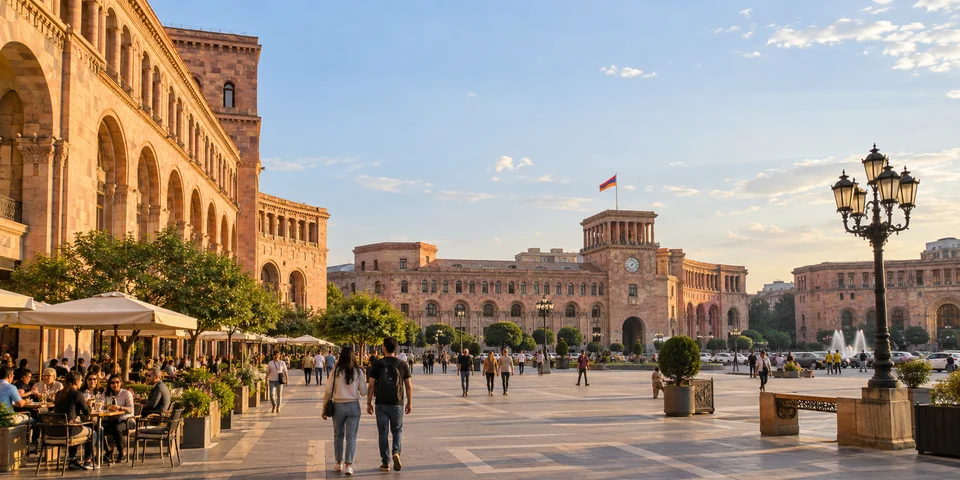
In brief: Armenia's capital is one of the oldest continuously inhabited cities on earth. Pink tuff-stone boulevards, a massive hillside staircase, excellent museums, and views of Mount Ararat make it worth at least two full days.
Yerevan does not look like what most people expect from a Caucasus capital. The city is compact, walkable, and built almost entirely from pink and orange volcanic tuff stone, giving it a warm glow that intensifies at sunset. Wide Soviet-era boulevards radiate from a central square. Parks and fountains fill every other block. And on clear days, the twin peaks of Mount Ararat rise above the rooftops to the southwest, impossibly close yet just across the border in Turkey.
The city is one of the oldest continuously inhabited settlements in the world. Its history stretches back nearly 2,800 years to the Urartian fortress of Erebuni. But modern Yerevan feels young and forward-looking, with a growing cafe culture, a craft beer scene, independent galleries, and some of the best food in the region.
If you are arriving from Tbilisi by rental car or on the overnight train, Yerevan makes a natural base for exploring Armenia. Most of the country's major sights are within a two-hour drive, so you can use the city as a hub for day trips and still have evenings free to eat, drink, and explore.
Start with the city highlights, then use the food, transport, and day-trip sections to turn Yerevan into an easy base for Armenia.
The Cascade Complex
The Cascade is Yerevan's most iconic structure: a monumental limestone staircase climbing the hillside in the northern part of the city. At the bottom, a sculpture garden features works by international artists including several large bronze pieces. At the top, you get one of the best urban panoramas in the Caucasus, with the city spread below and Ararat floating on the horizon.
You can climb the outdoor stairs (each tier is decorated with Soviet-era stone reliefs and fountains) or ride escalators through the interior, where the Cafesjian Center for the Arts occupies a series of gallery spaces. Several galleries are free to enter. The outdoor stairs are open around the clock.
For the best views of Ararat, arrive early in the morning. The sky tends to get hazy by midday, especially in summer. Spring and autumn mornings are the clearest.
Above the Cascade: Victory Park and Mother Armenia
From the top of the Cascade, a 20-minute walk through the upper city brings you to Victory Park, a large green space with an amusement park, an artificial lake, and the Mother Armenia statue. This 22-metre figure replaced an earlier Stalin statue in 1962 and stands on a hollow basalt pedestal that houses the Military Museum of Armenia (entry by donation).
Along the way you pass the October Revolution Memorial, a concrete plaza with a 50-metre obelisk built in 1967, and some impressive neo-Brutalist apartment blocks that are worth photographing.
Republic Square
The central square of Yerevan is surrounded by grand tuff-stone government buildings from the 1920s-1950s. In the evening, the musical fountains in the centre put on a colourful show. The History Museum and National Gallery occupy the building on the north side. The square is the natural starting point for exploring the city on foot.
The Matenadaran: Ancient Manuscripts
The Mesrop Mashtots Institute, universally called the Matenadaran, holds the world's largest collection of Armenian manuscripts: an estimated 23,000 documents plus half a million archival items. The building sits on the hillside behind the Cascade, and even if you skip the interior, the approach along Mesrop Mashtots Avenue is one of the city's best walks. The illuminated manuscripts on display are extraordinary. Open Tuesday to Saturday, 10am to 5pm, entry about 1,500 AMD.
The Armenian Genocide Memorial
Tsitsernakaberd, the national genocide memorial, occupies a hilltop west of the city centre. Twelve concrete slabs represent the lost Armenian provinces. An eternal flame burns at the centre, set 1.5 metres below ground. The adjacent museum traces the events of 1915 through documentary evidence, photographs, and survivor testimony. Entry is free. Allow at least two hours and be prepared for emotionally difficult content. This is an essential stop for understanding Armenia. See our complete memorial visiting guide for full details on what to expect, museum hours, and historical context.
Kond: The Oldest Neighbourhood
Yerevan does not have a preserved old town in the European sense, but the Kond district comes closest. This hillside neighbourhood of narrow lanes, weathered stone houses, and overgrown gardens sits on the western edge of the centre. It is not polished or tourist-ready, but it has real character and is excellent for photography. The small Saint Sarkis Cathedral, built from orange tuff, is the neighbourhood's anchor.
From Kond, a 500-metre pedestrian tunnel from the Soviet era cuts under the hill and emerges in Hrazdan Gorge, an unexpected green corridor along the river. The gorge contains a Soviet-era children's railway (still operational in summer), walking paths, and views up to the genocide memorial.
Where to Eat in Yerevan
Armenian food is rich, herb-heavy, and deeply underrated. Yerevan has excellent restaurants at every price point. A few categories worth seeking out:
- Lahmajun: Thin flatbread topped with spiced meat or vegetables. Several dedicated lahmajun restaurants operate in the city centre. Portions are generous and prices are low.
- Dolma: Grape-leaf-wrapped parcels of seasoned rice and meat. A national staple found on almost every menu.
- Khorovats: Armenian barbecue, typically pork or lamb skewered and grilled over charcoal. Best eaten at outdoor restaurants on warm evenings.
- Brandy tasting: The Ararat Brandy Factory on Admiral Isakov Avenue offers guided tours and tastings of Armenia's most famous export. The factory has been operating since 1887 and houses 15,000 barrels. Tours range from about 4,500 to 12,000 AMD depending on the tasting tier. Book ahead in summer.
- Wine: Armenia has a growing wine industry, and Yerevan's wine bars offer tastings of local varieties from Areni and other regions. Glasses start from about 800 AMD.
For coffee, the city has dozens of specialty cafes. Outdoor terrace culture is strong from April through October, and many cafes transform into cocktail bars after dark.
Best Day Trips from Yerevan by Car
Having a rental car in Yerevan opens up the entire country for day trips. Most major sights are within a 90-minute to 3-hour drive:
- Garni Temple and Geghard Monastery: A 1st-century Greco-Roman temple and a medieval monastery carved into a cliff face, both about 40 minutes east of the city. The two sites pair naturally and can be visited in a half day. Any car handles the road.
- Khor Virap Monastery: About an hour south, this monastery sits directly below Mount Ararat and offers the most dramatic views of the mountain anywhere in Armenia. Combine with a stop at the Areni wine region on the way back.
- Echmiadzin and Zvartnots: The Mother See of Holy Echmiadzin is one of the oldest cathedrals in the world. The ruins of Zvartnots Cathedral, with their ring of columns framing Ararat, are on the same road. Total drive time is about 40 minutes.
- Lake Sevan: Armenia's inland sea, about an hour northeast on the M4. Peninsula monastery, khachkar cemeteries, crayfish restaurants, and swimming from late June through August.
- Tatev Monastery: The iconic monastery reached by the "Wings of Tatev" cable car. It is a long day (4+ hours each way), but the route through the Vorotan Gorge is spectacular. Best done as an overnight if time allows.
- Haghpat and Sanahin: Two UNESCO-listed monasteries in the Debed Canyon in northern Armenia. About 3 hours each way. If you are driving to or from Georgia via the Tbilisi to Yerevan route, these are natural stops along the way.
We deliver cars free to anywhere in Yerevan and to Zvartnots Airport. Full off-road insurance options, roof tents, camping equipment, no deposit, and unlimited mileage. A Hyundai Tucson handles all the paved routes above. For rougher monastery access roads or mountain exploring, our 4x4 fleet is the better choice.
For artisan workshops, carpet dealers, and traditional craft stops along the way, see our Caucasus craft trail itinerary. For market and food exploration, check our GUM Market guide.
Getting to Yerevan
By Air
Zvartnots International Airport is 15 kilometres west of the city centre. Airlines including Wizz Air, FlyDubai, Qatar Airways, and Pegasus connect Yerevan to Europe and the Middle East. A taxi to the centre takes about 20 minutes. We offer car rental pickup directly at Zvartnots.
By Car from Tbilisi
The drive from Tbilisi to Yerevan takes 5 to 6 hours via the Sadakhlo-Bagratashen border crossing. The road is paved and in good condition throughout. We offer cross-border rental with all border documentation included, so you can pick up in Tbilisi and drop off in Yerevan (or vice versa) without paperwork hassles.
By Train
An overnight sleeper connects Tbilisi and Yerevan in about 10 hours. It runs every other night year-round and daily in peak summer. See our complete train guide for schedules, tickets, and what to expect.
Practical Tips
- Best time to visit: April to June and September to November. Summer (July-August) brings temperatures above 35°C. Winter is mild but grey, with daytime highs around 2°C in January.
- How many days: Two full days covers the major sights comfortably. Add one or two more for day trips. The city works well as a 3 to 5-day base.
- Safety: Yerevan has very low crime rates. It is considered safe for solo travellers, including women travelling alone. Standard city precautions apply.
- Currency: Armenian dram (AMD). ATMs are widespread. Cards are accepted at most restaurants and shops, though some smaller businesses are cash only.
- Language: Armenian. English is widely spoken in the centre, especially by younger people. Russian is also common.
- Driving in the city: Yerevan traffic is manageable but can be aggressive by European standards. Parking in the centre is available on-street and in paid lots. For day trips, having a car is far more efficient than public transport.
Sources
These official sources support the practical details in this guide. Recheck live schedules, prices, opening hours, and road conditions before you travel.
- Armenia Travel official destination guide - official destination information for Armenia, including cities, culture, food, and regional travel.
- Yerevan Transport official ticketing page - official Yerevan bus, trolleybus, and metro ticket options.