
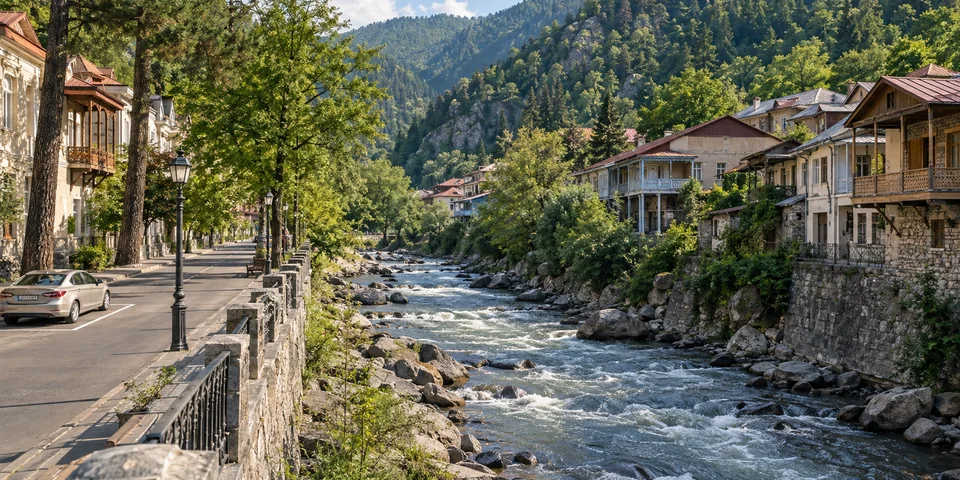
In brief: The complete guide to reaching Georgia's famous spa town from the capital. Compare trains, marshrutkas, private transfers, and rental cars with updated 2026 timetables and fares.
Borjomi has drawn visitors to its mineral springs and forested gorge since the days of the Russian Empire. Today the resort town remains one of the most popular day trips and weekend escapes from Tbilisi, thanks to its hot springs, hiking trails in Borjomi-Kharagauli National Park, a scenic cable car, and proximity to the Bakuriani ski resort.
The town sits 160 kilometres west of Tbilisi in the Samtskhe-Javakheti region. Driving takes roughly two to three hours on the main east-west highway, while the train is a slower but atmospheric alternative. Compare the 2026 options below by schedule, comfort, budget, and how much freedom you want after arrival.
Quick Comparison Table
| Transport | Duration | Cost (2026) | Best For |
|---|---|---|---|
| Private transfer | ~2 hours | From 200 GEL per car | Comfort and sightseeing stops |
| Rental car | 2-2.5 hours | From EUR 49/day + fuel | Flexibility and multi-day trips |
| Marshrutka | 2.5 hours | 12 GEL per person | Budget travellers |
| Train | 4 hr 15 min | 2 GEL per person | Scenic experience |
| Shared transfer | 2.5 hours | ~30 GEL per person | Solo travellers (summer only) |
Option 1: Rent a Car and Drive Yourself
Self-driving is hands down the best option if you want to stop along the way. The road from Tbilisi to Borjomi is fully paved, well signposted, and enjoyable to drive. You follow the main E60 highway westward past Mtskheta and Gori, then turn south at Khashuri and follow the Mtkvari River valley for the final 30 kilometres.
A standard sedan handles the route with no trouble. However, if you plan to continue to Bakuriani, explore the Samtskhe-Javakheti highlands, or venture into Borjomi-Kharagauli National Park on unpaved forest roads, a 4x4 gives you far more freedom. Our Toyota 4Runner and Jeep Wrangler are popular choices for this region. Browse the full 4x4 fleet in Tbilisi.
Fuel costs for the round trip are around 80 to 100 GEL depending on your vehicle. There are petrol stations along the highway and in Borjomi itself. We recommend downloading offline maps before you leave.
For travellers combining Borjomi with Kutaisi or Batumi, a rental car turns the trip into a multi-day western Georgia road trip. Check out our road trip itineraries for inspiration.
Option 2: Private Transfer
A private transfer is the most comfortable way to reach Borjomi without driving yourself. Door-to-door service starts from around 200 GEL per car, making it excellent value for two or more passengers splitting the cost.
The big advantage is flexibility. You can ask your driver to stop at Mtskheta to visit Svetitskhoveli Cathedral, swing by Gori to see the Stalin Museum, or detour to Uplistsikhe Cave City. At the turn-off for Borjomi, the town of Surami is famous for its fortress and nazuki sweet bread sold by roadside vendors.
Drivers are available round the clock. If you are arriving at Tbilisi Airport, you can arrange a direct transfer to Borjomi without going into the city first.
Option 3: Marshrutka Minivan
Marshrutkas are the go-to budget option for locals. They depart from Didube Bus Terminal in northern Tbilisi every hour on the hour from 8am to 7pm. The fare is 12 GEL per person and the journey takes roughly two and a half hours.
To find the marshrutka stand, take the metro to Didube station and exit into the market area. The terminal you need is Bus Station Nige, immediately on the left as you come through the last tunnel. Look for vans with "Borjomi" displayed on the windshield.
Vans leave early when they fill up, so arrive at least 30 minutes before the hour. In Borjomi, marshrutkas stop at Borjomi Bus Station in the southern part of town, but drivers will let you hop off at any point along the main road through town if you ask.
Fair warning: marshrutkas are cramped, and the driving style can be aggressive. If you are prone to motion sickness, consider a rental car or transfer instead. Read our full marshrutka survival guide for more tips.
Option 4: Train from Tbilisi Central Station
The Tbilisi to Borjomi train can be an economical public-transport option. Check the current schedule and fare with Georgian Railway before planning around it.
The train leaves Tbilisi Central Station at 6:25pm and arrives at Borjomi Parki Railway Station at 10:40pm. Heading back, the only return train departs Borjomi at 5:50am and reaches Tbilisi at 10:10am.
Tickets cannot be booked online. Buy them from the cash desk at the station on the day of travel. The train rarely sells out so there is no need to worry about availability. Payment is cash only.
The train itself has hard plastic seats and no air conditioning. It is atmospheric in a charming, old-school way, but it is not comfortable for the four-plus-hour ride. Make sure you arrive at Borjomi Parki station, which is a short walk from the town centre and Central Park, rather than the other Borjomi station which is further away.
For more Georgian rail tips, see our trains guide.
Option 5: Shared Group Transfer (Summer Only)
Between May and October, group transfer services run daily from Tbilisi to Borjomi. These shared vans depart at 8am and arrive around 10:30am. Hotel drop-off in Borjomi is typically included. Expect to pay around 30 GEL per person.
This is a solid middle ground between the marshrutka and a private car, especially for solo travellers who want something more comfortable without paying for an entire vehicle.
Getting Back: Borjomi to Tbilisi
All transport options work in reverse. Marshrutkas depart Borjomi Bus Station frequently throughout the day: 8am, 9am, 10am, 11am, 12pm, 1pm, 2pm, 3:30pm, 4pm, 4:45pm, 5:15pm, 6pm, and 6:30pm. Arrive 30 minutes early.
The only return train leaves Borjomi Parki Station at 5:50am. Private transfers can be arranged at any time.
If you have a rental car from us, you can drop it back in Tbilisi or arrange a different drop-off location like Kutaisi Airport or Batumi Airport.
Best Stops Between Tbilisi and Borjomi
If you are driving or have a private transfer, do not miss these stops along the highway:
- Mtskheta: Georgia's ancient capital, home to UNESCO-listed Svetitskhoveli Cathedral and Jvari Monastery. Just 20 minutes from Tbilisi. See our Tbilisi day trips guide.
- Uplistsikhe Cave City: A sprawling rock-hewn town dating back 3,000 years. Budget about one hour for a visit.
- Gori: Famous for the Stalin Museum and an imposing medieval fortress. A natural lunch stop.
- Surami: Climb the hilltop fortress and pick up fresh nazuki (sweet bread) from roadside stalls at the Borjomi highway turn-off.
Alternative Route via Kvemo Kartli
For adventurous drivers, there is a scenic alternative route that avoids the main highway entirely. Instead of heading west on the E60, you drive south through Kvemo Kartli and the Javakheti Plateau before approaching Borjomi from the south.
This route takes about five and a half hours but passes through some of the most dramatic and least-visited landscapes in Georgia. A 4x4 vehicle is recommended for parts of this route.
Reaching Borjomi from Other Cities
From Batumi
Borjomi is 275 kilometres from Batumi, roughly six hours by road. Direct marshrutkas are rare. You will likely need to change in Khashuri. Private transfers start from 270 GEL per car. Read our Tbilisi to Batumi transport guide.
From Kutaisi
Marshrutkas from Kutaisi to Akhaltsikhe pass through Borjomi. They run four times daily at 8:20am, 9:30am, 11:30am, and 1pm. The fare is 15 GEL, and travel time is about three hours. See our Kutaisi day trips guide.
From Kutaisi Airport
If you are flying into Kutaisi Airport, renting a car and driving to Borjomi is the easiest option. Check our Kutaisi Airport guide for details.
Continuing from Borjomi
Borjomi is a natural gateway to the wider Samtskhe-Javakheti region. With a rental car you can easily reach:
- Bakuriani: 30 minutes south, a popular ski resort in winter and hiking base in summer
- Vardzia Cave Monastery: One of Georgia's most spectacular sites, about two hours south
- Rabati Fortress in Akhaltsikhe: A beautifully restored multicultural fortress complex, one hour away
- Borjomi-Kharagauli National Park: Excellent multi-day hiking trails through old-growth forests
For the full list, read our Borjomi excursions and day trips guide.
Practical Tips
- Best time to visit: Borjomi is a year-round destination. Summer is busiest; spring and autumn offer beautiful foliage and fewer crowds. Winter pairs well with skiing in Bakuriani. Read our best time to visit Georgia guide.
- SIM card: Get a Magti or Geocell SIM for mobile data. See our SIM card guide.
- Travel insurance: Essential for any Georgia trip. See our insurance recommendations.
- Safety: The drive is safe and the road well maintained. See our Georgia safety guide.
- Budget: Borjomi is affordable. Budget 50 to 80 GEL per day for food and activities beyond transport. See our budget breakdown.
Pros and cons
Rental car or self-drive
- Pros: Best for flexible timing, scenic stops, luggage, and routes that continue beyond one town or viewpoint. Groups can share the daily cost instead of paying per seat on every transfer.
- Cons: One traveler needs to manage navigation, parking, fuel, and local road conditions. It is less useful if the whole day stays inside a walkable city center.
Marshrutka, minivan, or bus
- Pros: Usually the cheapest choice for a simple point-to-point journey. Works well when the plan follows a known route and does not need extra stops.
- Cons: Schedules, luggage space, comfort, and exact arrival points are less flexible. Some services leave when full or require a station transfer.
Train
- Pros: A calm scheduled option when the route is served by rail. Good for travelers who prefer not to drive or negotiate with drivers.
- Cons: Rail does not reach every village, trailhead, winery, or hotel area. Station transfers and ticket availability still need to be planned.
Sources
These official sources support the practical details in this guide. Recheck live schedules, prices, opening hours, and road conditions before you travel.
- Tbilisi Transport Company standard tariff - official Tbilisi metro, bus, minibus, and ropeway fare rules.
- Georgian Railway passenger ticket portal - official train ticket search and passenger schedule checks.
- Georgia Travel official destination guide - official country destination context for regions, cities, culture, and parks.
- National Parks of Georgia - official visitor information for protected areas and national parks.