
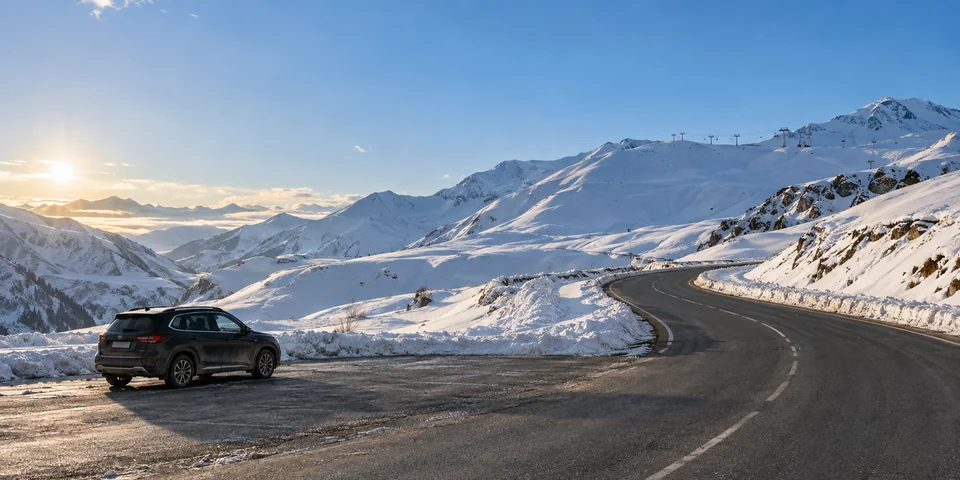
In brief: Private transfer, marshrutka, shared taxi, or self-drive? We break down every way to travel from Tbilisi to Gudauri with 2026 prices, schedules, and insider tips for the Georgian Military Highway.
Gudauri sits 120 kilometres north of Tbilisi along one of the most spectacular mountain roads in the Caucasus. Whether you are heading up for a week of skiing, a weekend of fresh air, or just passing through on your way to Kazbegi, the journey itself is half the adventure. The Georgian Military Highway climbs from the lowland plains through gorges, past medieval fortresses, and over the Jvari Pass at 2,395 metres before dropping you at the resort.
In good conditions, the drive takes around two hours. In winter, with freight traffic and snow, allow closer to three. There is no train service to Gudauri, so every option involves the road. Here is how each one stacks up.
The Route: What to Expect on the Georgian Military Highway
The road from Tbilisi to Gudauri follows the E117 north through Mtskheta, past Zhinvali Reservoir, and then climbs steeply through a series of hairpin turns. Along the way you will pass Ananuri Fortress, the Aragvi River valley, and eventually the ski resort perched on the southern slopes of the Greater Caucasus.
The highway is a single carriageway for most of the journey and shares the road with heavy freight traffic heading to and from the Russian border. Trucks sometimes park along the shoulder, narrowing the road. A new bypass tunnel is under construction and expected to open later in 2026, which should ease congestion significantly.
For a deeper look at every stop worth making on this drive, check our Georgian road trips guide.
Option 1: Self-Drive with a Rental Car (Our Recommendation)
For maximum flexibility, nothing beats having your own vehicle. You stop when you want, leave when you want, and can extend to Kazbegi, Truso Valley, or the Cross Pass viewpoints without negotiating with a driver.
Which Car to Choose
The road to Gudauri is fully paved, so a standard sedan handles it in summer. From November through April, however, we strongly recommend a 4x4 with winter tyres. The section between Zhinvali and Ananuri can be icy, and above the treeline conditions change fast.
Our top picks for the Gudauri run:
- Toyota 4Runner - the all-round mountain workhorse with proper ground clearance
- Jeep Wrangler - rugged, nimble, and handles hairpins with ease
- Toyota FJ Cruiser - compact 4x4 with excellent winter traction
- Chevrolet Suburban - best for groups with ski gear and luggage
Browse our full 4x4 rental fleet in Tbilisi or our Gudauri car rental page for current prices and availability.
Self-Drive Practicalities
- Cost: From EUR 49/day with us, full off-road insurance options, roof tents, camping equipment, no deposit, and unlimited mileage
- Delivery: Free to Tbilisi Airport or any hotel in the city
- Winter tyres: Fitted on all 4x4s from November to April at no extra charge
- Insurance: Full off-road coverage available at €35/day, ideal for mountain driving
- Fuel: Fill up in Tbilisi. There is a Wissol petrol station at Gudauri but fuel prices are higher
Before departing in winter, check the GeoRoad Facebook page for real-time highway status updates. The road is occasionally closed for a few hours after heavy snowfall or avalanche risk, usually at the Jvari Pass section above Gudauri.
Option 2: Private Transfer
If you do not want to drive yourself, a pre-booked private transfer is the most comfortable alternative. A driver meets you at your hotel or Tbilisi Airport, takes care of the mountain road, and delivers you door-to-door to your accommodation in Gudauri.
- Cost: From 180 GEL (approximately €60) per car for up to 4 passengers
- Duration: Around 2 hours in good conditions
- Sightseeing stops: Most drivers will stop at Ananuri Fortress, Zhinvali Reservoir, and the Friendship Monument if you ask
- Ski gear: Accommodated in the vehicle at no extra charge
The main drawback is cost. A transfer is a one-way trip, so you need to pay again for the return. If you are staying more than two days in Gudauri, renting a car ends up cheaper and gives you wheels for exploring the area.
Option 3: Marshrutka Minivan (Budget Option)
A marshrutka can be an economical way to reach Gudauri. Check the current departure point, schedule, and fare locally before travel.
How It Works
There is no direct Gudauri service. Instead, take a marshrutka bound for Stepantsminda (Kazbegi) from Didube Bus Station in northern Tbilisi. Reach Didube via the red metro line. Tell the driver you are going to Gudauri and they will drop you at the Wissol petrol station on the highway.
2026 Schedule and Fares
- Departures: 8am, 9am, 10am, 11am, 12pm, 1pm, 2:30pm, 3:30pm, 5pm, 6pm, 7pm
- Fare: 10 GEL to Gudauri (drivers may charge the full 15 GEL Kazbegi fare)
- Duration: 2.5 to 3 hours
- Booking: Not possible. Arrive 30 to 40 minutes early to secure a seat
VIP Mercedes minivans (30 GEL per person) also depart from Didube and are slightly faster and more comfortable.
The Honest Assessment
Marshrutky are cheap but come with trade-offs. Luggage space is minimal (skis ride on the roof). Drivers do not stop for sightseeing. The driving style on mountain roads can be aggressive. And in winter, the safety equation tips further against them. We never recommend marshrutka travel in the mountains for families with children or travellers with bulky equipment.
For full station details and tips, read our complete marshrutka guide.
Option 4: Shared Taxi
Shared taxis to Gudauri are available from Didube Bus Station. You share the car with three other passengers heading in the same direction.
- Cost: 40 to 50 GEL per person
- Duration: Around 2 hours
- Advantage: The driver takes you closer to your accommodation, not just the highway drop-off
- Disadvantage: You wait until the car fills, which can take anywhere from 15 minutes to over an hour
Getting Back: Gudauri to Tbilisi
The return trip mirrors your options. Private transfers work door-to-door. However, marshrutky coming down from Kazbegi are usually full by the time they reach Gudauri, so getting a seat is not guaranteed.
A handful of vans originate in Gudauri each morning. Ask your accommodation to call a driver and reserve a seat the day before. The main departure point is the small bus station near the Wissol petrol station on the highway.
The simplest return option? Drive yourself. Your rental car is waiting exactly where you parked it.
Road Conditions and Safety
Winter Driving (November to April)
The highway stays open throughout winter. Gudauri is a ski resort, after all, and freight trucks use the road year-round. Temporary closures (typically a few hours) occur after heavy snowfall, usually at the Jvari Pass above Gudauri. The road to the resort itself is generally accessible even when the pass closes.
Key winter driving tips:
- Winter tyres are essential. Our 4x4 rentals include them at no extra charge
- The stretch between Zhinvali Reservoir and Ananuri Fortress is the iciest section
- Carry a phone charger and keep your Georgian SIM card topped up for real-time road updates
- Consider our Full off-road insurance option (€35/day) which includes off-road and mountain coverage
Summer Driving (May to October)
The road is straightforward in summer, though it stays busy with trucks. Occasional mudslides after heavy rain can cause short closures. A standard car handles the paved road fine, but a 4x4 opens up side trips to Truso Valley and other off-road spots near Gudauri.
Sightseeing Stops on the Way
The Georgian Military Highway is one of the most scenic drives in the Caucasus. If you are driving yourself, do not rush through it. Here are the main stops between Tbilisi and Gudauri:
- Mtskheta - Georgia's ancient capital, a UNESCO World Heritage site just 20 minutes from Tbilisi
- Zhinvali Reservoir - turquoise waters surrounded by forested hills, excellent for photos
- Ananuri Fortress - a medieval castle complex overlooking the reservoir, free entry
- Pasanauri - where the white and black Aragvi rivers merge, and home to excellent khinkali restaurants
- Friendship Monument - the Soviet-era panoramic viewpoint with sweeping valley views
- Jvari Pass - at 2,395 metres, the highest point of the highway with dramatic mountain scenery
These stops add one to two hours to the journey but are the reason most travellers prefer self-driving over a marshrutka.
For a longer adventure, continue past Gudauri to Kazbegi and Gergeti Trinity Church. See our Tbilisi day trips guide for more ideas.
Cost Comparison: Which Option Wins?
Here is how the numbers work for a solo traveller, a couple, and a group of four:
Solo Traveller
- Marshrutka: check the current operator fare and departure point
- Shared taxi: 40 to 50 GEL
- Private transfer: 180 GEL
- Rental car: From EUR 49/day plus fuel (~30 GEL return)
Couple
- Marshrutka: 20 to 30 GEL total
- Shared taxi: 80 to 100 GEL total
- Private transfer: 180 GEL total
- Rental car: From EUR 49/day plus fuel (~30 GEL return) - with the bonus of having wheels in Gudauri
Group of Four
- Marshrutka: 40 to 60 GEL total
- Private transfer: 180 GEL total
- Rental car: From EUR 49/day plus fuel - clearly the best value, plus you keep the car
For stays longer than one night, the rental car wins at every group size. You get transport to Gudauri, transport around Gudauri, transport to sightseeing stops, and transport back, all for a single daily rate.
From Tbilisi Airport Directly to Gudauri
Many visitors fly into Tbilisi Airport and want to head straight to the slopes. Your options:
- Rental car pickup at the airport: We deliver to Tbilisi Airport for free. Your car is waiting when you land. This is the fastest independent option.
- Private transfer: A driver meets you in the arrivals hall and takes you directly to Gudauri (from 180 GEL)
- Marshrutka: Not available from the airport. You would need to take a taxi or metro to Didube station first
If arriving from Kutaisi Airport, there are direct shuttle buses to Gudauri during winter ski season (60 GEL, about 6 hours). See our Kutaisi Airport guide for details.
From Gudauri to Kazbegi and Beyond
Gudauri is only 40 minutes south of Stepantsminda (Kazbegi) by road. If you have a car, the natural extension is to continue north to see Gergeti Trinity Church, Truso Valley, and Dariali Gorge. Our Kazbegi excursions guide covers everything.
With a 4x4 from us, you can also drive to remote highland areas like Tusheti (summer only) or explore the Greater Caucasus at your own pace.
Pros and cons
Rental car or self-drive
- Pros: Best for flexible timing, scenic stops, luggage, and routes that continue beyond one town or viewpoint. Groups can share the daily cost instead of paying per seat on every transfer.
- Cons: One traveler needs to manage navigation, parking, fuel, and local road conditions. It is less useful if the whole day stays inside a walkable city center.
Shared taxi
- Pros: Often quicker than a scheduled minivan once the seats are filled. Useful for solo travelers who want a lower price than a private transfer.
- Cons: Departure time, space, and exact dropoff can depend on other passengers. Prices and meeting points should be checked on the day.
Marshrutka, minivan, or bus
- Pros: Usually the cheapest choice for a simple point-to-point journey. Works well when the plan follows a known route and does not need extra stops.
- Cons: Schedules, luggage space, comfort, and exact arrival points are less flexible. Some services leave when full or require a station transfer.
Private transfer or driver
- Pros: Door-to-door service is easier with luggage, children, late arrivals, or a one-way route. The driver handles navigation while you keep control over planned stops.
- Cons: It costs more than shared transport. After dropoff, you may still need a separate transport plan at the destination.
Sources
These official sources support the practical details in this guide. Recheck live schedules, prices, opening hours, and road conditions before you travel.
- Tbilisi Transport Company standard tariff - official Tbilisi metro, bus, minibus, and ropeway fare rules.
- Roads Department of Georgia restrictions - official road restriction and closure notices for mountain and highway routes.
- Georgia Travel official destination guide - official country destination context for regions, cities, culture, and parks.
- Wander-Lush Tbilisi to Sighnaghi and Telavi transport guide - local fare checks for Sighnaghi and Telavi shared taxis, marshrutkas, and private transfers.