
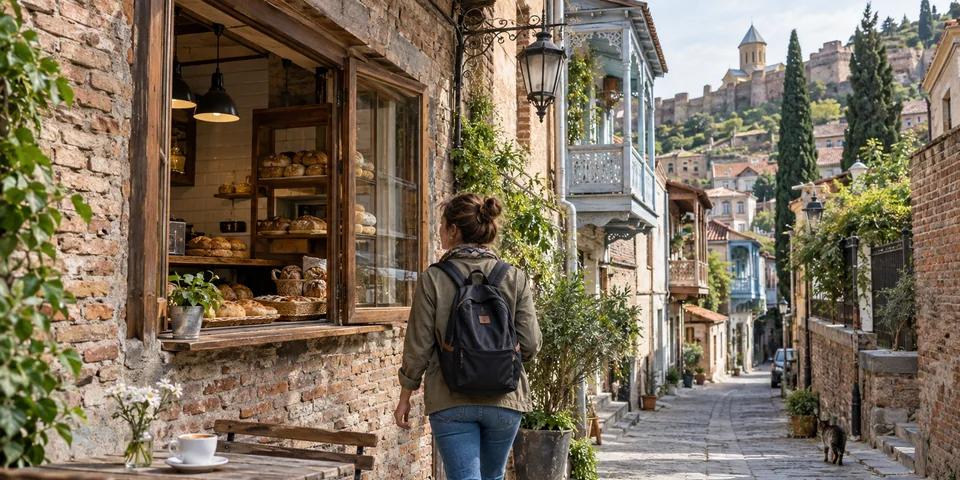
In brief: Practical tips covering money, transport, safety, road culture, and cultural etiquette to help you avoid the most common mistakes first-time visitors make in Georgia.
Georgia rewards the curious, the patient, and the flexible. It's a country where 8,000 years of winemaking coexist with cutting-edge street art, where a monastery perched on a cliff feels as natural as the traffic jam beneath it. But arriving without preparation can turn small surprises into real frustrations. Here are 20 things we wish every visitor knew before landing.
1. Always Use a Taxi App
Taxis in Georgia do not have meters. Fares are negotiated before you get in, which opens the door to inflated prices, especially at airports. Bolt is the standard rideshare app across Tbilisi, Batumi, and Kutaisi. Fares are transparent, payment is cashless, and you avoid any awkward bargaining. Never accept a ride from drivers soliciting inside airport terminals. If you're arriving at Tbilisi Airport or Kutaisi Airport, use the app or arrange a transfer in advance.
2. Get a Local SIM Card (Skip the Global eSIM)
Free Wi-Fi is everywhere in Georgia's cities, but a local SIM is essential if you plan to navigate with Google Maps, book Bolt rides, or drive a rental car. Georgian SIM cards from Magti cost about 10 GEL and come with unlimited 5G data for 10 GEL per week. Coverage in mountain areas is significantly better than international eSIM providers. Buy your SIM from a city branch rather than the airport kiosks, which charge more.
3. Cards Work in Cities, Cash Rules in Rural Areas
Contactless payments, including Apple Pay and Google Pay, are widely accepted in Tbilisi, Batumi, and other cities. Restaurants, hotels, and shops rarely have minimums or surcharges. However, guesthouses in smaller towns, market vendors, and car rental deposits often require cash. The Georgian lari (GEL) is the local currency. Use ATMs rather than airport exchange counters for the best rates. Basisbank and CartuBank ATMs typically have no withdrawal fees.
4. Georgia Is Not as Cheap as You've Heard
Prices have risen steadily since 2022. While Georgia remains excellent value compared to Western Europe, the old advice about rock-bottom budgets no longer holds, especially in Tbilisi and tourist hotspots. As a rough guide, expect to spend 25 to 40 USD per person per day on a budget, 50 to 70 for mid-range comfort, and 100 or more for upscale experiences. Food prices in particular have climbed 8 to 12 percent year over year.
5. Self-Driving Is the Best Way to See Georgia
Public transport between cities relies on marshrutka minivans, which are cheap but uncomfortable, and schedules are not centralized. Trains are pleasant but limited in coverage. For the flexibility to stop at viewpoints, visit monasteries on a whim, and reach mountain regions on your own schedule, renting a car is unmatched. If you're comfortable driving abroad and can handle unpredictable road behavior, self-driving opens Georgia completely.
We offer free delivery anywhere in Tbilisi, Batumi, and at both Tbilisi Airport and Kutaisi Airport. Full off-road insurance options, roof tents, camping equipment, no deposit required, and unlimited mileage included.
6. Add 20 to 30 Percent to Google Maps Drive Times
Georgia is small on a map, but distances are deceptive. Mountain roads wind endlessly, construction zones appear without warning, and livestock crossings are a regular feature. A drive that Google estimates at three hours will often take four. Plan your days with generous buffers, especially on routes through the Caucasus like the Georgian Military Highway or mountain passes to Tusheti or Svaneti.
7. Road Safety Requires Extra Attention
Speeding, aggressive overtaking, and passing on blind corners are unfortunately common. Road fatalities increased 20 percent in 2025. Seatbelts are only mandatory for front-seat passengers, but buckle up regardless. Avoid driving after dark on mountain roads, and never accept a ride if the driver seems impaired. When choosing transport providers or tour operators, prioritize safety credentials over low cost.
8. A 4x4 Is Essential for Mountain Roads
Georgia's most spectacular scenery sits at the end of unpaved mountain tracks. The Abano Pass to Tusheti, the road to Ushguli in Svaneti, and high passes in Racha and Khevsureti all require genuine 4x4 capability with high clearance. A standard sedan won't make it. Our 4x4 fleet includes the Toyota 4Runner, Jeep Wrangler, and FJ Cruiser, all with off-road insurance available.
9. Mountain Regions Have Short Access Windows
Tusheti, Khevsureti, and Upper Adjara are realistically accessible only from late June to early October. Even Svaneti and Kazbegi can be affected by sudden weather changes. Check road conditions before setting out. The reliable window for mountain road trips is July and August, though shoulder months work well for lower-altitude regions like Kakheti and Samtskhe-Javakheti.
10. The Best Time to Visit Is Not Summer
Peak summer brings heat, crowds, and inflated prices. Late spring (May after Orthodox Easter) and autumn (mid-September through October) are when Georgia is at its finest. Spring delivers wildflowers, mild weather, and empty trails. Autumn brings the wine harvest, golden light, and comfortable temperatures. For more on timing, see our seasonal planning guide.
11. Tbilisi Is Late to Rise
Mornings in Georgian cities are quiet. Banks open at 10am, most shops follow suit, and breakfast culture, while growing, is still not universal. Plan outdoor walks and sightseeing for the morning, save museums and galleries for the afternoon (most are closed on Mondays), and don't expect the city to fully wake up before mid-morning.
12. Tipping Is Appreciated but Not Mandatory
In restaurants and for private guides, 10 percent is considered polite if service is good, but no one will confront you for not tipping. Many restaurants add a 10 percent service charge to the bill. This is standard practice, not a scam, though it rarely reaches the staff directly. A small cash tip on top is appreciated. VAT is 18 percent and is included in menu prices.
13. Georgian Hospitality Works Differently Than You Expect
Georgia is famous for treating guests as a "gift from God," and that reputation is earned. But it doesn't look like Western-style service friendliness. Everyday interactions tend to be direct and reserved. Service staff rarely smile or make small talk. This isn't unfriendliness. Georgia's warmth shows up in incidental encounters, chance meetings, and gestures that feel genuine precisely because they're spontaneous. Give it time, be patient, and you'll experience it.
14. Georgia Is Physically Demanding
Expect uneven cobblestones, steep hills, and stairs without handrails, even in Tbilisi. Sidewalks can be broken or absent. If you're visiting monasteries, fortresses, or mountain villages, prepare for significant walking on rough terrain. Pace your days conservatively, especially in summer heat, and use taxis for longer city distances.
15. Don't Trust Google Maps Opening Hours
Businesses in Georgia change hours, close temporarily, or relocate without updating their Google listings. Facebook and Instagram are more reliable for checking if a place is actually open. Message ahead if a specific visit matters to you, and always have a backup plan.
16. Georgia Is Very Safe, but Stay Smart
Violent crime targeting tourists is extremely rare. Tbilisi feels safe at all hours. The biggest risks are taxi overcharging (use Bolt) and a known bar scam in Tbilisi and Batumi where a stranger invites you for drinks at an establishment that presents an outrageous bill. Avoid bars with no Google Maps presence or reviews. Police corruption is essentially nonexistent.
17. Book Your Rental Car 3 to 6 Months Ahead for Summer
Outside peak season, Georgia is wonderfully spontaneous. Accommodation and transport are easy to find at short notice. But in July and August, popular cars and mountain guesthouses book out fast. Reserve your rental car early for summer trips, especially if you need a 4x4. Train tickets should be booked as soon as they go on sale, usually three weeks in advance.
18. Cross-Border Trips to Armenia Are Easy
The Tbilisi to Yerevan route is a popular add-on. The border crossing is straightforward, and we prepare the required cross-border vehicle documents for travel into Armenia and back; always check the current border rules before departure. The journey takes about five hours and passes through beautiful scenery around Samtskhe-Javakheti. We also offer direct car rental in Yerevan and at Yerevan Airport.
19. Learn a Few Georgian Phrases
English is increasingly spoken in Tbilisi's tourist areas, but in smaller towns and rural Georgia, communication can be challenging. Learning "gamarjoba" (hello), "madloba" (thank you), and "gaumarjos" (cheers) goes a long way. Having Google Translate downloaded with the Georgian language pack is genuinely useful, especially when negotiating with guesthouse owners or asking for directions.
20. Georgia Rewards Flexibility
Plans change in Georgia. A road might be closed, a festival might appear, a guesthouse owner might invite you to dinner. The travelers who enjoy Georgia most are those who leave room in their itinerary for detours and surprises. Build buffer days into your trip, especially if you're heading to the mountains. The best moments in Georgia are often the ones you didn't plan.
Ready to Explore Georgia?
Start planning your trip with our complete Georgia destinations guide, check out our recommended road trip routes, or browse our full fleet to find the right car for your adventure. We deliver free across Tbilisi, Batumi, and both major airports. Full off-road insurance options, roof tents, camping equipment, no deposit, no hidden fees, and unlimited mileage.
Sources
These official sources support the practical details in this guide. Recheck live schedules, prices, opening hours, and road conditions before you travel.
- Roads Department of Georgia restrictions - official road restriction and closure notices for mountain and highway routes.
- Georgia Travel official destination guide - official country destination context for regions, cities, culture, and parks.