
In brief: The Caucasus breaks expectations: deep food traditions, comfortable city centers, generous hospitality, layered history, mountain roads, and planning details first-timers often underestimate.
There is a gap between what people expect from the Caucasus and what they actually encounter. Georgia and Armenia are ancient civilisations with their own scripts, their own churches, their own culinary traditions, and their own rules. First-time visitors usually need practical context as much as sightseeing ideas: road habits, cash, language, hospitality, and the cultural details that are easy to miss.
Two Countries, Two Completely Different Worlds
Grouping Georgia and Armenia together is convenient for trip planning but misleading for expectations. They share a border and a history of Soviet occupation, but nearly everything else differs. Languages use entirely separate alphabets. The churches (Georgian Orthodox vs Armenian Apostolic) split centuries ago. Georgian cuisine is cheese-and-herb driven; Armenian cooking leans toward grilled meat and preserved foods. Georgian social style is expressive and theatrical; Armenian temperament is more measured and direct.
Combining them in one trip makes logistical sense, since a rental car crosses the border easily. But visiting Tbilisi does not prepare you for Yerevan. Treat each country as its own destination.
Personal Safety Feels Easier Than Many Expect
Many visitors find central Tbilisi comfortable, including in the evening, but ordinary city awareness still matters. Watch your belongings in busy areas, use trusted transport, and avoid treating a relaxed atmosphere as a reason to stop paying attention.
Yerevan has a similarly calm public feel, with families in squares late into the evening. For most travelers, the bigger planning risks are mountain road conditions, weather, daylight, and unfamiliar driving habits rather than city safety. See our driving guide for road-specific details.
The Cuisine Outperforms Its Reputation
Georgian food is one of Europe's great undiscovered culinary traditions. Khinkali (soup dumplings), khachapuri (cheese bread in a dozen regional variations), pkhali (walnut-herb spreads), and churchkhela (grape-and-walnut candy) are starting points, not highlights. See our Tbilisi food guide.
Armenian food is equally impressive but entirely different. Flatbread, barbecued meat over vine cuttings, stuffed grape leaves, and spiced air-dried beef reflect a cuisine shaped by harsher climate and pastoral tradition. The GUM Market is the best place to experience it firsthand.
Both countries have winemaking traditions measured in millennia. Georgia's qvevri method (buried clay vessels) is 8,000 years old and UNESCO-recognised. Armenia's Areni grape, cultivated near the world's oldest known winery, is gaining international attention.
Faith Is a Living Force, Not a Heritage Label
Armenia became the world's first Christian nation in 301 AD. Georgia followed in 337 AD. In both countries, the church remains a living institution that shapes daily life, architecture, and national identity. People cross themselves from car windows when passing churches. Thousand-year-old monasteries hold daily services. Religious holidays, particularly Easter, are major national events.
Dress modestly at religious sites: cover shoulders and knees. Stay quiet during services. These are functioning places of worship, not tourist attractions with an entry fee.
The Past Is Not Past
Armenia's experience of the 1915 Genocide, which killed an estimated 1.5 million people, is not background reading. It is present in the Tsitsernakaberd memorial, in family conversations, in the fact that the global diaspora outnumbers the homeland population.
Georgia carries its own scars: Soviet occupation, the Abkhazia and South Ossetia wars of the 1990s, and the 2008 Russian invasion. The 1988 Armenian earthquake killed 25,000 and devastated Gyumri, which is still rebuilding. These are not distant events. People your age lived through them. Approach territorial disputes and geopolitical topics with care.
Language Barriers Are Lower Than Expected
In Tbilisi and Yerevan, most young people speak functional English. Hotel staff, restaurant servers, and car rental operators communicate comfortably. Russian was compulsory during Soviet times; English has replaced it as the preferred second language for younger generations.
In rural areas, English fades. Older residents often speak Russian. Download Georgian and Armenian for offline use in Google Translate. One practical note: both scripts are unique and unrelated to any other alphabet. You cannot sound out signs. Major road signs include Latin transliterations, which helps enormously when driving.
Hospitality Is Cultural Infrastructure
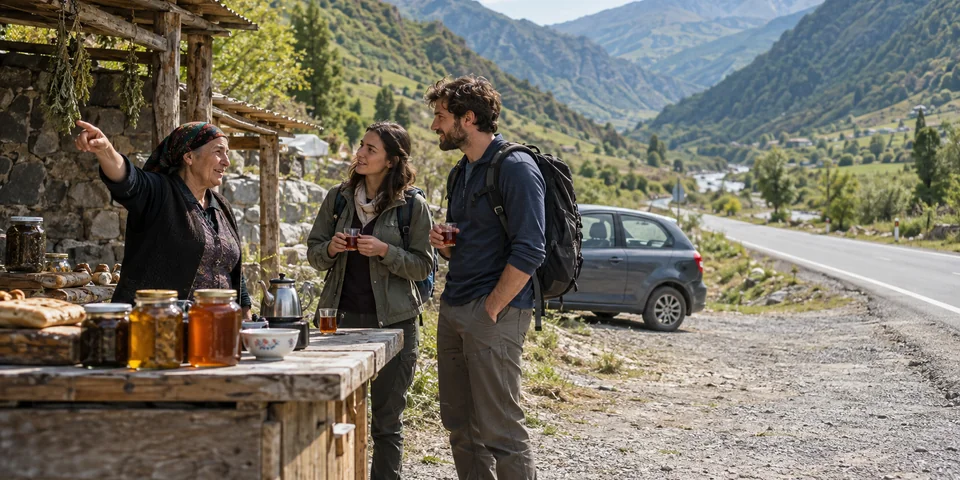
Caucasian hospitality is not exaggerated. In Georgia, the supra (feast) tradition treats guests as gifts from God. You may receive dinner invitations from strangers, wine from petrol station attendants, or fruit from vendors who refuse payment. Armenian warmth is quieter but equally real: restaurant owners who ask about your family, monastery caretakers who open up rooms for genuinely interested visitors.
This is not transactional. Accept graciously, eat what is offered, and show genuine interest in the people you meet. See our hospitality guide for how to navigate this.
Crossing Between Countries Is Simple (With Exceptions)
The Georgia-Armenia border at Sadakhlo/Bagratashen is open and straightforward. Most Western passport holders enter both countries visa-free (Georgia for 1 year, Armenia for 180 days). The crossing takes 30 to 60 minutes. Our cross-border rental includes all documentation.
The critical exception: Armenia's borders with Turkey and Azerbaijan are closed. Travelling between Armenia and Azerbaijan requires transiting through Georgia. Factor this into itinerary planning. See our Caucasus planning guide.
Keep Cash on Hand Outside the Capitals
Cards work in Tbilisi and Yerevan at hotels, restaurants, and shops. Outside the capitals, cash rules. Rural petrol stations, family guesthouses, roadside stalls, and markets all run on paper money.
Georgia uses the lari (GEL), Armenia uses the dram (AMD). ATMs are plentiful in cities. Exchange offices offer fair rates. Carry small denominations: breaking a 100-lari note at a village shop is often impossible.
A Car Helps Once You Leave the Main Corridors
Buses connect major cities, but the best experiences are off main routes. Georgia's road trips through Svaneti, Racha, and Tusheti rank among Europe's finest. In Armenia, the Debed Canyon drive to the northern monasteries is memorable.
A rental car provides freedom to stop at unmarked viewpoints and reach villages no bus serves. Standard sedans handle paved highways. Mountain passes, Tusheti, and off-road routes require a 4x4. See our guides on transport options and hiring a driver.
The Soviet Layer Is Inescapable
Both countries left the USSR in 1991. The evidence persists: Brutalist housing blocks, decommissioned factories, metro stations with marble and chandeliers. In Gyumri, Soviet housing neighbours 19th-century tuff-stone mansions. In Tbilisi, the Dry Bridge flea market mixes Soviet memorabilia with antique carpets.
Attitudes toward this period are layered. Some older residents recall the stability fondly. Younger people tend to view it as occupation. Approach with curiosity rather than assumptions.
This Region Recalibrates Expectations
Visitors to Georgia and Armenia often return for a mix that is hard to reduce to one reason: dramatic landscapes, ancient culture, memorable food, genuine warmth, and a sense of discovery. The region is more popular than it used to be, but many routes still feel personal when you give them enough time.
Sources
These official sources support the practical details in this guide. Recheck live schedules, prices, opening hours, and road conditions before you travel.
- Roads Department of Georgia restrictions - official road restriction and closure notices for mountain and highway routes.
- Georgia Travel official destination guide - official country destination context for regions, cities, culture, and parks.
- Armenia Travel official destination guide - official destination information for Armenia, including cities, culture, food, and regional travel.
- Yerevan Transport official ticketing page - official Yerevan bus, trolleybus, and metro ticket options.