
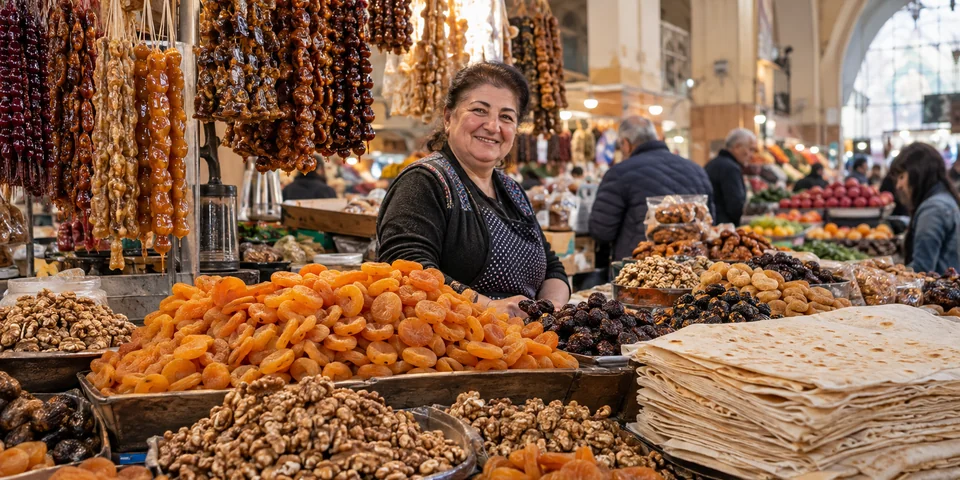
In brief: Yerevan's market culture runs on apricots, spiced beef, and bread baked in underground ovens. Whether you have 45 minutes between sights or a full morning to explore, here is where to eat, what to buy, and how to navigate the stalls like a local.
The best introduction to Armenian food is not a restaurant. It is a market stall where someone hands you a piece of candied apricot without asking and waits for your reaction. In Yerevan, that stall is almost certainly inside GUM, the city's largest indoor food hall, located a short walk south of the centre behind the massive Saint Gregory the Illuminator Cathedral. But GUM is only the starting point. Yerevan has a network of markets, each with its own character, and understanding how they fit together unlocks a side of the city that most visitors miss.
GUM: The Anchor of Armenian Food Culture
The name is a Soviet-era holdover (it abbreviates "State Universal Store" in Russian), but there is nothing institutional about the experience. GUM operates as a dense, two-level bazaar where the ground floor specialises in preserved and dried goods. The first thing you notice is colour: deep orange apricots, red sour cherry leather rolled into cylinders, dark strings of sujukh (Armenia's answer to Georgian churchkhela, made with walnuts dipped in thickened grape or pomegranate juice) hanging in tight rows from metal hooks. Vendors call out to you, offering tastes. This is standard protocol, not a sales tactic.
Deeper inside, the atmosphere shifts. The preserved food section gives way to a corridor of stalls selling Armenia's famous flatbread. The sheets are enormous, sometimes over a metre long, paper-thin, and baked in underground clay ovens called tonirs. UNESCO recognised this baking tradition as Intangible Cultural Heritage in 2014. If you arrive before mid-morning, you may catch the bakers at work. The dried version of this bread can be packed flat in luggage and rehydrated later with a damp cloth.
The Hidden Back Rooms
Most visitors see only the front section. But GUM has a second life behind narrow passageways that branch off the main hall. This rear area is where Yerevan does its actual grocery shopping. Stalls here sell seasonal vegetables arranged with geometric precision, bundles of fresh herbs tied with string, and an entire ecosystem of pickled and fermented foods: cabbage stacked in white towers, garlic cloves suspended in brine, peppers in every stage from fresh to deeply preserved. If you are staying somewhere with a kitchen, this section alone makes the trip worthwhile.
Seven Things Worth Buying (and Packing)
- Sujukh: Walnut strings coated in concentrated grape, pomegranate, or mulberry juice. Travel-friendly and unlike anything available outside the Caucasus.
- Sun-dried apricots: The fruit's Latin name (Prunus armeniaca) is a nod to its origins here. The flavour difference between these and supermarket imports is striking.
- Basturma: Air-cured beef coated in a thick paste of fenugreek, paprika, and garlic, sliced paper-thin. A signature Armenian protein.
- Ttu lavash (fruit leather): Rolled sheets of dried sour plum or apricot pulp. Eaten as a snack or dissolved in water for a tart drink.
- Spice mixes: Look for sumac, dried tarragon, barberry, and pre-mixed khorovats (barbecue) blends. Lightweight, packable, and genuinely useful in a home kitchen.
- Mountain honey: Syunik and Tavush region honeys are exceptional. Also look for rose petal jam and cornelian cherry preserves.
- Braided smoked cheese: Sold by the piece. Travels well for a day or two unrefrigerated.
For non-food souvenirs and a broader shopping strategy, see our Yerevan shopping guide.
Beyond GUM: Other Markets Worth Knowing
- Vernissage: Yerevan's famous weekend open-air market focuses on crafts, antiques, and handmade goods, but the periphery always has food vendors selling churchkhela, dried fruit, and seasonal produce. See our shopping guide for details.
- Neighbourhood bazaars: Smaller markets in the Arabkir and Malatia-Sebastia districts serve purely local customers. Prices are lower, English is rare, and the experience is entirely authentic.
- The Pak Shuka building: On Mashtots Avenue, this ornate Soviet-era structure with gilded facade motifs was once Yerevan's main covered market. It was controversially converted into a supermarket chain after independence, a decision that still generates strong feelings among residents. Worth seeing for the architecture, but the market experience has moved to GUM.
A Walking Route That Connects the Dots
If you have a half day in Yerevan, this 2.5-kilometre route links GUM with surrounding landmarks:
- Start at Republic Square. Walk south along Abovyan Street.
- Stop at the Blue Mosque on Mashtots Avenue (free entry, one of the city's oldest surviving buildings).
- Continue past the Pak Shuka facade on Mashtots.
- Visit Saint Gregory the Illuminator Cathedral (the largest Armenian church in the world, free entry).
- Enter GUM from behind the cathedral. Spend 45 minutes to an hour exploring and tasting.
- Return via metro from Zoravar Andranik station (two stops back to Republic Square, 100 AMD).
Logistics for Drivers
- Location: 35 Movses Khorenatsi Street, south-central Yerevan.
- Parking: Street parking on Khorenatsi and surrounding side streets. Central Yerevan parking is inexpensive.
- Hours: Officially 11:00 to 17:00, but stalls open earlier. Sunday mornings are the busiest and most atmospheric.
- Payment: Cash only at nearly all stalls. ATMs are within a 2-minute walk.
- Combining with day trips: GUM sits near the southern exit of Yerevan, making it a logical stop before driving to Khor Virap (40 min), Garni and Geghard (45 min), or Lake Sevan (1 hour north). See our monasteries guide for full routes.
For car rental options in Yerevan, see our Yerevan rental page or 4x4 rentals for mountain excursions. Arriving from Georgia? Check our cross-border rental.
Sources
These official sources support the practical details in this guide. Recheck live schedules, prices, opening hours, and road conditions before you travel.
- Armenia Travel official destination guide - official destination information for Armenia, including cities, culture, food, and regional travel.
- Yerevan Transport official ticketing page - official Yerevan bus, trolleybus, and metro ticket options.