
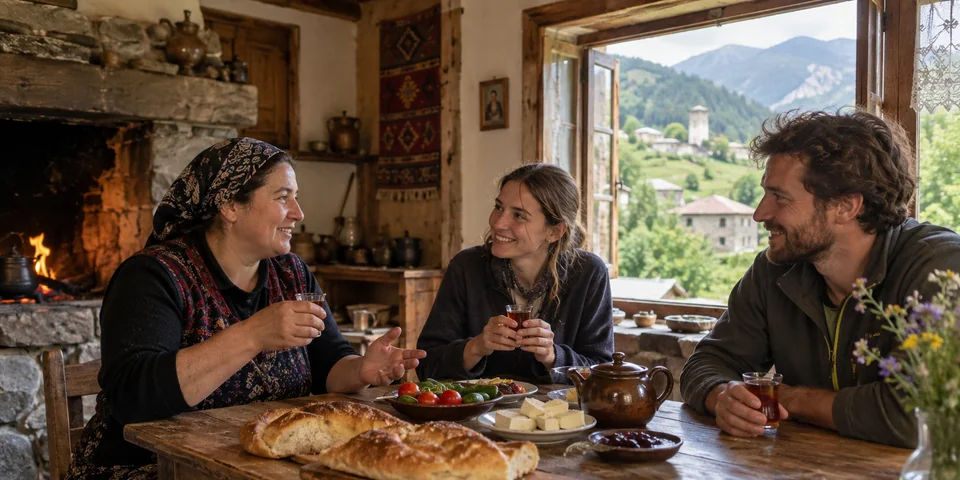
In brief: In the Caucasus, guests are considered a gift from God. This is not a marketing slogan. It is a cultural code that shapes every interaction you will have, from the petrol station attendant who gives you directions to the family who invites you to dinner. Here is what to expect and how to respond.
Every travel destination claims to be friendly. The Caucasus is different. In Georgia and Armenia, hospitality is not a personality trait. It is an institution, codified over centuries, embedded in language, religion, and daily custom. Guests occupy a specific and elevated position in both cultures, and the obligations that come with hosting are taken seriously in a way that visitors from Western countries rarely encounter.
This is not a romanticised travel essay. It is a practical guide to understanding what Caucasian hospitality actually looks like, why it exists, how to navigate it, and what it means for your trip. If you are planning your first visit to the region, understanding the hospitality culture will improve every interaction you have.
The Georgian Supra: More Than a Meal
The centrepiece of Georgian hospitality is the supra, a feast that follows a strict set of traditions. A supra is not just a large dinner. It is a ceremony with a tamada (toastmaster) who leads a sequence of toasts, each one building on themes of family, friendship, ancestors, the homeland, and God. The tamada's role is part poet, part philosopher, part entertainer, and refusing a toast is not really an option.
At a supra, the table will be covered with more food than the group can possibly eat. This is intentional. An empty plate is a sign that the host has not provided enough. Dishes arrive continuously: khachapuri, pkhali, lobio, grilled meat, fresh herbs, cheese, bread, and wine poured from clay pitchers. The wine is often homemade, fermented in qvevri (buried clay vessels), and served in quantities that would alarm a Western doctor.
If you are invited to a supra, you are being offered something meaningful. It is not casual. The host has prepared for it, the family is involved, and your presence is genuinely valued. Accept the invitation if you possibly can.
Armenian Hospitality: Quieter, Equally Deep
Armenian hospitality operates differently from Georgian hospitality but runs just as deep. Where Georgians tend to be theatrical and expansive, Armenians are more reserved and direct. The hospitality is less performative but no less sincere.
In Armenia, hospitality often manifests in practical gestures: a restaurant owner who personally drives you to a monastery because you mentioned wanting to visit; a market vendor who insists on giving you extra fruit because you are a guest in the country; a guesthouse host in Gyumri who asks about your family and genuinely wants to know the answer.
The Armenian tradition of hospitality is connected to a deeper cultural narrative about survival and community. As a small nation that has endured genocide, earthquake, and blockade, Armenians understand what it means to depend on the kindness of others. This awareness shapes how they treat visitors.
What Hospitality Looks Like on the Road
If you are exploring Georgia and Armenia by rental car, you will encounter hospitality in forms that no guidebook prepares you for:
- Directions that become escorts: Ask for directions in a village and there is a reasonable chance someone will get in their car and lead you there personally, waving you on from ahead.
- Roadside gifts: Stopping at a fruit stall or a churchkhela stand sometimes results in the vendor giving you something for free, simply because you are a guest in Georgia.
- Unsolicited help: If you look lost, someone will approach you. If your car looks stuck, someone will stop. This is not limited to tourist areas. It happens on mountain roads in Tusheti and on highway rest stops equally.
- Dinner invitations: Staying at a family guesthouse in Svaneti, Racha, or rural Armenia often includes being invited to eat with the family. These are not tourist experiences. They are real meals with real families, and they are often the most memorable part of a trip.
- The taxi driver code: When taking a taxi or shared car, drivers routinely go beyond the job description. They stop at viewpoints, explain local history, and make sure you are connected with onward transport at your destination. In Armenia, a taxi driver on the road to Tatev may insist on waiting while you explore, not for extra fare but because he feels responsible for your experience.
The Religious Foundation
In both Georgia and Armenia, hospitality has a religious dimension. The Georgian Orthodox tradition holds that every guest may be an angel in disguise, a belief rooted in biblical teaching about Abraham's hospitality to strangers. The Armenian Apostolic tradition carries similar themes of welcoming the stranger as a sacred duty.
This is not abstract theology. It shapes behaviour. When a Georgian family hosts you for dinner, they are not just being nice. They are fulfilling a spiritual obligation that connects their action to centuries of tradition. When an Armenian monastery caretaker opens a normally locked chapel for you, they are extending a welcome that has religious weight.
For visitors, understanding this context changes how you experience the hospitality. It is not quaint. It is not naive. It is deeply considered, and responding with genuine gratitude rather than tourist-grade politeness is appropriate.
How to Respond: A Practical Guide
Caucasian hospitality can be overwhelming for visitors from cultures where social interactions are more transactional. Here is how to navigate it:
- Accept what is offered. Refusing food, drink, or assistance can be perceived as rude. You do not have to eat everything or drink every toast, but accepting the gesture matters more than the quantity consumed. Take a bite, take a sip, and express genuine thanks.
- Bring a gift if visiting a home. Wine, chocolate, fruit, or something from your home country are all appropriate. The gift does not need to be expensive. The gesture is what counts.
- Show interest in the person. Ask about their family, their work, their village. Caucasian hospitality is relational, not transactional. Genuine curiosity is the most valued form of reciprocity.
- Learn the words. Gamarjoba (hello) and madloba (thank you) in Georgian. Barev (hello) and shnorhakalutyun (thank you) in Armenian. Using even basic local language signals respect and effort.
- Do not insist on paying. If someone gives you fruit, buys you a churchkhela, or refuses payment for a favour, do not force money on them. It diminishes the gesture. Accept it, thank them sincerely, and move on.
- Tip generously at restaurants. While informal hospitality should be accepted graciously, commercial establishments are where your money makes a direct difference. Ten to fifteen percent at restaurants is appropriate. See our responsible travel guide for more on supporting local economies.
- Reciprocate with time. The most valuable thing you can give a host is your presence and attention. Sit, talk, listen. Do not rush through a meal or a conversation because you have a sightseeing schedule. Hospitality in the Caucasus operates on a different clock.
The Supra Survival Guide
If you are invited to a Georgian supra, here is what to know:
- Pace yourself. A supra can last hours. The toasts are frequent and the wine is strong. It is acceptable to take small sips rather than draining your glass with each toast, though the tamada may encourage otherwise.
- Eat constantly. Food absorbs alcohol, and there will be plenty of it. The bread, cheese, and grilled meat are your best friends.
- Stand for important toasts. Toasts to the dead and to the motherland are typically given standing. Follow the lead of other guests.
- You may be asked to give a toast. If so, speak from the heart. It does not need to be long or eloquent. A sincere toast to your hosts, to Georgia, or to the friendship between your countries is perfect.
- Do not leave early. Leaving a supra before it naturally winds down can be seen as discourteous. If you absolutely must leave, explain why and thank the host repeatedly.
Where You Will Experience the Most Hospitality
Hospitality exists everywhere in Georgia and Armenia, but it is most intense in places where tourism has not yet created a transactional dynamic:
- Rural guesthouses: Tusheti, upper Svaneti, Racha, and Guria in Georgia. Dilijan, Goris, and the Debed Canyon in Armenia.
- Small-town restaurants: The family restaurants in Telavi, Tskaltubo, and Gyumri where the owner cooks, serves, and often sits down to talk.
- Monasteries: Armenian monasteries in particular often have caretakers who will spend 30 minutes showing you hidden details if you show genuine interest.
- On the road: Petrol station attendants, roadside vendors, and random passersby who notice your foreign plates and want to make sure you are having a good experience in their country.
A rental car is the best way to reach these places. Buses connect major cities, but the deepest hospitality happens in communities where public transport does not go. See our road trip guide for routes that take you through the most welcoming regions.
Sources
These official sources support the practical details in this guide. Recheck live schedules, prices, opening hours, and road conditions before you travel.
- Roads Department of Georgia restrictions - official road restriction and closure notices for mountain and highway routes.
- Georgia Travel official destination guide - official country destination context for regions, cities, culture, and parks.
- Armenia Travel official destination guide - official destination information for Armenia, including cities, culture, food, and regional travel.
- Yerevan Transport official ticketing page - official Yerevan bus, trolleybus, and metro ticket options.