
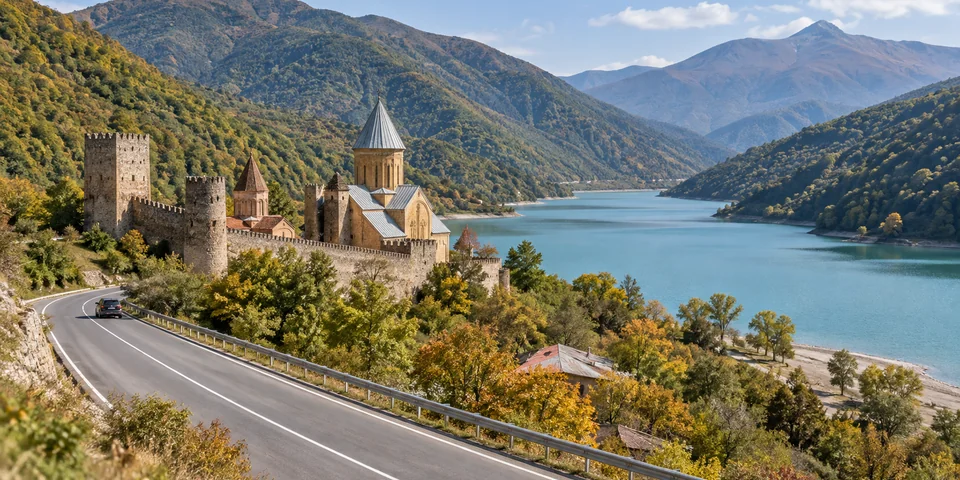
In brief: Two hundred kilometres of engineered switchbacks, ancient fortresses, and the Greater Caucasus rising on both sides. The Military Highway is Georgia's most famous drive and the one road every visitor should experience behind the wheel.
The Georgian Military Highway runs roughly 200 kilometres from Tbilisi north through the Greater Caucasus to the Russian border, passing through the town of Stepantsminda (commonly called Kazbegi) along the way. The road has existed in some form since the 1st century BC. It was formalised as a military route in the 1780s when Russian soldiers widened the ancient horse track into a proper highway, and later reinforced with iron bridges during the Russian Empire's annexation of Georgia.
Today it is a paved two-lane highway (designated E117) that climbs from Tbilisi's 500-metre elevation to the 2,395-metre Jvari Pass before descending into the Kazbegi valley. The route is generally maintained through the year, but the section between Gudauri and Stepantsminda can face temporary weather, avalanche, rockfall, traffic, or maintenance restrictions. Check current official status before departure.
This is the most popular drive in Georgia and the one we recommend to many first-time visitors. If you want to drive it yourself, focus on weather, truck traffic, fuel, daylight, and whether you plan to detour beyond Stepantsminda.
Why Drive It Yourself
The standard alternatives are marshrutka minibuses (cheap but no stops), shared taxis (limited flexibility), and organised day tours (fixed itinerary, large groups). All of these get you from Tbilisi to Kazbegi, but none of them let you control the experience.
With a rental car, you stop where you want, for as long as you want. You can pull over at unmarked viewpoints, linger at a fortress, eat lunch in a village restaurant, and detour to the Juta Valley if the mood strikes. The highway is well-maintained and well-signposted. Any confident driver who is comfortable with mountain switchbacks can handle it.
If you prefer not to drive mountain roads yourself, consider hiring a private driver for the day. This gives you the same flexibility without the stress of navigating hairpin turns with truck traffic.
- Tbilisi: Start north from the city and fill up before leaving.
- Zhinvali and Ananuri: Reservoir viewpoints and the 13th-century fortress, about 70 km from Tbilisi.
- Pasanauri: Practical lunch stop after Ananuri, known for khinkali.
- Gudauri: Mountain resort section before the highest pass.
- Jvari Pass: The highway reaches 2,395 metres, with the Friendship Monument viewpoint nearby.
- Stepantsminda and Gergeti: Kazbegi base town, with Gergeti Trinity Church above it at 2,170 metres.
Road Conditions and What to Expect
The highway is fully paved from Tbilisi to Stepantsminda. Road quality is generally good, with some rough patches and construction zones that shift annually. The surface narrows in several places, particularly through the avalanche galleries north of Gudauri, where concrete tunnels protect against winter slides. These galleries are single-lane in places, meaning you may need to yield to oncoming traffic (trucks always have priority by convention).
Key driving details:
- Distance: Approximately 155 km from central Tbilisi to Stepantsminda (the tourist-relevant section).
- Drive time: 3 to 3.5 hours without stops. With sightseeing, plan a full day (6 to 8 hours round trip).
- Fuel: Fill up in Tbilisi. There are petrol stations along the highway but selection thins after Gudauri.
- Altitude: The Jvari Pass reaches 2,395 metres. Temperature drops significantly at the summit, even in summer.
- Truck traffic: The highway is a major freight corridor between Russia, Georgia, and Turkey. Long queues of heavy trucks line the road, especially in winter when border delays back up for days. Give trucks wide clearance and be patient when overtaking.
- Speed: 60 to 80 km/h through most of the mountain section. Police speed cameras are active, particularly near villages.
For general driving advice in Georgia, see our complete driving guide.
Which Car Do You Need
A standard sedan handles the Military Highway comfortably in dry conditions (May to October). The road is paved throughout, so a regular rental car is perfectly adequate for a summer trip.
For winter driving (November to April), we strongly recommend a 4x4 with winter tyres. Snow and ice on the Jvari Pass section are common, and conditions can deteriorate rapidly. Winter tyres are legally required on this route from 1 December to 1 March.
If you plan to detour to the Juta Valley (a rough unpaved track branching east near Stepantsminda), a 4x4 is essential regardless of season.
The Route: Section by Section
Tbilisi to Ananuri (70 km, 1 hour)
The highway begins north of Tbilisi, passing through flat terrain and suburban sprawl before entering the Aragvi River valley. The first notable landmark is the Zhinvali Reservoir, a man-made lake created in 1986 when the valley was dammed. Pull over at the marked viewpoints for photos of the vivid blue water.
Ananuri Fortress sits on the reservoir's edge, 70 km from Tbilisi. This 13th-century defensive complex includes two churches, a watchtower you can climb for panoramic views, and remarkably detailed stone carvings on the Church of the Assumption (1689). The Georgian script carved into the facade is an older form of the alphabet. Entry is free. Parking costs 3 GEL (about EUR 1) in the main lot, or you can park for free on the road below the gates.
Ananuri is the most-visited stop on the highway and gets busy by mid-morning. Arrive early or visit on the return trip.
Ananuri to Gudauri (55 km, 1 hour)
After Ananuri, the road passes through Pasanauri, a small village famous as the birthplace of khinkali (Georgian soup dumplings). Several roadside restaurants compete for the title of best khinkali on the highway. Stop for lunch here. The dumplings are genuinely excellent and cost about 1 GEL each (EUR 0.35).
Beyond Pasanauri, the road begins climbing in earnest. Mineral springs bubble up alongside the highway, their iron-rich deposits painting the rocks in rust and orange. Locals fill bottles from these springs, which are considered therapeutic. The water is bubbly and strongly metallic.
The approach to Gudauri involves a series of tight switchbacks with increasing elevation. Gudauri itself is Georgia's premier ski resort, busy in winter but quiet in summer. The Gudauri to Kobi cable car operates in both seasons and offers views of Mount Kazbegi from above.
Gudauri to Stepantsminda (45 km, 1 hour)
This is the most dramatic section. Just past Gudauri, the Friendship Monument (a Soviet-era mosaic viewpoint built in 1983) offers a panoramic vista over Devil's Valley. The circular mosaic depicts scenes from Georgian and Russian history and is one of the most photographed landmarks in the country.
From here, the road crosses the Jvari Pass at 2,395 metres. In summer, the pass is a green corridor between snow-streaked peaks. In winter, the landscape is entirely white. Temperature at the summit can be 15°C colder than Tbilisi.
The descent into the Kazbegi valley passes through the village of Sno, where a collection of oversized stone heads (portraits of Georgian poets, carved by local artist Merab Piranishvili) sits in a field. A quick detour. Beyond Sno, the road follows the Terek River gorge into Stepantsminda, where Mount Kazbegi (5,047 m) dominates the skyline.
What to Do in Stepantsminda
The main attraction is Gergeti Trinity Church, a 14th-century stone church perched at 2,170 metres on a hilltop above the town, with Mount Kazbegi as its backdrop. You can hike up (about 1.5 hours each way) or drive a rough 4x4 track to the top (20 minutes). The views from the church are among the most iconic in the Caucasus.
Other activities from Stepantsminda include:
- Hiking to the Gveleti Waterfalls (30-minute walk from the road, 8 km north of town)
- Visiting the Dariali Monastery, a modern church built near the Russian border in a spectacular gorge
- The Juta Valley and Chaukhi Pass hike (requires a separate day and a 4x4 to reach the trailhead)
For a complete list, see our Kazbegi excursions guide.
Overnight or Day Trip?
A round trip in a single day is possible but rushed. You will spend 6 to 7 hours driving and have limited time for stops. We recommend two approaches:
- Day trip: Leave Tbilisi by 7:00 AM. Make stops at Ananuri and Pasanauri on the way up. Spend 2 hours in Stepantsminda (hike to Gergeti or drive up). Return via the Friendship Monument viewpoint. Arrive back by 6 to 7 PM.
- Overnight: Drive up at a relaxed pace with all stops. Stay one or two nights in Stepantsminda. Use the second day for Gergeti, Juta, or Gveleti. Return to Tbilisi on day two or three. This is the better option.
Guesthouses and hotels in Stepantsminda range from EUR 20 (family guesthouse) to EUR 80 (boutique hotel with Kazbegi views). Book ahead in July and August.
Seasonal Considerations
- May to June: Ideal conditions. Green valleys, wildflowers on the Jvari Pass, comfortable temperatures. Some snow may linger at altitude. See our spring guide.
- July to August: Peak season. Warm, busy, Gergeti hike at its best. Book accommodation early.
- September to October: Autumn colours in the Aragvi valley. Cooler temperatures at altitude. Quieter than summer.
- November to April: Winter driving conditions. Snow and ice on the Jvari Pass. Road closures possible (hours to days). 4x4 with winter tyres mandatory. Combined well with skiing at Gudauri.
Check road conditions before departure via GeoRoad's Facebook page or call the Roads Department Hotline at +995 322 313 076. See our month-by-month guide for broader planning.
Combining With Other Routes
The Military Highway connects naturally with several other drives:
- Kakheti wine region: A recently sealed road from Tianeti to Ninigori connects the Military Highway with Kakheti, letting you skip Tbilisi entirely when linking wine country with Kazbegi.
- Tusheti: From Stepantsminda, you can loop east through Alvani to the Abano Pass (Tusheti access road, open June to September, 4x4 only).
- Svaneti: Return to Tbilisi, then drive west to Svaneti for a comprehensive Greater Caucasus itinerary.
For a complete road trip strategy, see our Georgia road trips guide and itinerary planner.
Sources
These official sources support the practical details in this guide. Recheck live schedules, prices, opening hours, and road conditions before you travel.
- Tbilisi Transport Company standard tariff - official Tbilisi metro, bus, minibus, and ropeway fare rules.
- Roads Department of Georgia restrictions - official road restriction and closure notices for mountain and highway routes.
- Georgia Travel official destination guide - official country destination context for regions, cities, culture, and parks.