
In brief: Tbilisi bakes in summer. Here is how to structure your days around the heat, where to find relief underground and at altitude, and why escaping the city by car might be the smartest move you make.
Let us be direct: Tbilisi in summer is punishing. The capital sits in a valley hemmed by hills that trap hot air like a clay oven. By mid-July, the thermometer regularly touches 40°C, the asphalt radiates heat long after sunset, and the Mtkvari River shrinks to a sluggish ribbon. If you imagined strolling through the Old Town at noon in August, recalibrate. The city demands a different rhythm between June and August, one built around early mornings, strategic retreats underground or uphill, and well-timed escapes into the mountains.
Summer often provides wider access to Georgia's mountain landscapes, but weather, road works, and official restrictions can still affect individual passes and villages. The long days also allow more time for travel. Use Tbilisi as a launchpad, plan city days around the heat, and verify each mountain leg before leaving for cooler valleys, forests, and mountains.
What the Thermometer Actually Says
June eases in gently: the first half often feels like an extension of spring, with temperatures in the low to mid-20s and occasional rain. By late June, expect consistent 28-30°C days. Humidity is moderate, and evenings are pleasant enough for terrace dining.
July is the furnace. Average highs hover around 31-33°C, but multi-day streaks of 38-42°C are normal. The valley geography amplifies the effect: even at 33°C the enclosed air feels several degrees hotter. UV intensity is extreme. The upside is near-zero rainfall and maximum sunshine hours, if you can tolerate the exposure.
August mirrors July's heat profile but adds a cumulative exhaustion factor. The ground, walls, and pavement have been absorbing energy for weeks, and they radiate it back through the night. Minimum temperatures rarely dip below 22°C. Late August occasionally delivers brief thunderstorms that break the monotony without truly cooling anything down.
For a month-by-month breakdown across the entire year, see our complete seasonal guide.
Restructuring Your Day Around the Heat
The single most important adjustment is schedule. Locals who stay in Tbilisi during summer shift their entire social life to the evening: dinners at 10 PM, walks at midnight, cafés open until 2 AM. Mornings between 6 and 9 AM are your window for sightseeing on foot. The three-hour block from noon to 3 PM should be spent indoors, underground, or in water.
This schedule works beautifully with car travel. Leave the city at dawn, drive to a cooler destination, return after dark. A Hyundai Tucson with functioning AC is all you need for paved routes. For mountain escapes, a Jeep Wrangler or Toyota 4Runner opens up unpaved highland tracks that are only accessible in summer.
Going Underground: Tbilisi's Cool Cellars and Basements
Tbilisi was built on top of itself for centuries, and the result is a network of brick-vaulted cellars, caravanserai passages, and subterranean wine chambers that stay remarkably cool even when the surface broils. Several of these spaces now function as restaurants, wine bars, and museums.
The city's wine museum occupies the lower levels of an old palace, and spending two hours wandering its cool stone corridors is a genuine antidote to the midday blaze. Basement restaurants throughout Sololaki and Abanotubani serve traditional meals in spaces that have been naturally climate-controlled for centuries.
For a deeper look at Tbilisi's neighbourhoods and their character, see our dedicated guide.
Altitude as Air Conditioning: Day Trips That Drop the Temperature
The most reliable way to escape the heat is to gain elevation. Every 1,000 metres of altitude sheds roughly 6-8°C from the thermometer. Within a 90-minute drive of Tbilisi, you can reach terrain that feels like a different climate zone entirely.
Kojori and the Didgori Plateau
Just 30 minutes south of the city, Kojori sits on a forested ridge that catches breezes the valley floor never sees. Drive another 20 minutes and you reach the Didgori plateau, which in summer is carpeted with wildflowers and rarely exceeds 25°C. Pack a picnic. The views of the distant Greater Caucasus are extraordinary in clear weather.
Algeti National Park
An hour southwest of Tbilisi, Algeti protects dense mixed forests where marked trails follow shaded streams. The canopy blocks direct sun, and the air temperature under the trees is noticeably cooler than the trailhead parking area. Stick to the forest walks behind Manglisi, the exposed canyon at Birtvisi is scorching in summer.
The Saguramo Ridge and Tbilisi National Park
Northeast of the city, the forested hills of Tbilisi National Park offer half-day hikes that start from suburban bus stops. The Martkopi monastery trail is a reliable choice: partly shaded, modest elevation gain, and a destination with actual architectural interest.
For more structured itineraries around the capital, check our guide to day trips from Tbilisi.
Water: Lakes, Rivers, and Urban Alternatives
Tbilisi has three lakes within or near the city limits. Lisi Lake, above the Saburtalo district, is the most pleasant: small, backed by a mountain panorama, with bike paths and waterside cafés. The Tbilisi Sea (a reservoir, technically) has sandy stretches and watersports facilities, though water quality is variable. Turtle Lake is charming but tiny and gets very crowded on weekends.
For proper river swimming, drive 90 minutes north to Pasanauri, where the White and Black Aragvi rivers merge in a photogenic collision of dark and light water. Rafting outfitters operate from this area throughout summer, offering 75-minute guided runs that are suitable for beginners. The spray alone is worth the drive.
Closer to the city, Bazaleti Lake and Sioni Lake are both reachable within 90 minutes and offer quieter shorelines than anything inside Tbilisi proper.
Seasonal Food and Drink Worth Seeking Out
Summer transforms Georgian markets and restaurant menus. From late June, stalls overflow with berries, mulberries, blueberries, blackberries, sold by the kilogram for a fraction of what you would pay in western Europe. Stone fruit season follows: white peaches, apricots, and later figs appear in abundance. By August, watermelon vendors park Lada cars with their boots open, selling chilled melons straight from the cool water tap.
Georgian lemonade, nothing like the sugary Western version, is the essential summer drink. It is made from sparkling mineral water, fresh fruit (tarragon, pear, or cherry), mint, and ice. Every restaurant makes its own version, and it is genuinely refreshing in a way that sugary alternatives never achieve.
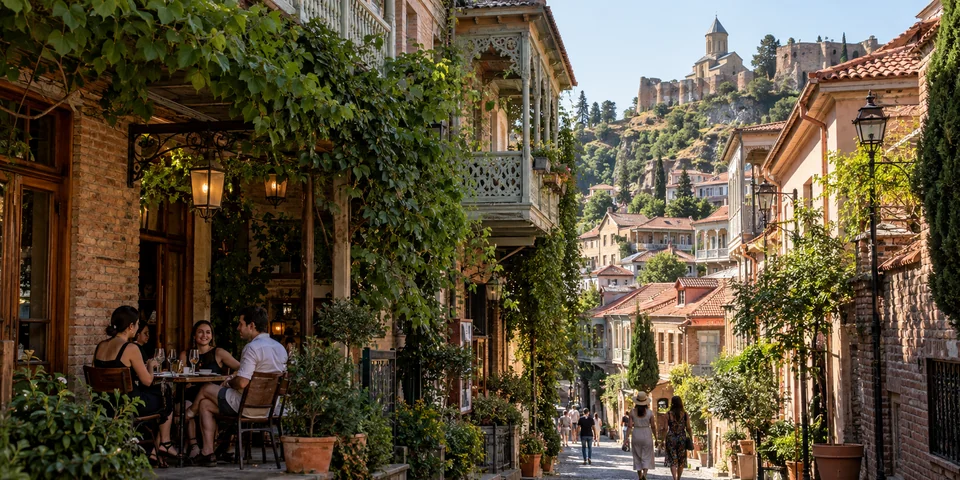
Courtyard restaurants come into their own in summer. Vine-draped terraces in the Old Town serve seasonal menus that lean on fresh herbs, cold yoghurt sauces, and grilled vegetables. Reservations are advisable for popular spots, especially on Friday and Saturday evenings. For restaurant recommendations, see our Tbilisi food guide.
Summer Festivals and Cultural Events
July brings the Art-Gene Festival to the Open Air Museum of Ethnography near Turtle Lake, a multi-day celebration of Georgian folklore, regional wine-making, and traditional dance. The national ballet Sukhishvili typically performs a short summer residency at outdoor venues during the same month, and tickets sell out within hours of being announced.
Early June hosts WinExpo, the only international wine and spirits fair in the South Caucasus, held at Expo Georgia. It is open to the public and functions as an all-you-can-taste event with hundreds of producers from across Georgia and the wider region.
Throughout the summer, street food markets pop up at parks and along Rustaveli Avenue, organised by local collective STALL. Evening food markets in particular are worth visiting, they run late, temperatures are bearable, and the range of regional Georgian cuisine on offer is extensive.
For a full calendar, see our festivals guide.
Using Tbilisi as a Summer Launchpad
A strong reason to visit Tbilisi in summer is what lies beyond the city. Summer typically provides the broadest window for reaching Georgia's mountain regions, yet no season guarantees access to every pass, track, or village. Weather, maintenance, and restrictions can change quickly, so check the Roads Department of Georgia and other relevant official authorities before each mountain leg.
Tusheti
The Abano Pass is a highly demanding seasonal mountain road whose access window depends on current conditions and official restrictions. Beyond it lies Tusheti, a highland region of stone tower villages, alpine meadows, and shepherd culture. Confirm that a 4x4 rental, the driver, and the route are eligible before travel, and check the current official road status.
Svaneti
The Svaneti road trip often has a broader access window in July and August. Conditions on the Mestia-Ushguli route can still change after weather or road works, so verify current status and vehicle suitability rather than relying on a fixed opening date.
Kazbegi and the Military Highway
The Georgian Military Highway is generally maintained through the year, but temporary weather, avalanche, traffic, or maintenance restrictions can occur in any season. Summer often brings drier conditions and green mountain scenery. Check current official status before departure; the Kazbegi excursion guide covers the route in more detail.
Racha and Oni
Georgia's least-visited mountain region, Racha, is at its best in summer. The Shaori Reservoir is warm enough for swimming, the forested valleys are lush and deeply green, and the whole region receives a fraction of the tourist traffic that Svaneti and Kazbegi absorb.
For a broader overview of multi-day driving routes, see our road trips guide.
Practical Notes for Summer Visitors
- Accommodation: Summer is peak season. Book hotels and guesthouses at least two weeks in advance, especially in mountain areas where capacity is limited.
- Transport: The Tbilisi-Batumi train sells out days ahead in July and August. Book early or consider renting a car for flexibility.
- Clothing: Lightweight, loose fabrics. Long sleeves protect against UV better than sunscreen alone. Churches require covered shoulders and knees regardless of temperature.
- Hydration: Carry water constantly. Dehydration sneaks up fast in Tbilisi's dry heat. Pharmacies sell electrolyte sachets cheaply.
- Driving: AC is essential, confirm your rental car has functioning climate control. Avoid leaving anything in a parked car; interior temperatures can exceed 60°C within minutes. For road condition tips, see our driving guide.
- SIM card: Get a local SIM for navigation and checking road conditions in real time. Our SIM card guide covers the process.
- Insurance: Mountain driving is inherently riskier. Review our travel insurance recommendations before heading to highland areas.
The Best Car for Summer in Georgia
Your choice depends entirely on your itinerary. If you are staying on paved roads around Tbilisi, Batumi, Kutaisi, and Kakheti, a crossover like the Hyundai Tucson is comfortable and more than adequate.
If mountain regions are on your list, compare a Jeep Wrangler, Toyota 4Runner, or Chevrolet Suburban for groups. Summer often brings wider mountain access, but route eligibility, vehicle availability, current road status, pickup or drop-off, insurance options, and add-ons must be confirmed for the booking.
Sources
These official sources support the practical details in this guide. Recheck live schedules, prices, opening hours, and road conditions before you travel.
- Tbilisi Transport Company standard tariff - official Tbilisi metro, bus, minibus, and ropeway fare rules.
- Roads Department of Georgia restrictions - official road restriction and closure notices for mountain and highway routes.
- Georgia Travel official destination guide - official country destination context for regions, cities, culture, and parks.