
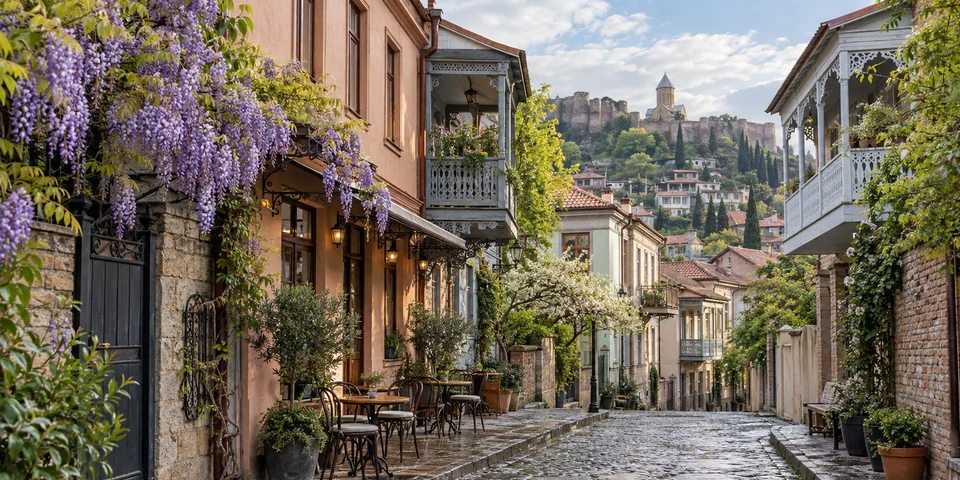
In brief: Wisteria-covered balconies, midnight Easter candles, bazaar strawberries, rooftop wine bars, and the year's best light for photography. A month-by-month breakdown of what makes Tbilisi irresistible in spring.
There is a window each year when Tbilisi sheds its grey winter skin and becomes something entirely different. The transformation is gradual: a magnolia tree erupts outside a neighbourhood bakery, a café drags its tables onto the pavement, purple vines appear overnight on a rusty balcony railing. By May, the entire city smells of tarragon and wet stone.
Spring shoulder season delivers the best of Tbilisi without the heat, dust, or crowds of summer. But it is also the city's most temperamental period. March can dump sleet and sunshine in the same afternoon. May is statistically the wettest month. The reward for packing an umbrella? Blossoms, festivals, seasonal food that only appears for a few weeks, and a city that feels like it is waking up.
Spring changes quickly in Georgia, so plan around the month you are actually visiting: March can still feel wintry, April brings blossoms and Easter traditions, and May is the greenest month for city walks and lowland road trips.
The Case for a Spring Visit
Tbilisi in spring offers mild walking temperatures (13-25°C depending on the month), shorter queues at attractions, lower hotel rates compared to summer, and seasonal food and wine events concentrated in April and May. It is the best window for urban hiking, with clear skies that reveal the Caucasus peaks beyond the city. The trade-off is unpredictable weather and the fact that high-altitude mountain destinations remain closed until June.
For a broader country-wide perspective, see our month-by-month guide to the best time to visit Georgia.
March: Winter's Last Stand
Daytime highs around 13°C, lows near 4°C, roughly 8 rainy days. March is genuinely unpredictable. One morning you are walking in sunshine past almond blossoms; by afternoon a cold wind has swept in from the north and you are reaching for your scarf. Occasional snow is not unheard of.
The final two weeks bring the first real colour. Magnolia trees in Rike Park and 9 April Park flush pink. Peach and plum blossoms dot the Old Town. The Japanese Garden inside the National Botanical Garden shows its first sakura flowers. But this is still firmly coat weather, especially after dark.
Holidays: Mother's Day (March 3) and International Women's Day (March 8) are both public holidays. Museums and government offices close, but restaurants and shops stay open. On Women's Day, you will see men across the city carrying bouquets for the women in their lives.
April: The Showstopper Month
Highs reach 19°C, lows around 8°C, approximately 11 rainy days. Early April is the most photogenic time to visit Tbilisi. This is peak wisteria season. Purple cascades drape over fences, balconies, and drainpipes across the Old Town. The vine at Queen Darejan's Palace convent garden is a local favourite. Rustaveli Avenue transforms when the trees and garden beds come alive.
Café terraces reopen, outdoor markets pick up pace, and the city's food scene shifts into a lighter, greener register. Rain is more frequent than March, arriving in sudden downpours that clear quickly.
Holidays: National Unity Day (April 9) commemorates the 1989 Tbilisi Massacre. Orthodox Easter falls on April 10-13 in 2026, bringing four consecutive public holidays and the city's most atmospheric religious traditions.
May: The Wettest, Busiest, Best
Highs hit 25°C, lows 14°C, around 12 rainy days. May is paradoxical: statistically the rainiest month but also the most eventful. Wine festivals cluster in early May, poppies bloom on the hillsides above Narikala Fortress, and the city pulses with energy ahead of Independence Day.
With 14-15 hours of daylight, you can pack an enormous amount into each day. The rain actually works in Tbilisi's favour, clearing the valley of summer dust and pollution. Skies after a May shower are strikingly clear.
Holidays: National Day of Georgian Wine (May 8, new for 2026), Victory Day (May 9), Saint Andrew's Day (May 12), Day of Family Purity (May 17), Independence Day (May 26).
Blossoms and Where to Find Them
Late March: Magnolias, Almonds, and Fruit Trees
Rike Park's magnolias against the modern architecture of the Peace Bridge. The small cluster of fruit trees outside neighbourhood cafés in Kala. 9 April Park near Orbeliani Bazaar. The Botanical Garden's main entrance, where a canopy of white and pink extends along the pathways.
April: Wisteria Takes Over
The entire Old Town is draped in purple. Key spots include the convent garden at Queen Darejan's Palace, Telegraph Dead End in Sololaki, and the streets behind the Academy of Sciences on Rustaveli Avenue. The Botanical Garden's main entrance hosts a particularly impressive vine.
May: Poppies and Wildflowers
Red poppies appear on Sololaki Ridge near Narikala Fortress, mixed with dandelions and wild grasses. The Kojori trail (an easy day hike from the city) produces chamomiles, wild orchids, and even edible wild asparagus in the undergrowth.
Easter Week in Tbilisi
Georgia's Easter is the country's most important religious holiday. In the weeks before Holy Week, markets and bazaars fill with colourful dyes, bundles of madder root, and wheatgrass pots. The dyes are for colouring eggs; the wheatgrass symbolises new life. On Palm Sunday (Bzoba), stalls outside churches sell boxwood branches for blessing.
The centrepiece is Litonioba, the midnight service held from approximately 11 PM on Holy Saturday through the early hours of Easter Sunday. The Holy Fire, transported from Jerusalem, is ceremoniously presented. The largest mass takes place at Sameba Cathedral, but smaller neighbourhood churches offer a more intimate experience. Worshippers carry votive candles and circle the church building.
Many Tbilisians leave the city from Good Friday through Easter Monday to visit family in rural villages. The capital becomes unusually quiet. Some smaller restaurants close for the long weekend. For more, see our Easter in Georgia guide.
What the Markets Are Selling
The Dezerter Bazaar, Tbilisi's main produce hub, is a year-round destination but transforms in spring. Look for:
- Alucha: Tiny sour green plums that appear from April. Used fresh in salads or cooked into tkemali sauce
- Fresh tarragon: Sold in enormous bundles from April. The essential herb for chakapuli stew
- Malina martskvi: Miniature "raspberry strawberries" that arrive mid-spring. Intensely sweet, dirt cheap (3-5 GEL/kilo), but spoil within hours
- Jonjoli: Pickled bladdernut buds, a spring staple served as a side dish
- Paska: A special Easter cake similar to panettone, available in bakeries and supermarkets from weeks before Holy Week
For a more raw experience, the Navtlughi Bazaar and its Barakholka section (second-hand market) sell everything from Soviet-era enamel signs to vintage pottery.
Spring on the Table
The Stew Everyone Waits For
Chakapuli is Georgia's definitive spring dish: lamb or veal braised slowly with white wine, unripe sour plums, and enormous quantities of fresh tarragon. Traditionally an Easter preparation, it appears on menus from April. Some restaurants now offer a vegetarian version with mushrooms. Try it at Kakhelebi or any Kakhetian-focused restaurant in Tbilisi.
Wine Straight from the Clay
Spring is when winemakers crack open clay qvevri for the first taste of last year's vintage. Wine bars like 8000 Vintages and Nino Meris Wine Selection pour new-season amber wines by the glass. The Zero Compromise Natural Wine Festival (May 1-2, 2026) and the New Wine Festival (May 9, 2026) are the biggest ticketed events, with bottomless tastings and live music. A brand-new public holiday, the National Day of Georgian Wine, will be celebrated for the first time on May 8, 2026.
Courtyard Season Opens
From mid-April, restaurants open their outdoor areas. Mova Maisi ("May Will Come"), Restaurant Littera, and Ninia's Garden all offer dining under blossoming trees and budding grape vines. Rooftop bars along the Mtkvari River come alive after sunset.
Unexpected Ice Cream
The Cone Culture's Ajika-Vanilla flavour is a spicy-cool combination that captures Tbilisi's culinary playfulness. Udabno Shop's vegan almond soft serve uses ingredients from their regenerative farm in Kakheti.
Walking the City's Hills
Tbilisi is built into a river valley surrounded by forested hills, and spring is the ideal season for walking them. The most popular urban route connects Turtle Lake to Mtatsminda, winding through forest with panoramic viewpoints over the city. The recently relaunched Mtatsminda cable car offers a shortcut up from Rustaveli Avenue.
Vake Park, the city's largest, has new walking paths and recreation areas. Nearby Mziuri Park features contemporary sculptures and the Fragments of Memory installation: Soviet-era stained-glass panels that catch spring light beautifully. Above Vake Park, the Open Air Museum of Ethnography preserves traditional Caucasus dwellings transplanted to the capital.
For book lovers, spring brings open-air book vendors to Rustaveli Avenue. Some wheel in wooden bookshelves, others spread volumes across park benches. Browse Georgian, Russian, and English titles in the sunshine.
When It Rains
Sulfur Baths
A traditional kisi scrub at one of the historic Abanotubani bathhouses is the practical spring deep clean. The contemporary Lisi Bath on Lisi Lake's shore offers a Scandinavian-style alternative with private and public rooms.
Museums Worth the Detour
The Georgian National Museum on Rustaveli Avenue covers the full sweep of Caucasus history. New for 2026: Art Foundation Anagi in Vake (cartography and modern art) and the reopened National Palace Museum. Unexpected picks include the State Silk Museum, the Museum of Georgian Medicine in Chugureti, and the Art Palace.
Café Culture
Tbilisi's specialty coffee scene is excellent. Eari Books of Spring in Sololaki doubles as a bookshop. Coffee LAB at Lisi Lake and Slink inside Roses Park both have attractive outdoor spaces for when the rain clears.
Spring Day Trips by Car
Udabno and the Rainbow Mountains
The semi-desert landscape southeast of Tbilisi comes alive in early spring with almond and cherry blossoms. By summer it is too hot. Spring is the window for exploring the Davit Gareji monastery complex and hiking the mineral-painted hills.
Kakheti Wine Country
Visit Sighnaghi without summer crowds. Admire blooming gardens at Bodbe Convent. If lucky, witness the ceremonial opening of a clay qvevri at a family vineyard and taste wine that has not yet been bottled.
Gurjaani Peach Orchards
Between late March and early April, the peach orchards around Gurjaani explode into flower. Several farms welcome visitors for photos and pop-up lunches beneath the blossoms. The window is narrow: flowers come and go in days.
Marneuli Poppy Fields
An hour south toward the Azerbaijan border, Marneuli's wild poppy fields bloom in late April and carpet the landscape through May. Combine with a visit to Bolnisi and Dmanisi for wine and archaeology.
What to Wear and Carry
- Lightweight layers: jeans, long-sleeved shirt, denim jacket or light shell
- A fold-up travel umbrella and lightweight raincoat (carry both daily from April)
- Comfortable dark-coloured walking shoes. Avoid white: they will get muddy
- One warmer layer for evenings: a cardigan, scarf, and sunglasses
- Check the forecast before flying. Late cold snaps in March and early April catch visitors off guard
For the full seasonal checklist, see our Georgia packing list.
Getting Around
For more spring inspiration beyond Tbilisi, browse our complete guide to spring in Georgia, our region-by-region guide, or our winter guide if you are comparing seasons.
Sources
These official sources support the practical details in this guide. Recheck live schedules, prices, opening hours, and road conditions before you travel.
- Tbilisi Transport Company standard tariff - official Tbilisi metro, bus, minibus, and ropeway fare rules.
- Georgia Travel official destination guide - official country destination context for regions, cities, culture, and parks.