
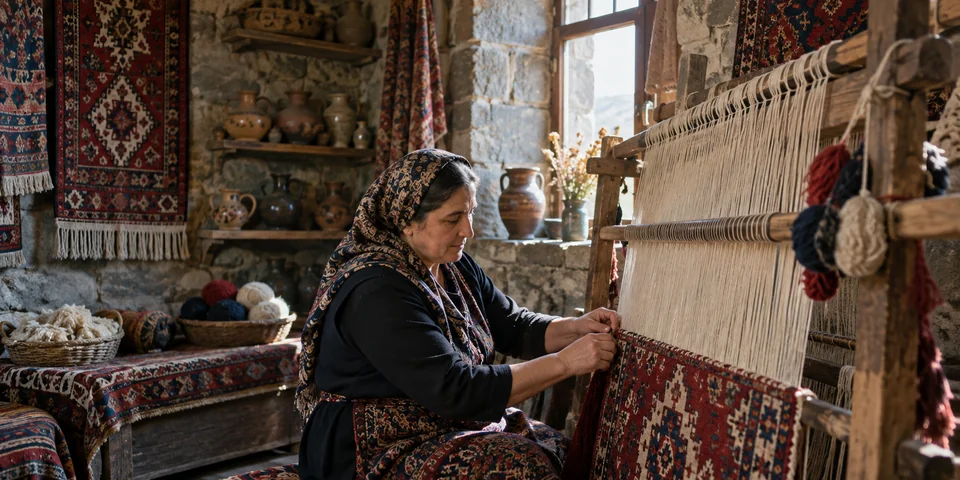
In brief: From hand-knotted carpets in Tbilisi's old quarter to embroidered velvet in Yerevan's workshop studios, the Caucasus holds one of Europe's most underrated craft traditions. This driving itinerary connects the best places to watch, learn, and buy.
The Caucasus sits at a crossroads where Persian, Ottoman, Byzantine, and Silk Road influences converge. The result is a craft tradition that is varied, deeply rooted, and still very much alive. Unlike museum-piece heritage that exists only behind glass, the traditional crafts of Georgia and Armenia are practiced in active workshops, sold in open-air markets, and woven into everyday domestic life.
Follow a craft-focused route from Tbilisi carpet shops and blue tablecloth makers to Kakheti wool workshops, Svaneti weaving, Tusheti carpets, and Yerevan studios. The itinerary runs from Tbilisi to Yerevan, but each stop also works as a standalone day trip.
Tbilisi: Where Every Street Has a Carpet
Start in Tbilisi's old town, where antique carpet dealers have occupied the same stone-walled shops for decades. The streets around Erekle II and Shardeni are lined with rugs hung on walls and draped over balconies. Some are genuine Caucasian antiques (wool pile, geometric motifs, 50+ years old). Others are newer reproductions or imports. The key difference is texture: hand-knotted originals have irregular density on the reverse, while machine-made versions are perfectly uniform.
Beyond carpets, Tbilisi holds several craft-focused sites worth visiting:
- The State Silk Museum on Tsabadze Street occupies a building that once served as the Caucasian Sericulture Station, established in 1887 during the Russian Empire to research regional silk production. Georgia had an endemic mulberry species and a climate suited to silk cultivation, making it the only country in the Caucasus with a significant silk industry. Exhibits include cocoons, natural dye pigments, and samples from across the Silk Road. The building itself, with original wooden fittings and cabinets, is worth the visit.
- The Ethnography Museum on the hill above Vake Park reconstructs traditional houses from every Georgian region. Inside many of them you will find working looms, folk costumes, and examples of regional weaving styles that vary dramatically between highland and lowland communities.
- Dry Bridge Market operates daily but expands on weekends. It is primarily a flea market (Soviet memorabilia, paintings, antique silverware), but patient browsing turns up kilims, embroidered textiles, and occasional finds of genuine craft value. Prices are negotiable.
Allow a full day in Tbilisi for the craft circuit. Parking is available near Meidan Square. See our day trips guide for combining craft visits with other Tbilisi activities.
Georgia's Blue Tablecloths: A Lost Art Returning
Georgia has a signature textile that exists nowhere else: the lurji supra, or "blue tablecloth." These indigo-dyed cotton cloths were once found in every household in eastern Georgia. The technique involves transferring designs onto fabric using carved wooden blocks and cold-vat dyeing. Patterns reference domestic life: knives, forks, animals, and paisley-like flourishes arranged in symmetrical grids.
Production peaked in the 17th and 18th centuries around Tbilisi, Gori, and Telavi. The craft survived industrialisation (factories replaced hand-blocks with silk screens), but collapsed entirely after the Soviet Union dissolved. In 2010, researchers at the Tbilisi State Academy of Arts began recovering the original blockprinting methods. Their contemporary versions, sold in gift shops around the capital, are faithful to the originals in colour and pattern but use modern cotton.
If you find a lurji supra with a cotton tag bearing the maker's name, it is likely from this revival project. An authentic piece makes an exceptional souvenir: flat, lightweight, packable, and genuinely unique to Georgia.
Kakheti: Felt, Wool, and Wine Country Workshops
Drive east from Tbilisi into Kakheti (1.5 hours on the main highway) and the craft landscape shifts from urban antique dealers to rural producers. Kakheti's connection to textiles is rooted in its agricultural economy: sheep farming supplied wool, and the region's relative prosperity under medieval Georgian kingdoms funded decorative arts.
- Sighnaghi: This hilltop town overlooking the Alazani Valley has a natural wine restaurant that doubles as one of eastern Georgia's best carpet galleries. The collection includes antique Caucasian rugs sourced from families across the region. Prices are available on request. Sighnaghi itself, with its 18th-century walls and views of the Caucasus range, justifies the 1.5-hour drive from Tbilisi.
- Felt workshops near Telavi: Several small workshops around Kakheti's capital produce traditional Georgian felt (nabadi). The felting process involves layering raw wool, wetting it, and rolling it by hand until the fibres lock together. Nabadi cloaks were worn by Georgian shepherds for centuries as waterproof outerwear. Contemporary versions include wall hangings, rugs, and bags.
A Kakheti craft and wine loop works perfectly as a 2-day itinerary from Tbilisi. See our Kakheti transport guide for driving details.
Svaneti: Mountain Weaving at 2,000 Metres
If you are heading into Svaneti for the towers and the trekking, add the Svaneti Museum of History and Ethnography in Mestia to your itinerary. This is a excellent institution that covers every aspect of Svan culture, including weaving traditions shaped by centuries of geographic isolation. The textiles here have a character entirely different from lowland Georgian craft: bold, high-contrast patterns in black and bright colours, reflecting a mountain aesthetic that favours drama over subtlety.
Svaneti requires a 4x4 for the Mestia to Ushguli section. The museum is in central Mestia and open daily.
Tusheti: Where Carpet Tradition Started
Georgia's premier carpet-weaving tradition comes from Tusheti, the remote mountain region accessible only by one of Europe's most challenging roads (open June to October). Tushetian weavers from villages like Omalo are considered the country's master craftspeople. Their rugs use geometric patterns and natural dyes derived from local plants.
Visiting Tusheti for craft alone is impractical (the road takes 4+ hours from Telavi in a capable 4x4), but if you are already planning the drive for the scenery, seek out family workshops in Omalo and Dartlo. The experience of watching a rug take shape at 2,000 metres, surrounded by stone towers and sheep pastures, is unlike any craft encounter you will have elsewhere. See our Tusheti transport guide.
Crossing Into Armenia: Yerevan's Craft Scene
Cross the border at Sadakhlo/Bagratashen (our cross-border rental handles the paperwork) and drive south to Yerevan. Armenian craft traditions overlap with Georgian ones in material (wool, silk, natural dyes) but differ sharply in aesthetics. Armenian design draws heavily on Christian iconography: the intricate carved cross-stones (khachkars) found at every monastery inspire embroidery, carpet motifs, and metalwork throughout the country.
Vernissage Market
Yerevan's enormous open-air market operates on weekends with a smaller daily section. The eastern edge of the market is where you find carpets, kilims, and embroidered textiles alongside woodwork, pottery, and obsidian jewellery. Quality and provenance vary, so inspect pieces carefully. The best strategy is to visit early, browse slowly, and compare before buying. See our Yerevan shopping guide for more detail.
Megerian Carpet Museum and Workshop
This family-run operation has been producing Armenian carpets since 1917, with showrooms in Yerevan and internationally. The Yerevan location functions as both workshop and museum: you can watch weavers at active looms and browse a collection of antique pieces that documents Armenian carpet traditions across centuries. Guided tours are available. This is the single best place in Armenia to understand the country's carpet heritage in depth.
Armenian Embroidery: Marash Work
Armenia's most distinctive textile tradition is Marash embroidery: intricate geometric patterns of interlocking crosses stitched onto dark velvet. The technique traces back to the Armenian city of Marash (now Kahramanmaraş in Turkey) and was carried by survivors of the 1915 Genocide into the diaspora and back to the homeland. Several social enterprises in Yerevan employ artisans producing contemporary Marash-inspired pieces, supporting women-led cooperatives in rural Armenia.
Social Enterprise Craft Shops
Armenia has a strong social enterprise scene connecting traditional craft to international markets. Shops on Isahakyan and Abovyan streets sell Fair Trade embroidery, upcycled textile products, felt goods, and ceramics produced by rural cooperatives and refugee artisans. Purchases from these shops directly fund community development programmes. This intersection of craft and social impact is one of the most compelling reasons to buy in Armenia rather than importing.
What to Buy and How to Get It Home
- Small carpets and kilims: Roll tightly and pack in checked luggage. Most sellers will vacuum-wrap them for free. Lightweight kilims (flat-weave, no pile) pack more compactly than knotted rugs.
- Lurji supra tablecloths: Virtually weightless when folded. The best Georgian souvenir by effort-to-impact ratio.
- Felt products: Nabadi bags and wall hangings compress well but are bulkier than textiles. Consider shipping for larger pieces.
- Embroidered items: Armenian Marash work on velvet, Georgian cross-stitch on cotton. Small pieces (cushion covers, framed samples) are the most practical size for travel.
- Pottery: Georgian black clay pottery from Shrosha (near Kutaisi) is beautiful but fragile. Wrap heavily or ask the shop to ship.
For a broader overview of what to buy and where, see our Yerevan shopping guide and food markets guide.
Driving Logistics for the Craft Trail
- Total route: Tbilisi → Kakheti → Tbilisi → (optional: Svaneti or Tusheti) → Yerevan. Minimum 5 days at a comfortable pace.
- Car type: A standard sedan handles Tbilisi, Kakheti, and the highway to Yerevan. For Svaneti or Tusheti side trips, switch to a 4x4.
- Border crossing: Georgia to Armenia at Sadakhlo takes 30 to 60 minutes. Our cross-border rental includes all documents.
- Best season: May to October for full access including mountain roads. Tbilisi and Yerevan craft shops operate year-round. See our seasonal guide.
- Budget: Craft purchases range from EUR 5 (small embroidery) to EUR 500+ (quality antique carpet). Market prices are generally fair. See our budget guide.
Sources
These official sources support the practical details in this guide. Recheck live schedules, prices, opening hours, and road conditions before you travel.
- Tbilisi Transport Company standard tariff - official Tbilisi metro, bus, minibus, and ropeway fare rules.
- Roads Department of Georgia restrictions - official road restriction and closure notices for mountain and highway routes.
- Georgia Travel official destination guide - official country destination context for regions, cities, culture, and parks.
- National Parks of Georgia - official visitor information for protected areas and national parks.