
In brief: Plan Georgia by region, from Tbilisi and Kazbegi to Svaneti, Kakheti, Racha, Borjomi, Kutaisi, Batumi, and the Black Sea coast.
Georgia packs an extraordinary amount of diversity into a small footprint. With the Greater Caucasus rising in the north, fertile wine valleys in the east, subtropical beaches on the Black Sea, and ancient cave cities in the south, no two regions feel remotely alike. Having helped thousands of travelers plan their rental car trips across the country, we have put together this region-by-region guide to the best places to visit.
Whether you are planning your first visit or returning for a deeper dive, use this as your roadmap. Every destination listed here is accessible by car, and we have included links to our location pages so you can check pricing and availability as you plan.
Tbilisi: Where Every Trip Begins
Tbilisi is the natural starting point for any Georgia trip. The capital layers Persian bathhouses, Orthodox churches, Art Nouveau mansions, and Soviet-era relics alongside a fast-growing scene of wine bars, specialty coffee shops, and creative spaces. The Old Town neighbourhood of Sololaki is best explored on foot, with its narrow streets winding past colourful wooden balconies and up to the Narikala Fortress for panoramic views.
Beyond the historic core, modern Tbilisi offers the Dry Bridge flea market, the trendy Fabrika complex, sulfur baths in the Abanotubani district, and cable car rides over the Mtkvari River. Most visitors spend two to three days here before picking up a rental car from Tbilisi Airport and heading into the countryside.
The Georgian Military Highway and Kazbegi
The drive from Tbilisi to Kazbegi along the historic Military Highway is one of the most scenic road trips in the Caucasus. The route winds through deep gorges, past the medieval Ananuri Fortress, over the Jvari Pass at 2,395 metres, and through the ski resort of Gudauri before dropping into the Kazbegi valley.
At the end of the road, the town of Stepantsminda (Kazbegi) sits beneath the towering Greater Caucasus, with Gergeti Trinity Church perched on a hillside above. The short hike up to Gergeti is practically a rite of passage for visitors to Georgia. Longer trails branch into the Juta, Truso, and Sno valleys, where the jagged Chaukhi Massif has earned the nickname "Georgian Dolomites."
Best car for this route: The Military Highway itself is fully paved, but side valleys like Juta and Truso require a 4x4. A Jeep Wrangler or Toyota 4Runner gives you the flexibility to explore everything.
Kakheti: Georgia's Wine Country
East of Tbilisi, the Alazani Valley stretches out beneath the Caucasus foothills, blanketed in vineyards that have been producing wine for over 8,000 years. This is Kakheti, Georgia's most important wine region and home to the traditional qvevri method of fermenting wine in buried clay vessels.
The two main bases are Telavi, the regional capital with a lived-in local feel and excellent restaurants, and Sighnaghi, a picturesque walled town with sweeping valley views. Between them, dozens of family cellars and larger estates offer tastings alongside visits to hilltop monasteries like Alaverdi Cathedral and Nekresi.
For something wilder, continue southeast to Dedoplistskaro, the gateway to Vashlovani National Park. Here, the landscape shifts dramatically from lush vineyards to semi-desert canyons and mud volcanoes, one of the most unexpected environments in Georgia.
Kakheti is an easy day trip from Tbilisi, but we recommend spending at least two nights. A comfortable crossover like the Hyundai Tucson handles all the main wine routes perfectly.
Mtskheta: The Ancient Capital
Just 20 kilometres north of Tbilisi, Mtskheta was Georgia's capital for nearly a thousand years and remains the spiritual heart of the country. The UNESCO-listed monuments here include the grand Svetitskhoveli Cathedral, built in the 11th century, and the hilltop Jvari Monastery, which overlooks the dramatic confluence of the Aragvi and Mtkvari rivers.
Most people visit Mtskheta as a quick stop on the way to Kazbegi or Gori, but spending a night here lets you experience golden hour in the cobbled old town after the tour buses have left.
Kutaisi and Western Georgia
Kutaisi is Georgia's second city and, in many ways, the cultural heart of the country. Centred around the roaring Rioni River, it is an easygoing city of leafy parks, lively bazaars, and excellent restaurants, with a charm that grows on you quickly.
The surroundings are packed with things to see. The UNESCO-listed Gelati Monastery sits on a hillside outside town, while nearby attractions include the turquoise waters of Martvili Canyon, the suspended walkways of Okatse Canyon, and the massive underground chambers of Prometheus Cave.
Two of Georgia's most fascinating post-Soviet destinations are also within easy reach: Tskaltubo, a former spa town where grand sanatoria sit in beautiful decay around a central park, and Chiatura, a mining city famous for its network of rattling Soviet-era cable cars strung across a deep gorge.
Pick up a car from Kutaisi Airport and use the city as a base for exploring the entire western half of the country.
Svaneti: Tower Villages in the High Caucasus
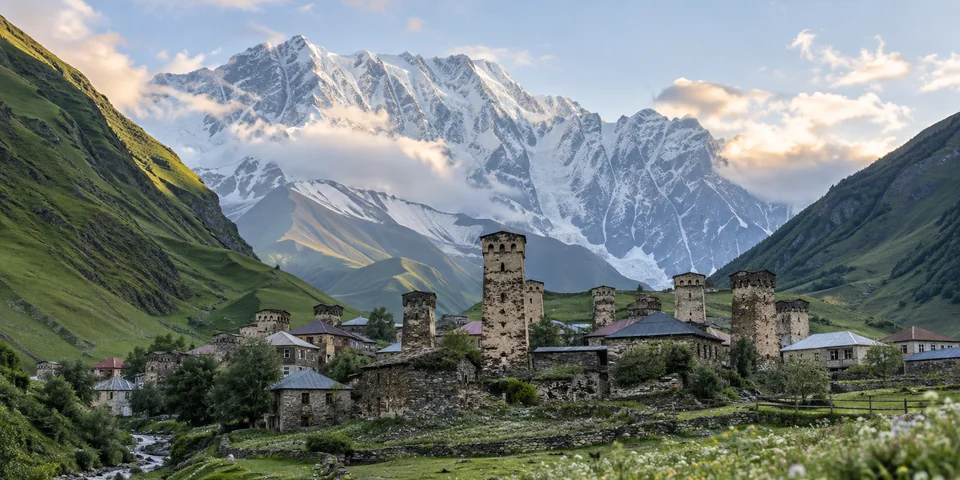
Svaneti is the crown jewel of Georgian mountain tourism. This remote highland region in the northwest is defined by medieval stone defence towers, glacial valleys, and some of the best multi-day hiking in the Caucasus.
The main hub, Mestia, offers museums, guesthouses, and easy access to day hikes with views of Mount Ushba. From here, the classic four-day trek to Ushguli, one of Europe's highest continuously inhabited settlements, traverses alpine pastures and glacier-fed rivers beneath Mount Shkhara, Georgia's tallest peak.
For something quieter, the Becho Valley near Mazeri offers gentle walks with front-row views of Ushba, while Lower Svaneti provides an alternative direction between Kutaisi and the highlands.
The road is seasonal: Conditions and official access restrictions on the Mestia–Ushguli–Zagari–Lentekhi routes can change after weather or road works. Before departure, check the Roads Department of Georgia or the relevant official road authority, then choose a vehicle suitable for the current conditions.
Batumi and the Black Sea Coast
Batumi is Georgia's main Black Sea resort, blending a long pebble beach and palm-lined boulevard with bold modern architecture and an increasingly cool cafe scene. Beyond the glitzy waterfront, there is a charming Old Town, a beautiful botanical garden, and easy access to the mountains of Adjara.
The coast stretches well beyond Batumi. To the north, quieter alternatives include Kobuleti's long sandy beach, the rocky swimming coves of Tsikhisdziri, and the landscaped Shekvetili Dendrological Park. At the far northern end, the port city of Poti offers Art Nouveau architecture and access to Kolkheti National Park, a UNESCO-listed wetland explored by speedboat through dense riverine forest.
Inland from Batumi, the road climbs into the mountains of Upper Adjara, passing waterfalls and highland villages on its way to the Goderdzi Pass ski resort. The Guria region, tucked between Batumi and Kutaisi, is home to Georgia's forgotten tea plantations, being revived by a new wave of family-run estates.
Pick up a car from Batumi Airport and explore the coast at your own pace. Avoid July and August when traffic is gridlocked. September's "Velvet Season" is ideal.
Racha and Lechkhumi: The Quiet Highlands
Northwest of Kutaisi, the twin regions of Racha and Lechkhumi are two of Georgia's most underrated mountain destinations. These areas offer quiet hiking trails, family wineries producing rare mountain wines like Khvanchkara and Usakhelouri, alpine villages, and almost no crowds.
The small town of Oni in Racha is a natural base, with a monumental 19th-century synagogue, a local museum, and guesthouses serving Rachan specialities like cured ham and shkmeruli. Further west, Lechkhumi's limestone pillars and icy mountain pools feel genuinely undiscovered.
Gori and Central Georgia
An hour west of Tbilisi, Gori is best known as Stalin's birthplace, but there is more here than the controversial museum. The hilltop Gori Fortress offers sweeping views, and the nearby cave city of Uplistsikhe, carved into cliffs above the Mtkvari River, is one of Georgia's oldest settlements, dating back three millennia.
The surrounding Shida Kartli region hides quiet valleys perfect for autumn hiking, including the trail to Rkoni Monastery and its beautiful medieval stone bridge.
Borjomi and the South
Set in a forested valley in central Georgia, Borjomi has been a health retreat since the Romanov era. Life still revolves around the central park, where you can fill a bottle of the famous mineral water straight from the source, soak in open-air thermal baths, and ride a cable car for valley views. Nearby Bakuriani is a family-friendly ski resort surrounded by pine forests.
Further south, the region of Samtskhe-Javakheti holds some of Georgia's most spectacular historical sites. Vardzia, a 12th-century cave city carved into a sheer rock face above the Mtkvari River, spans 13 levels of tunnels, chapels, and living quarters. The gateway city of Akhaltsikhe has a beautifully restored castle complex reflecting the region's Ottoman and Georgian heritage.
On the high plateau near the Armenian border, the Javakheti Protected Areas contain over 70 volcanic lakes scattered across empty steppe and extinct volcanic cones. This stark, high-elevation landscape, sometimes called the "Georgian Arctic," is one of the country's top birdwatching destinations.
Planning Your Road Trip
Georgia is compact enough to see a huge amount in two weeks, but varied enough to reward months of exploration. The key is having your own wheels. Public transport connects the major cities, but the most memorable places in Georgia sit at the end of mountain roads, rural backroads, and unpaved trails that no bus will take you.
We offer free delivery to Tbilisi Airport, Kutaisi Airport, Batumi Airport, and Yerevan Airport. Full off-road insurance options, roof tents, camping equipment, no deposit, unlimited mileage, and From EUR 49/day.
For road conditions and driving tips, read our complete guide to driving in Georgia. To figure out the right time for your trip, check our season-by-season guide. And for less-traveled ideas, see our list of 15 hidden places most tourists never visit.
Sources
These official sources support the practical details in this guide. Recheck live schedules, prices, opening hours, and road conditions before you travel.
- Tbilisi Transport Company standard tariff - official Tbilisi metro, bus, minibus, and ropeway fare rules.
- Georgian Railway passenger ticket portal - official train ticket search and passenger schedule checks.
- Roads Department of Georgia restrictions - official road restriction and closure notices for mountain and highway routes.
- Georgia Travel official destination guide - official country destination context for regions, cities, culture, and parks.