
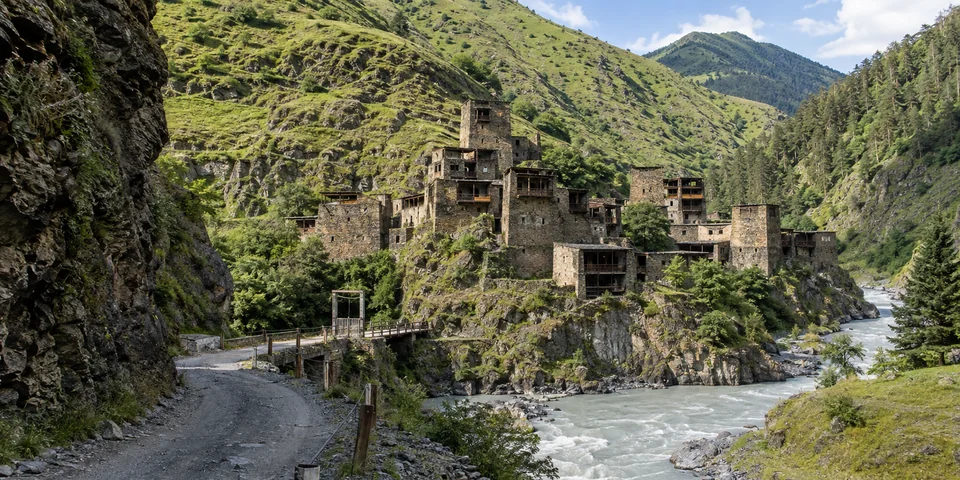
In brief: A complete guide to reaching Shatili and the tower villages of Khevsureti, covering the weekly marshrutka, private drivers, self-driving tips, road conditions over the Datvisjvari Pass, and scenic stops along the way.
Khevsureti is one of Georgia's most remote and atmospheric mountain regions, a landscape of medieval fortress-villages, defensive towers, and wild Caucasus valleys accessible only via the Datvisjvari Pass at 2,600 metres. Shatili, the main settlement in Upper Khevsureti, is the gateway to this ancient world.
Unlike the notorious Abano Pass road to Tusheti, the Datvisjvari Pass road is considerably tamer, wider, lower, and less exposed, making Khevsureti a more accessible (though still adventurous) destination for travellers with the right vehicle.
Below are the 2026 transport options from Tbilisi to Shatili, with road conditions, costs, seasonal availability, and the best stops along the way.
Distance, Drive Time & Road Overview
Shatili sits 150 km north-east of Tbilisi. The only road in traverses the Datvisjvari (Bear Cross) Pass at 2,600 m elevation. Expect a minimum 4-hour drive from the city outskirts, longer if you stop for photos or hit traffic leaving Tbilisi.
Key segment times:
- Tbilisi outskirts to Korsha (Lower Khevsureti): ~1 hour 45 minutes
- Korsha to the Datvisjvari Pass: ~50 minutes
- Datvisjvari Pass to Shatili: ~1.5 hours
- Shatili to Mutso: ~45 minutes
- Mutso to Khonischala: ~20 minutes
The first section follows the Georgian Military Highway before branching off at Zhinvali reservoir. From Zhinvali to Korsha, the road is new asphalt transitioning to concrete. Beyond Korsha, conditions shift to unpaved gravel, narrow, steep, and flanked by drop-offs as you climb toward the pass.
Road Conditions by Section
- Zhinvali to Korsha: Recently sealed asphalt with clear markings, transitioning to concrete. Some potholes near Korsha but generally smooth.
- Korsha to Roshka (Abudelauri Lakes trailhead): Very rough off-road track requiring a proper 4WD. Road improvement works are ongoing.
- Korsha to the Datvisjvari Pass: Unpaved gravel after Ghelisvake. Progressively steeper and narrower. Metal rope barricades line most sections, though some have collapsed into the river.
- Datvisjvari Pass to Shatili: Continuation of gravel road, narrow and bumpy with a drop-off on one side.
- Shatili to Mutso: Gravel road, flatter and wider than the pass section.
- Mutso to Khonischala/Ardoti: Rougher gravel with a river crossing (no car bridge) followed by a steep descent.
When Is the Road Open?
The Datvisjvari Pass road is seasonal, typically opening in mid-May to mid-June and closing in November or December depending on weather. The safest months are July, August, and September when rainfall is lower.
The marshrutka van service usually starts later than the road opening, typically late June. Always check conditions locally before departing, especially after heavy rain. Flash flooding and landslides are real dangers in this region. The Geo Road Facebook page provides updates on temporary closures.
For broader seasonal advice, see our best time to visit Georgia guide.
What Vehicle Do You Need?
A 4WD with high ground clearance is essential for reaching Shatili. Sedans may manage the sealed section to Korsha, but beyond that the gravel roads, steep gradients, and potential river crossings demand a capable off-road vehicle.
Browse our 4×4 rental fleet in Tbilisi or 4×4 rentals from Kutaisi for vehicles suited to Khevsureti. FSTA applies rental-length, weather, safety, and vehicle-suitability rules to off-road access. Choose a suitable 4×4 for the conditions, and check current weather, official road status, and local warnings before departure.
Option 1: Weekly Marshrutka Van
During summer (typically late June through September), a scheduled 4×4 Mercedes van service operates between Tbilisi's Didube Station and Shatili. As of 2026, the service runs once per week.
2026 Schedule
- Tbilisi → Shatili: Saturday, 10:00 AM
- Shatili → Tbilisi: Sunday, 12:00 PM (midday)
Fare: ~30 GEL per person, one-way. Journey time: 4.5-5 hours including brief photo stops.
These are not regular minibuses but reinforced Mercedes Vario 4×4 trucks with bigger windows. Space for luggage is limited, arrive 40 minutes early to secure a seat and stow your bags. Tickets are cash only (Georgian Lari). In peak season (July-August), reserve your seat in advance through the driver.
The van departs from the same parking area as Kazbegi-bound vans inside Didube Terminal. You can alight at any village before Shatili, just tell the driver. For more on navigating Didube, see our marshrutka guide.
Important: There is no onward connection from Shatili to other Georgian destinations. To continue to Kazbegi, you can exit the return van at Zhinvali junction and flag down a northbound marshrutka on the Military Highway.
Option 2: Private Driver or Transfer
The most comfortable and flexible way to reach Khevsureti. A private driver picks you up from Tbilisi and delivers you to your guesthouse in Shatili, with unlimited photo stops along the way.
Hiring a driver for the full duration of your visit (rather than just a one-way transfer) is highly recommended, there is no public transport between villages within Khevsureti, so having your own vehicle lets you explore Mutso, Khonischala, and the Abudelauri Lakes area from Roshka.
Expect to pay 250-400 GEL per day for a driver with a 4WD, depending on the vehicle and itinerary. For tips on finding trustworthy drivers, see our private driver guide.
Option 3: Organised Multi-Day Tour
We strongly advise against visiting Shatili as a day trip from Tbilisi, the drive is too long and demanding. Multi-day tours (2-3 days minimum) that include overnight stays in Shatili and visits to Mutso are far safer and more rewarding.
Some operators combine Khevsureti with Kazbegi in a single trip, which works well since both regions branch off the Georgian Military Highway at Zhinvali. Check our first-time tips for advice on choosing tour operators.
For the truly adventurous, multi-day guided treks from Shatili to Omalo (Tusheti) via the Atsunta Pass are available during July and August.
Option 4: Self-Driving to Shatili
Only recommended for experienced off-road drivers who are comfortable with Georgia's mountain roads. Key considerations:
- No fuel stations in Khevsureti, fill up before Zhinvali and carry extra fuel
- No mobile signal for most of the drive beyond Korsha
- Google Maps times are optimistic, add 30-50% to estimated drive times
- Check weather conditions before departing, avoid driving after heavy rain
- Check current official road access, closures and weather can make the Shatili road unsafe
Our 4×4 fleet includes vehicles suited to demanding mountain conditions. Browse our full rental range or choose a suitable vehicle for Khevsureti. For general road-trip advice, see our Georgia road trips guide.
Best Stops Between Tbilisi and Shatili
The drive through Pshavi and the Datvisjvari Pass is extraordinarily scenic. Having your own vehicle for at least one leg makes it possible to stop at these highlights:
- Pshavi Khinkali Restaurants: The villages of Kalilo and Sharakhevi in the Pshavi region are famous for hand-made khinkali dumplings. Time your drive for a lunch stop here, the kalakuri-style dumplings are outstanding.
- Vazha-Pshavela House Museum: A short detour to Chargali to visit the 1961-built museum honouring Georgia's legendary poet. Closed Mondays.
- Korsha Village: The first settlement in Khevsureti proper, with a small ethnography museum inside a reconstructed stone tower.
- Datvisjvari Pass (2,600m): The highest point of the drive. Park safely and walk to viewpoints and small mountain shrines. A metal cross marks the true summit ridge.
- Lebaiskari Tower: A beautifully preserved Vainakh-style defensive tower with a distinctive tapered silhouette and shale roof, visible from the road approaching Shatili.
- Kistani Fortress: Twin ruins perched on green hills above a stony river, one of the most photogenic spots in the region.
- Guro's Tears: A mossy rock wall with perpetually dripping spring water and a shallow cave, located roadside just before Shatili. Impossible to miss.
Getting Around Inside Khevsureti
There is no public transport between villages in Khevsureti. If you arrive by marshrutka, arrange a local driver through your guesthouse in Shatili to visit Mutso, Khonischala, or the Abudelauri Lakes trailhead near Roshka.
Inter-village roads range from rough gravel to river crossings requiring 4WD. Walking between nearby villages (e.g. Shatili to the Anatori bone crypts) is possible and recommended for experiencing the landscape at a slower pace.
Connecting to Other Destinations
There are no direct onward connections from Shatili to other regions. You must return via the same road toward Tbilisi. However, you can break the return journey at Zhinvali junction to connect to:
- Kazbegi/Gudauri: Continue north on the Military Highway (~2.5 hours from Zhinvali). See our Gudauri transport guide.
- Kakheti (Telavi/Sighnaghi): Take the backroad through Tianeti (~2 hours from Zhinvali). See our Kakheti transport guide.
Pros and cons
Marshrutka, minivan, or bus
- Pros: Usually the cheapest choice for a simple point-to-point journey. Works well when the plan follows a known route and does not need extra stops.
- Cons: Schedules, luggage space, comfort, and exact arrival points are less flexible. Some services leave when full or require a station transfer.
Sources
These official sources support the practical details in this guide. Recheck live schedules, prices, opening hours, and road conditions before you travel.
- Tbilisi Transport Company standard tariff - official Tbilisi metro, bus, minibus, and ropeway fare rules.
- Roads Department of Georgia restrictions - official road restriction and closure notices for mountain and highway routes.
- Georgia Travel official destination guide - official country destination context for regions, cities, culture, and parks.