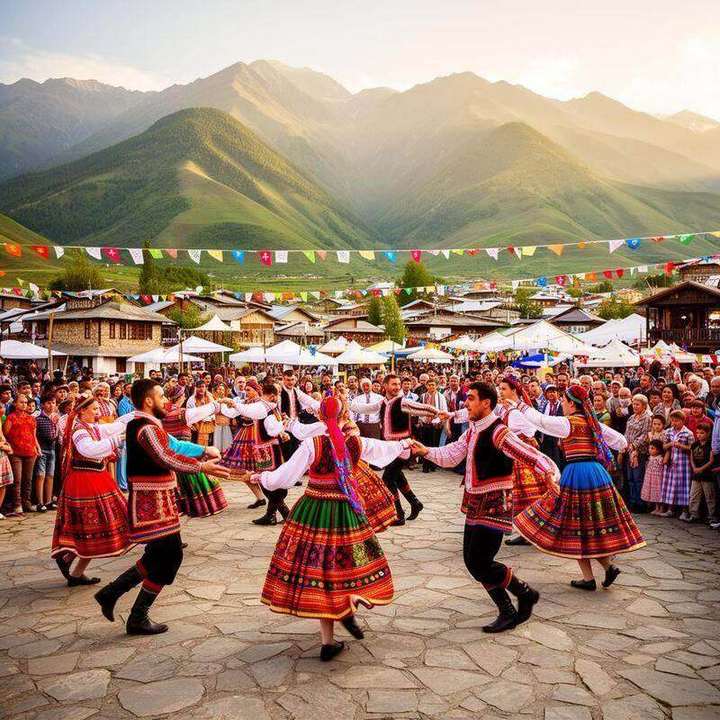
Georgia has one of the richest festival calendars in the Caucasus. From ancient pagan rituals in mountain villages to world-class wine festivals in Tbilisi, there is something happening almost every week of the year. Timing your trip around one of these events can transform a good holiday into an unforgettable one.
One important note: dates for many Georgian festivals are not confirmed until a few weeks (sometimes days) in advance. Religious holidays follow the Orthodox calendar and are fixed, but food festivals, cultural events, and seasonal celebrations tend to shift from year to year. Use this guide as a planning framework, and check back closer to your travel dates for confirmation.
January: Orthodox Christmas and Epiphany
Georgia celebrates Christmas on January 7 according to the Julian calendar. The biggest events are the Alilo Parades, religious processions where hundreds of people sing through the streets collecting donations for those in need. In Tbilisi, the parade starts from First Republic Square and ends at Sameba Cathedral.
Natlisgheba (Orthodox Epiphany) on January 19 marks the end of the festive period. The most dramatic celebration takes place on frozen Paravani Lake in Samtskhe-Javakheti, where a priest cuts a cross-shaped hole in the ice and brave participants take a plunge. This is a powerful experience if you are driving through southern Georgia in winter.
February: Fire Festivals in Svaneti
Lamproba (February 14) is one of Georgia's most atmospheric winter festivals. In Mestia and across Svaneti, families craft torches and walk them to ancestors' graves before lighting massive bonfires in front of village churches. The night sky fills with flame. Sometimes called "Georgia's Day of the Dead," it is hauntingly beautiful.
Berikaoba (February 22), held in Kakheti villages about 65 km east of Tbilisi, is an ancient pre-Christian festival tied to spring and fertility. Villagers don elaborate masks and costumes and walk in procession, with traditional wrestling matches and feasting afterward. A compact rental car is enough for the drive from Tbilisi.
March and April: Orthodox Easter
Orthodox Easter (April 10 to 13 in 2026) is the most important religious holiday in Georgia. Good Friday through Easter Monday are public holidays. Midnight mass on Saturday night is the centerpiece, and on Sunday and Monday families visit cemeteries to commune with the dead. Eggs are dyed red with madder root, and paska fruit cake appears in every bakery.
On Easter Sunday, the village of Shukhuti in Guria hosts Lelo Burti, a full-contact ball game played with a 16-kilogram ball made of sand soaked in wine. Two villages compete to carry the ball 500 meters across a stream. It is raw, joyful, and completely unique. Getting there requires a car. We deliver free to Batumi, which is the closest major city.
For more about Easter traditions in Georgia, see our dedicated guide.
May: Wine Festivals and Independence Day
May is when Georgia's festival season truly ignites. Zero Compromise (May 1 to 2) is the flagship natural wine tasting, organized by the Natural Wine Association with 120+ Georgian winemakers. The New Wine Festival follows shortly after at Mtatsminda Park, where hundreds of producers exhibit their latest vintages from the previous autumn's harvest.
Kutaisoba (May 2), the "Day of Chamomiles," fills Kutaisi with live music, food markets, and flower-adorned festival goers. Batumoba does the same for Batumi on the same weekend.
May 8 marks the first ever National Day of Georgian Wine, a new public holiday celebrating 8,000 years of winemaking tradition.
Independence Day (May 26) closes out the month with military parades, food markets stretching the length of Rustaveli Avenue in Tbilisi, wine showcases, and evening fireworks. Tbilisi Open Air, Georgia's biggest music festival, is usually held the same weekend.
June: The Mountains Open
June is the start of mountain season. The Abano Pass to Tusheti typically reopens in early to mid-June, marking the beginning of trekking and 4x4 season in Georgia's most remote region. You need a serious 4x4 vehicle like a Toyota 4Runner or Jeep Wrangler for the Abano Pass.
Lomisoba (June 3) near Gudauri combines pagan and Christian traditions with a pilgrimage to a mountaintop church. If you are driving toward Gudauri that day, expect significant traffic delays on the Georgian Military Highway.
The Tbilisi Cheese Festival (early June) at Mtatsminda Park showcases more than 250 regional Georgian cheeses, from Tushetian guda to Meskhetian tenili. Entry is free.
July: Mountain Festivals and Music
The Black Sea Jazz Festival (July 10 to 12) in Batumi is one of Georgia's biggest music events, drawing international headliners across jazz, soul, and hip-hop.
The Art-Gene Festival (late July) at Tbilisi's Open Air Museum of Ethnography brings together folk ensembles from every Georgian region alongside food and wine markets. Tickets are around 60 GEL.
Kvirikoba (July 28) in Kala village in Svaneti features traditional boulder-tossing competitions and Svan blessings at a mountaintop church. It draws huge crowds from across the region.
August: Tusheti Festivals and Horse Racing
Atnigenoba is a roving cycle of village festivals across Tusheti and Khevsureti that runs from late July through August. If you visit Tusheti on any weekend during this period, you will find horse competitions, khinkali-making demonstrations, folk singing, and feasting happening somewhere.
Tushetoba in Omalo is the most visitor-friendly of these festivals, while Peristsvaleba (August 19) marks the symbolic end of summer with a tradition of smearing forest berry juice on your forehead.
On the same day, the Bakhmaro Horse Race in Guria sees riders compete on a mountain circuit. It is an exhilarating spectacle in one of Georgia's most beautiful alpine settings.
September and October: The Wine Harvest
Rtveli (the wine harvest) is the defining event of autumn in Georgia. Starting in the first week of September in Kakheti and continuing through October in western regions like Racha and Imereti, it transforms the country. Families gather to pick grapes, press them in traditional qvevri clay vessels, and feast together. Many wineries welcome visitors to participate.
The Tsinandali Festival (September 3 to 13) at the Chavchavadze Estate near Telavi is a world-class classical music event, with 10 days of concerts in a gorgeous vineyard setting.
Tbilisoba (October 3 to 4) is Tbilisi's biggest annual celebration, taking over the Old Town with food markets, wine tastings, concerts, and a carnival atmosphere. The city shuts down for this one.
November and December: Closing the Year
Giorgoba (November 23) honors Saint George, Georgia's patron saint. The public holiday sees religious services across the country and family gatherings.
The Amerimeri Wine Festival in Tskaltubo brings natural winemakers together for tastings in the atmospheric setting of a renovated Soviet-era sanatorium. It is a fitting end to Georgia's wine year.
New Year's Eve in Tbilisi features fireworks, outdoor concerts on Rustaveli Avenue, and a festive atmosphere that carries into January. The holiday period stretches all the way to Orthodox Christmas on January 7, making late December through early January one long celebration.
Planning Your Trip Around a Festival
The best festivals to plan around depend on your interests. Wine lovers should target May (new wine tastings) or September to October (Rtveli harvest). Culture seekers should aim for February (Lamproba in Svaneti) or August (Tusheti village festivals). Music fans have the Black Sea Jazz Festival in July and Tbilisi Open Air in May.
For practical trip planning, see our seasonal guide, our best road trip routes, and our first-time visitor tips. Browse our full fleet to find the right car, with free delivery to Tbilisi Airport, Kutaisi Airport, and Batumi Airport.
Frequently Asked Questions — Georgia Festival Calendar 2026: Monthly Events
- What is this guide about?
- A month-by-month guide to Georgia's biggest festivals, holidays, wine harvests, and cultural celebrations in 2026, with practical tips for planning your trip around them.
- When is the best time to follow this guide?
- Most destinations and routes in Georgia are best from May to October. Winter travel works well for cities and ski resorts. Check seasonal notes in the article above for specific timing.
- Do I need a car for this?
- A rental car gives you the most flexibility. Many places covered in this guide are difficult or impossible to reach by public transport. For mountain roads, a 4x4 is recommended.
- Is it safe?
- Georgia is one of Europe's safest countries for travelers. The main risks are road conditions in remote areas, not personal safety. Always carry offline maps and a full tank when heading off main highways.
- How much does it cost?
- Georgia is affordable by European standards. Budget travelers can manage on 40 to 60 USD per day including accommodation, food, and fuel. Car rental starts from around 35 USD per day with FSTA.
Sources & References
- Georgian National Tourism Administration (GNTA) — official tourism body for Georgia
- UK FCDO — Georgia travel advice — safety and entry requirements
- US State Department — Georgia — travel advisory
- Australian DFAT — Georgia — travel advice
- Georgia (country) — Wikipedia
- Tourism in Georgia — Wikipedia
Pros and Cons: Offbeat vs Popular Destinations
Pros of Offbeat Destinations
- Fewer crowds — most sites have no other visitors at all
- More authentic experiences — interact with locals rather than tour groups
- Lower costs — accommodation, food, and activities are cheaper outside tourist hubs
- Better photography opportunities — no crowds, untouched landscapes, dramatic light
- Greater sense of discovery — explore places not yet covered by mainstream guidebooks
Cons of Offbeat Destinations
- Harder access — many require a 4x4 or long drives on unpaved roads
- Fewer amenities — limited guesthouses, restaurants, and fuel stations
- Less safety information — remote areas may lack cell coverage and emergency services
- Minimal signage — navigation depends on offline maps and local directions
- Seasonal restrictions — mountain destinations are only accessible from June to September