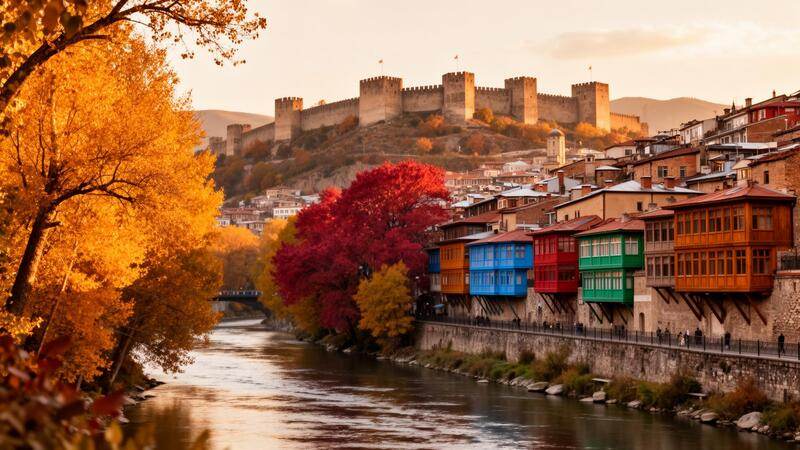
Something shifts in Tbilisi around the second week of September. The air loses its oppressive weight. Shadows lengthen across the courtyards. Vine leaves on the wooden balconies of Sololaki begin curling at the edges, turning from deep green to parchment yellow. By October, the entire valley glows — a slow-burning palette of bronze, rust, and honey that makes every walk through the Old Town feel like stepping into a Renaissance painting.
If summer is about surviving the heat and escaping to the mountains, autumn is about returning to the city itself. Tbilisi reclaims its rhythm: families come back from coastal holidays, café terraces fill up at reasonable hours, and the cultural calendar explodes with festivals, harvest celebrations, and performances that have been building momentum since spring. This is the season when the capital earns its reputation as one of Europe's most atmospheric cities.
September: The Transition Month
Early September still carries the residual warmth of summer. Daytime temperatures hover around 26–28°C, and the city feels like a continuation of August — minus the most punishing heat. By mid-month, the thermometer eases into the low 20s, and evenings cool enough to require a light jacket become the norm rather than the exception.
This is harvest season across Georgia. The Rtveli — the annual grape harvest — begins in Kakheti and radiates outward. Even in Tbilisi, the effects are visible: wine shops display new vintages, restaurants add harvest-themed dishes to their menus, and the general mood tilts toward celebration. Outdoor festivals are still running on weekends, though with noticeably thinner crowds than July.
For travellers, September offers a rare combination: mountain passes are still open (the Tusheti road typically stays accessible until mid-October), yet the city itself is comfortable enough for full days of walking. It is arguably the single best month to visit Georgia overall. See our seasonal guide for the complete picture.
October: Peak Colour and Peak Culture
October is when Tbilisi reaches its visual peak. Daytime temperatures settle between 15–20°C — ideal for exploring on foot without breaking a sweat or reaching for a heavy coat. The light mellows into golden tones that photographers and filmmakers covet, casting long shadows across the city's layered architecture.
The deciduous trees along Rustaveli Avenue, in Vake Park, and on the hillsides above Abanotubani turn simultaneously, creating a canopy of amber and crimson that frames the skyline. Early mornings, before the street sweepers pass with their straw brooms, leave the pavements carpeted in fallen leaves — a fleeting scene that rewards those who set an alarm.
Tbilisoba: The City Festival
The first weekend of October (dates shift slightly each year) brings Tbilisoba, the capital's biggest annual celebration. The festival transforms Rike Park and Orbeliani Square into an open-air showcase of Georgian regional culture: farmers display autumn produce, winemakers pour from clay qvevri, wrestlers compete on outdoor mats, and folk dance troupes perform on stages scattered through the Old Town. Tbilisoba is free to attend and offers a compressed experience of the entire country in a single afternoon.
The Svetitskhovloba Pilgrimage
On October 14, the ancient capital of Mtskheta — a 30-minute drive from Tbilisi — hosts the Svetitskhovloba religious festival at the UNESCO-listed Svetitskhoveli Cathedral. Thousands of pilgrims converge on the town for a day of liturgy, processions, and communal celebration. It is one of the most visually striking religious events in the Caucasus and easily combined with a day trip from Tbilisi.
November: Quiet Days and Deep Colours
November strips the trees bare and replaces the golden canopy with stark silhouettes against grey skies. Temperatures drop to 8–12°C during the day and approach freezing at night. The tourist crowds thin dramatically, and the city takes on an introspective, local feel that some visitors prefer to the busier months.
The foliage season is not over in November — it simply moves. While the city centre trees are shedding, the forested hills around Tbilisi hold their colours well into mid-November, and lower-elevation valleys like Rkoni and Tianeti are at peak beauty. By late November, the first hints of winter arrive: shorter days, occasional frost, and the smell of wood smoke drifting through residential streets.
Where to Find the Best Autumn Colours
Inside the City
Vake Park is the undisputed champion: 200 hectares of old-growth trees that form golden tunnels from October onward. The riverside promenade between Marjanishvili Bridge and the Bridge of Peace offers postcard views of the skyline framed by foliage. Lisi Lake, above Saburtalo, is quieter and backed by hills that catch the season's colour.
Even ordinary streets surprise: the plane trees along Aghmashenebeli Avenue, the vines hanging from courtyard railings in Chugureti, the carpet of leaves in small neighbourhood squares that have no name on any map.
Within Driving Distance
Tianeti (90 minutes): The road to this small town northeast of Tbilisi is lined with tall trees that blaze gold in October. The route doubles as a scenic connector between Kakheti and the Military Highway, making it a natural addition to a driving loop.
Rkoni Valley (90 minutes): A forested valley in Shida Kartli region, ideal for a half-day hike through autumn woodland to a medieval monastery and the elegant Queen Tamar Bridge. A high-clearance vehicle is recommended for the final stretch to the trailhead.
Didgori Plateau (45 minutes): The same plateau that blooms with wildflowers in spring turns tawny and atmospheric in autumn, with fog rolling through the memorial site on cooler mornings.
Sabaduri Forest (40 minutes): A popular local escape north of Tbilisi where beech forests deliver reliable autumn colour and easy walking trails wind through the canopy.
For a comprehensive list, see our day trips guide.
The Autumn Harvest Table
Georgian cuisine is seasonal by nature, and autumn brings the most dramatic shift in what appears on the table. Markets overflow with pomegranates, persimmons, chestnuts, figs, and cornelian cherries. Strings of dried persimmons hang like amber necklaces from vendor stalls. Pumpkin enters the rotation — transformed into pkhali (herb-walnut paste) and filling for traditional bread.
Wild mushrooms — chanterelles and the prized Caesar's mushroom — arrive from the forests of western Georgia. Restaurants across the city feature mushroom-forward dishes from late August through October, often paired with new-vintage wines that are barely weeks old.
The real event, though, is the grape harvest itself. Even if you cannot make it to a vineyard in Kakheti, Tbilisi's wine bars pour the year's first fermentations by mid-October. Tasting a glass of Saperavi that was crushed just weeks earlier, while sitting in a cellar beneath a 200-year-old building, is one of those experiences that anchors Tbilisi in the memory.
For restaurant and wine bar recommendations, see our Tbilisi food guide.
Cultural Life in Autumn
The performing arts season kicks into gear after the summer hiatus. The national opera and ballet return to Rustaveli Avenue, while smaller theatres across the city programme new productions. The Sukhishvili National Ballet often performs at Takara, their outdoor amphitheatre in the hills above the city, during September — tickets vanish within hours of announcement.
Street art tours are particularly rewarding in autumn: the soft, diffused light is ideal for photographing murals, and the cooler temperatures make walking for three or four hours comfortable rather than exhausting. The Chugureti neighbourhood and the concrete tower blocks of Varketili on the city outskirts harbour some of the most impressive large-scale works.
Weekend maker's markets organised by STALL continue into October, with stalls selling handmade crafts, artisanal food, and regional wine on Rustaveli Avenue and in city parks.
For a complete event overview, check our festivals calendar.
Sulfur Baths in the Cool Air
Locals will tell you that the sulfur baths of Abanotubani are best enjoyed when the outside air is brisk. Stepping from a steaming mineral pool into a cool October evening is an entirely different sensation than the summer version, where the heat inside and outside blurs together. Autumn evenings — especially in late October and November — are the sweet spot: cold enough to make the hot water feel luxurious, warm enough that the walk home is pleasant rather than punishing.
The domed brick bathhouses are scattered across the Abanotubani quarter, each with its own character. Some offer private rooms with ornate tiled interiors; others are communal and stripped-down. A traditional kisi scrub (a vigorous exfoliation with a rough cloth) is the standard treatment and costs a fraction of what a similar spa experience would run in western Europe.
Driving Routes for Autumn
A car transforms autumn in Tbilisi from a city experience into a regional one. The following routes are all paved and manageable in a standard sedan like the Hyundai Tucson:
- Tbilisi → Tianeti → Kakheti loop: A full-day circuit through the best foliage corridor near the capital, with wine tasting in Telavi as the reward. Allow 6–7 hours.
- Tbilisi → Mtskheta → Gori → Rkoni Valley: Combine Georgia's ancient capital with a fall hike in Shida Kartli. Allow a full day.
- Tbilisi → Sabaduri Forest → Bazaleti Lake: A shorter half-day loop for foliage and quiet lakeside walks. Allow 4–5 hours.
- Tbilisi → Dashbashi Canyon → Borjomi: Dramatic canyon views plus the spa town's autumn atmosphere. Allow a full day or overnight.
For unpaved mountain destinations — the Rkoni trailhead, parts of Tianeti, or the Svaneti interior — a 4x4 such as the Toyota 4Runner or Jeep Wrangler is advisable. Mountain passes begin closing from mid-October onward, so plan highland trips early in the season.
Browse our full rental fleet or arrange airport pickup from Tbilisi Airport, Kutaisi Airport, or Batumi Airport. No deposit, unlimited mileage, free delivery.
What to Pack for Autumn in Tbilisi
- September: Summer clothing with a light jacket for evenings. Temperatures are still warm during the day.
- October: Layers. A medium-weight jacket, jeans or trousers, and a scarf for windy days. Comfortable walking shoes are essential.
- November: A warm outer layer, closed-toe shoes, and a rain jacket. Mornings can be cold (5°C), even if afternoons warm up slightly.
- All months: Modest clothing for church visits (covered shoulders and knees). A compact umbrella. Sunglasses for the low-angle autumn sun.
For a complete checklist, see our packing guide.
Frequently Asked Questions
What is the weather like in Tbilisi in autumn?
September averages 22–28°C and feels like a mild extension of summer. October is the sweet spot at 15–20°C with golden light and dry days. November cools to 8–12°C with occasional rain and the first hints of winter.
When do the autumn colours peak in Tbilisi?
The city centre trees peak in late October to mid-November. Forested hills around Tbilisi show colour from late September. Higher-altitude areas like Tianeti peak in mid-October.
What is Tbilisoba and when does it happen?
Tbilisoba is Tbilisi's annual city festival celebrating Georgian culture, food, wine, and folk traditions. It typically takes place on the first weekend of October. The event is free, centred around Rike Park and Orbeliani Square.
Can I still drive to the mountains in autumn?
September and early October allow access to most mountain regions including Tusheti and Svaneti. By mid-October, high passes begin closing. The Georgian Military Highway to Kazbegi remains open year-round but conditions deteriorate in late November.
What is the best car for autumn in Georgia?
A sedan like the Hyundai Elantra handles all paved routes perfectly. For mountain roads or unpaved forest tracks (Rkoni, high-altitude Svaneti), a 4x4 like the Toyota 4Runner is recommended. September is the last month for reliable highland access.
Sources & References
- Georgian National Tourism Administration (GNTA) — official tourism body for Georgia
- UK FCDO — Georgia travel advice — safety and entry requirements
- US State Department — Georgia — travel advisory
- Australian DFAT — Georgia — travel advice
- Georgia (country) — Wikipedia
- Tourism in Georgia — Wikipedia
Pros and Cons: Offbeat vs Popular Destinations
Pros of Offbeat Destinations
- Fewer crowds — most sites have no other visitors at all
- More authentic experiences — interact with locals rather than tour groups
- Lower costs — accommodation, food, and activities are cheaper outside tourist hubs
- Better photography opportunities — no crowds, untouched landscapes, dramatic light
- Greater sense of discovery — explore places not yet covered by mainstream guidebooks
Cons of Offbeat Destinations
- Harder access — many require a 4x4 or long drives on unpaved roads
- Fewer amenities — limited guesthouses, restaurants, and fuel stations
- Less safety information — remote areas may lack cell coverage and emergency services
- Minimal signage — navigation depends on offline maps and local directions
- Seasonal restrictions — mountain destinations are only accessible from June to September