Table of Contents
- Start With the Khan's Palace
- Notice the Craft, Not Only the Colour
- Continue to the Caravanserai
- Add the Winter Palace and Smaller Streets
- Best Time for Photos
- How to Fit It Into a Route
- Guide or No Guide?
- Accessibility and Comfort
- FSTA Route Support
TL;DR: Look closer at Sheki's most important historic spaces, from patterned palace interiors to caravanserai courtyards built for Silk Road movement.
Overview
Sheki's architecture is not only decorative. It tells you how the town worked: as a Silk Road stop, a craft centre, a place of trade, and a mountain town that needed shade, storage, hospitality, and status. The Khan's Palace and the caravanserai are the two clearest places to read that story.
Plan this as a slow half-day route, not a quick photo stop. The best details are small: wooden joints, painted borders, patterned glass, stone thresholds, and the way courtyards control heat and movement.
Start With the Khan's Palace
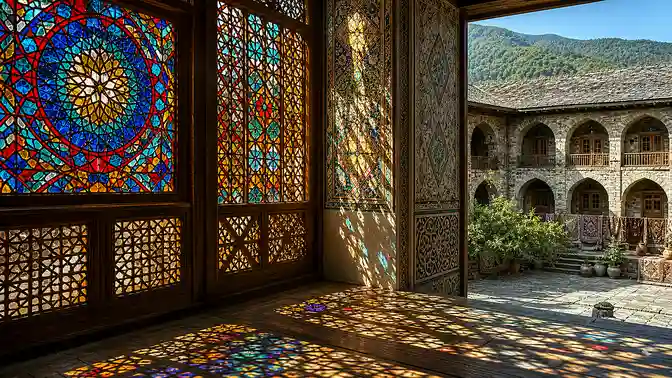
The Khan's Palace is Sheki's jewel and part of the historic centre recognised by UNESCO. Its shebeke windows, miniature-style paintings, timber details, and garden setting make it one of the most beautiful interiors in the Caucasus. Go early to avoid the busiest tour groups and to give your eyes time to adjust inside.
Look for how light changes the room. The coloured glass is not just decoration; it softens brightness, adds pattern, and makes the interior feel alive as the sun moves.
Notice the Craft, Not Only the Colour
Shebeke work is assembled from small pieces of wood and glass without nails. Painted surfaces combine floral, geometric, and narrative details. When guides are available, they can help explain the symbolism, but even without one, slow looking pays off.
Respect photography rules. If staff say no photos, put the phone away. These rooms are fragile, and the experience is better when people are not constantly pushing for angles.
Continue to the Caravanserai
A caravanserai was practical travel infrastructure. Merchants needed a place to sleep, feed animals, store goods, and protect valuables. Sheki's caravanserai courtyards still communicate that logic: a controlled entrance, rooms facing inward, thick walls, and a calm centre protected from the street.
Walk the courtyard before sitting down. Imagine arrival after days on the road, then notice how the architecture turns movement into rest.
Add the Winter Palace and Smaller Streets
If time allows, add the Winter Palace and the lanes between the main sights. Sheki's smaller houses and walls are part of the same architectural language, with timber, brick, stone, and garden edges working together. This is where the town feels less like a museum and more like a living place.
Best Time for Photos
Morning is better for palace-area calm; late afternoon is better for warm stone and courtyard atmosphere. Summer midday can be harsh and hot. In winter, shorter daylight means you should start earlier and avoid leaving the old town for the end of the day.
How to Fit It Into a Route
Do Sheki architecture after an overnight stay, not after driving from Baku the same morning. If you are coming from Lahic or the mountain villages, arrive, sleep, then visit the palace district fresh.
Guide or No Guide?
A guide is worthwhile if you care about symbolism, craft technique, and Sheki's role in regional trade. Without one, read a little before arriving and move slowly. The architecture is dense with detail, and a fast visit reduces it to pretty colours.
Accessibility and Comfort
Expect uneven surfaces, steps, bright sun between buildings, and limited seating in some heritage areas. Carry water and keep your palace visit separate from a long transfer day. Architecture-focused travel is much better when your feet and patience are both intact.
FSTA Route Support
FSTA can help build heritage stops like Sheki into realistic driving days. The goal is not only reaching the monuments; it is arriving with enough attention left to enjoy them.